Brilliant Labs has built three answers to a question the rest of the smart-glasses business often ducks: what, precisely, should happen after you put a computer on your face? Its first answer was Monocle, a tiny clip-on display that looked like something a jeweler might use to inspect a suspicious diamond. The second was Frame, round spectacles with a camera, microphone, color display and an assistant called Noa. The third is Halo, a tidier pair of glasses designed to listen, see, remember and let its owner invent little applications by asking for them.
All three have worn a $349 price tag at some point. That repetition is the useful bit. Brilliant Labs is not hopping from gadget to gadget. It is holding price and premise roughly steady while changing the answer underneath: first prove programmers care, then prove the hardware can resemble eyewear, then attack the reasons people stop wearing it.
The prototype wore a monocle
Founded in 2019 and headquartered in Singapore, Brilliant Labs started with a deliberately unfinished object. Monocle shipped in 2023 as a pocket-size, open-source augmented-reality lens. It clipped onto ordinary glasses, connected through a phone, and gave developers a display, camera, microphone and enough access to make strange things. The company called it a kind of Raspberry Pi for AR. That was honest positioning: this was a tool for people who enjoy a soldering iron more than a luxury unboxing.
The customer was not yet everyone with a nose. It was the imaginative hacker, the computer-vision student, the person willing to read documentation so an idea could hover in front of one eye. A group of Stanford students supplied the viral proof. They connected GPT-4 to Monocle and built a dating prompter that listened to conversation and suggested what its wearer might say next. It was equal parts clever, creepy and perfect market research. Nobody at Brilliant Labs needed to put “romantic autocomplete” on a roadmap. Open hardware let users reveal the appetite themselves.
“Other AR and VR headsets tend to keep you around your couch at home. We are running in the exact opposite direction.”Bobak Tavangar, co-founder and CEO
That philosophy separates Brilliant Labs from headsets built around immersion and from camera glasses built around capture. Monocle was supposed to go outside. Frame, released in 2024, made that intention look less eccentric. At roughly 39 grams, with prescription options and a 640 by 400 monocular display, it looked close enough to round glasses that a passerby might blame taste before technology.
What failed first was ordinary life
Frame could identify scenes, translate speech or text, solve a math problem and fetch current information through Noa. It combined services including Perplexity, OpenAI models, Whisper and Stable Diffusion, with the phone doing the network work. In a good demo, that arrangement felt like a preview of computing after the phone. In daily use, the phone, cloud and glasses formed a relay race in which every handoff could add delay.
Independent testing found the weaknesses quickly. Noa could respond slowly or misread a scene. Battery life varied with connectivity and workload: one reviewer saw five or six hours on some days and about two on others. Another found pairing fiddly, the battery level difficult to monitor, Android support late during the review period, and the magnetic charging accessory awkward while wearing the glasses. None of these is as glamorous as multimodal AI. Every one can decide whether a device remains on a face.
Three products, one direction
Brilliant Labs says Frame forced “hard lessons” in development and manufacturing. The company later described painful changes to its team and supply chain after reflecting on its culture and operations. That is the closest thing to a change-of-mind memo: Halo would not simply be Frame with a prettier temple. The job of the glasses had to become narrower, and the machinery had to follow.
Halo refuses YouTube on your nose
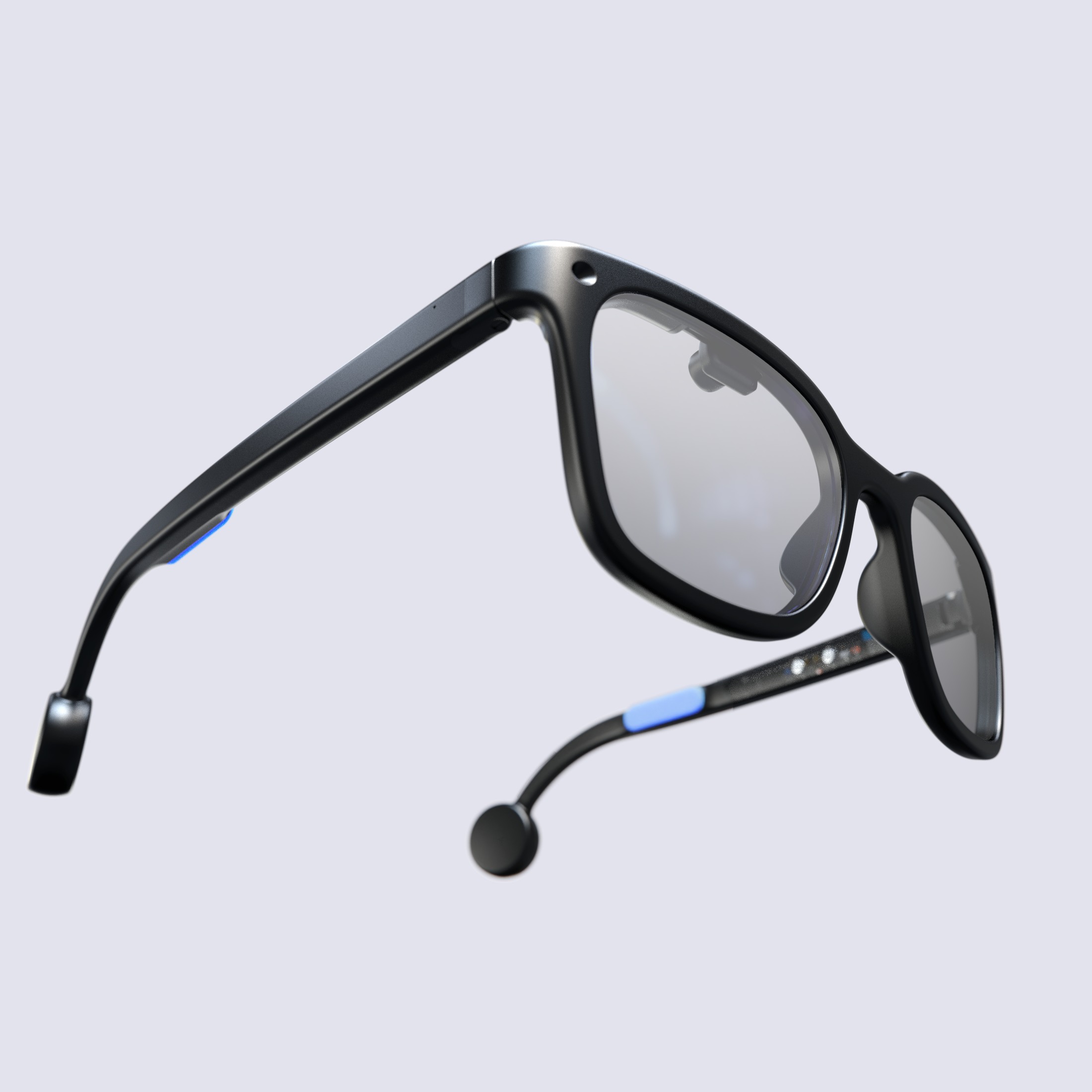
Halo is built around all-day AI inference rather than social-media capture or miniature entertainment. Brilliant Labs left out Wi-Fi, a large image sensor and an overpowered application processor. In their place are a low-power optical sensor, two microphones, a six-axis motion sensor, two bone-conduction speakers, Bluetooth 5.3 and a color microOLED display. The Alif Semiconductor Balletto B1 combines a Cortex-M55 CPU and neural-processing unit. Brilliant Labs claims 14 hours of battery life in glasses weighing just over 40 grams.
This is not a spec-sheet surrender. It is a theory of use. A sensor optimized to help AI interpret a menu needs less data than a camera optimized to film the meal. The phone still serves as a relay for cloud intelligence, but more work at the edge can reduce latency, battery drain and exposure. In March 2026, Brilliant Labs and Alif announced they would go beyond supplying Halo’s chip and co-define silicon for future glasses. For a small company, the processor is becoming product strategy.
The product is memory; the wedge is permission
Noa, the company’s assistant, is evolving from a question-answering interface into a memory system. Halo’s “Narrative” feature is designed to reason over what the wearer has seen and heard, then retrieve context later: a person’s name, a past conversation, where an object appeared. Brilliant Labs says its approach avoids storing raw photos and audio, using encrypted embeddings instead. That reduces one category of exposure, but it does not dissolve the social question created by glasses that can listen and remember. Privacy will be judged by architecture, defaults, disclosure and behavior, not the word itself.
The second software idea is Vibe Mode. A wearer describes an application in natural language; Noa generates the small program. Beneath that friendly request is ZephyrOS, a Lua interface, open firmware and mobile SDKs. This matters because an app store run by ten people would lose to Meta by lunchtime. A system in which users can produce a location pin, a custom viewer or a contextual tool without waiting for the company changes the contest.
Brilliant Labs sells directly online. Halo is listed at $349, with a capped Noa tier included. Noa+ costs $19.99 a month for more memory, real-time conversation and app creation. The hardware creates distribution; the subscription is the recurring bet. It works only if the glasses earn a place in the daily uniform. A monthly plan cannot rescue a wearable in a drawer.
What founders can steal
Monocle did not pretend to be the final form. It cheaply asked developers whether programmable visual AI deserved a market.
Keeping the price near $349 made each product revision legible. The company changed capability more than positioning.
The developer community surfaced uses, failure modes and desires that a small internal product team could not enumerate.
Halo became clearer when Brilliant Labs rejected capture, Wi-Fi and oversized compute. A useful product is also a list of noes.
The copyable playbook is simple, though not easy: launch a narrow, programmable wedge; invite the most motivated users inside; observe what they force it to do; and let the second product solve form while the third solves habit. Publish enough of the stack that outsiders can contribute faster than your headcount suggests. Then show that community feedback altered the bill of materials, not merely the marketing page.
When it will not work: openness is not a substitute for reliable fulfillment, comfortable fit or support. The model fails if developers arrive only to browse code, if cloud round trips make assistance late, if memory feels invasive, or if changing delivery targets spend trust faster than the community can replenish it. Halo’s official page still carried a Q1 2026 shipping line in August 2026. For hardware, the last mile is not a metaphor.
A small company in a giant market
Brilliant Labs competes with Ray-Ban Meta, Even Realities, Vuzix, Xreal, Solos, Halliday and the future eyewear plans of Google, Samsung and others. It cannot outspend those companies on distribution, models or celebrity campaigns. Its defensible corner is different: a visible display, inspectable hardware and software, a developer culture, and an assistant aimed at personal context rather than a camera aimed at followers.
That puts its likely customers in two overlapping circles. One contains developers, researchers and obsessive early adopters who want a wearable platform they can change. The other contains people who want translation, visual help, recall and quiet access to AI without reaching for a phone. Halo must satisfy the first circle without looking like a kit and satisfy the second without behaving like a beta. Most hardware startups get one audience. Brilliant Labs has volunteered for both.
The company’s achievement is not that it has finished the future of computing. It plainly has not. It has made the learning process unusually visible. Monocle showed that a cheap open device could attract inventive developers. Frame showed that normal-looking AI glasses could still fail at the deeply normal matters of charging, pairing and patience. Halo is the revised thesis: use less power, remember more context, expose the machinery, and let owners describe what they need.
Now comes the test no render can pass. The glasses have to ship, fit, last and help at the moment help is needed. If they do, Brilliant Labs will have demonstrated a route through a market crowded with larger rivals: not the biggest model or the sharpest camera, but a small computer on the face whose most attractive feature is that its owner is allowed to disagree with its maker.