The useful thing about a game engine is that it refuses to be impressed by a convincing sentence. A character either clears the ledge or does not. A multiplayer session connects or sulks. A door opens, a shader renders, a save file survives. Inside a running game, code must live with consequences. Ben Kim has built his company around that stubbornness.
Kim is the co-founder and CEO of Nitrode, a San Francisco company from Y Combinator's Winter 2025 batch. Its first public shape was easy to understand: an AI-assisted game engine meant to compress the journey from an idea to a playable prototype. It combined visual building, generated code and assets, and a live game world. The promise had the agreeable simplicity of a shortcut. More people could make games; fewer of them would have to become intimate with every unfriendly corner of an engine first.
The product reached number three on Product Hunt. It also delivered a less marketable gift: a detailed inventory of where AI struggled. Game development does not ask a model merely to produce a plausible patch. It asks the model to reason about space, use complicated tools, alter an interdependent codebase, and operate in a world changing in real time. Each new convenience in the interface leaned on a stack of difficult judgments below it.
We started by building an AI game engine.Ben Kim and the Nitrode team
A founder shaped by games and systems
Kim studied Information Science at Cornell, graduating in 2025. His public biography places him at Supercell AI Lab and in data and venture-corporate work at Wilson Sonsini before Nitrode. Those are oddly compatible vantage points: games on one side, the machinery of technology companies on the other, data running between them.
The less formal education involved blocks. Kim used to be ranked in Minecraft speedrunning, a pastime that rewards detailed knowledge of a system and the nerve to move through it quickly. His Forbes profile also mentions redstone machines, Brawl Stars ladder matches and Catan. There is a lovely consistency to it. Even leisure arrives with rules, feedback loops and the possibility that a sheep might be negotiated into something more useful.
Nitrode was not assembled from strangers at a networking mixer. Kim and his collaborators had been building together for six years before the company's latest chapter, beginning with projects such as a sports-team analytics tool. Brian La studied Computer Science at Cornell. Sejoon Chang studied Computer Science and Product Design at Stanford. By the time the group reached game engines, it had already accumulated the quiet advantage of knowing how each person thinks when the work becomes inconvenient.
The Sunday demo
Kim's account of entering Y Combinator is not a neat procession of validated assumptions. On The Founder Initiative podcast, he described blunt interview feedback, a pivot just before the interview and a challenge over whether the new idea could become large enough. Michael Seibel pushed the team to remove soft language - summarized in the episode as “cut the crap” - and asked for a demo. “I'll see you Sunday,” came the deadline. The team had a week.
A sprint can produce a demonstration. It cannot protect the idea from what the demonstration uncovers. Nitrode's important move came after the pitch: the founders kept looking at the mismatch between what coding agents appeared able to do and what a running game demanded. Instead of sanding away that mismatch in public, they eventually made it the subject.
The company announced a $1.8 million round in 2025 led by Rebel Fund and Rebel Maiora Ventures, with Y Combinator, Clay VC, Cosmic Venture Partners, Goodwater Capital and others participating. Kim thanked Seibel as the team's earliest supporter. Money gave the experiment room; it did not make the engine's hard problems polite.
A harder exam for coding agents
In July 2026, Kim appeared among the authors of GameEngineBench. The benchmark places coding agents inside real Unreal Engine 5 projects and asks them to complete scoped C++ changes. The tasks span gameplay mechanics, multiplayer behavior, AI orchestration, animation, interface systems, loading, online services, persistence, data serialization, extended reality and rendering plugins.
The evaluation does not stop when a file looks sensible. A proposed change must compile. Automated Play-in-Editor tests run it. Runtime tests inspect what it does. A behavioral review considers whether the result matches the requested outcome. The benchmark's strongest tested configuration reached 55.5 percent pass@1. Thirty-one tasks remained unsolved by all twelve configurations.
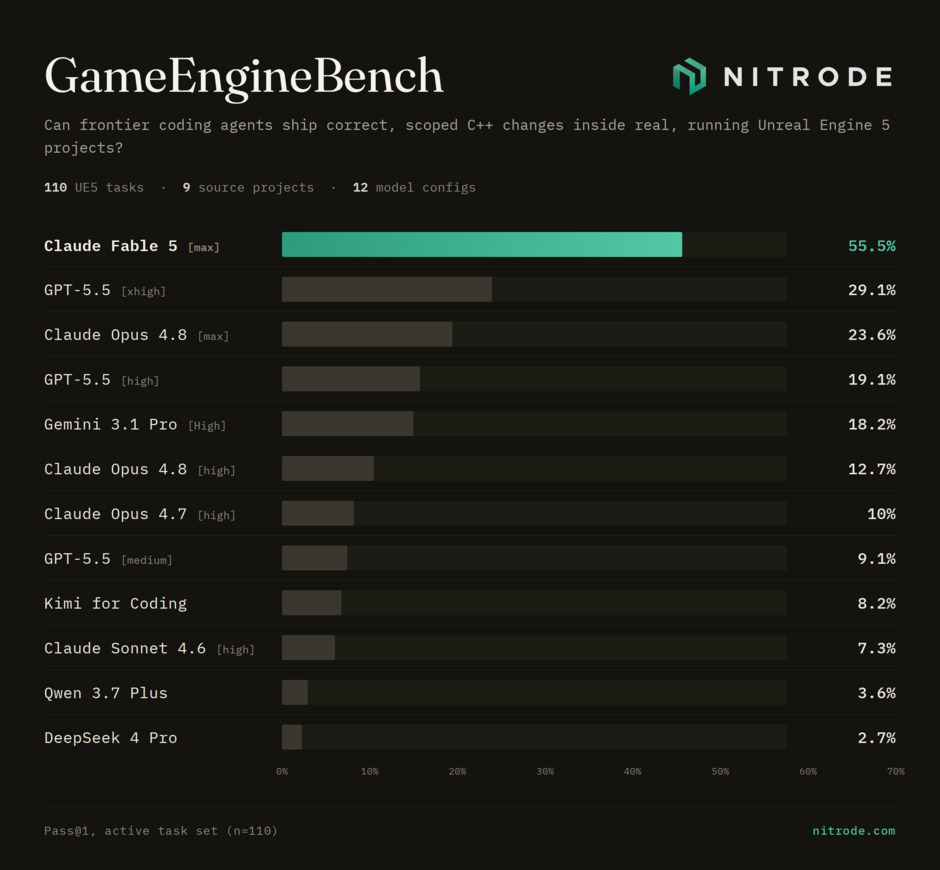
Those figures turn a vague complaint - AI is bad at complicated games - into a surface that researchers can inspect. The benchmark also found that model class and reasoning effort predicted performance, while rankings aligned more closely with spatial-reasoning benchmarks than with conventional agentic-coding tests. Different frontier models showed complementary strengths. The practical implication is mildly inconvenient and therefore useful: code generation and interactive understanding are related, but they are not interchangeable.
Consider the difference between repairing a sentence and repairing a jump. A sentence can be evaluated where it sits. A jump depends on the character controller, collision geometry, animation, input timing, camera and whatever enthusiastic decision the level designer made five rooms ago. The requested change may be small while its neighborhood is a metropolis. An agent has to locate the right lever, move it without dislodging the others, and recognize success after the simulation begins.
This is why the benchmark's use of public, real-world repositories matters. Toy exercises politely remove history. Production-shaped projects contain conventions, dependencies and old decisions. They force an agent to read before writing. They also make failure legible in several ways: the compiler can object, the test can fail, or the game can run and still do the wrong thing. Each failure describes a different missing capability.
In a game, correct code is only the admission ticket. The world still gets a vote.YesPress
The company underneath the pivot
Nitrode now describes itself as a research company advancing game development with AI. Alongside public benchmarks, it is building Mint, a platform that brings game-development experts into the production of custom data. Engine programmers, technical artists and developers contribute examples drawn from real workflows: building, debugging, testing and iterating inside creative tools.
The menu extends from supervised fine-tuning data to reinforcement-learning environments and executable tasks. For gaming companies, Nitrode proposes custom benchmarks and post-training aimed at particular failure modes. A studio does not merely receive a general assurance that a model has improved; it can define the kind of work that matters, watch where agents fail, and train against that boundary.
This is less visually magical than asking for a city-builder and watching one appear. It may be more consequential. Generated artifacts are the part audiences can see. Evaluation determines whether the machinery beneath them becomes dependable. The engine was the theatre; the benchmark walks backstage and starts checking the ropes.
There is a business logic hiding inside the scientific one. Generic models improve in public, but studios encounter private problems: a proprietary toolchain, a particular engine fork, a style of debugging learned over years. By recruiting practitioners who know those environments, Nitrode can translate tacit work into tasks that a model can attempt and a company can judge. The value is not the size of a pile of data. It is whether each example preserves the decisions experts actually make.
What Kim followed
Kim's story is sometimes presented as a familiar acceleration tale: college, Y Combinator, funding, launch. The more instructive line bends. His team began with a creation tool and allowed the tool to expose a research problem. They replaced a broad promise - AI can help anyone build games - with narrower questions that can be tested. Can an agent alter a multiplayer system? Can it preserve state? Can it understand enough of a three-dimensional world to make the requested behavior real?
That move requires a particular kind of ambition. It is tempting to defend the first interface because customers, investors and founders have learned its vocabulary. Nitrode kept the underlying subject - AI and game development - while changing what it sold and measured. The continuity lies in the obstacle, not the packaging.
Kim has also written about agent-native gameplay, where artificial agents can fold a player's choices into stories. That aspiration sits beyond the benchmark, but the path between them is visible. A world with responsive characters and branching consequences needs models that understand more than text. They must inhabit systems, use tools and remain coherent as events unfold.
Games are unusually good at making such weakness obvious. They are spatial, temporal, interactive and gleefully intolerant of bluffing. Kim, the former Minecraft speedrunner, has chosen an appropriate arena. In a speedrun, the clock catches every hesitation. In a benchmark, the runtime does much the same.