Wednesday brought the bank statements. At LendingHome, the mortgage business where Dimitri Dadiomov worked before starting Modern Treasury, people from payments, accounting, capital markets and customer service gathered to work out what had happened to the money. The documents came with yellow highlighting. The questions kept coming back. A meeting devoted to explaining transactions had become a recurring transaction of its own.
Dadiomov hated it. He later described the impulse behind his company as “rage founding.” There is something pleasingly practical about this origin story. No revelation on a mountaintop was required. An appointment on the calendar would do. The irritation was specific, shared by colleagues, and expensive enough in human attention to deserve a closer look.
He went looking for a product other companies already used. His search took him to businesses including Airbnb, Uber, Coinbase and Gusto. What he encountered were internal engineering efforts, rather than something he could buy. “They all needed the same thing,” he recalled. The obvious shopping trip was becoming a business opportunity.
By 2018, he, Matt Marcus and Sam Aarons had founded Modern Treasury. The three had worked on payment operations at LendingHome, later renamed Kiavi. They understood the job from inside the machinery: send funds, keep track of them, and establish that what a business expected to happen actually happened. A bank balance can tell you how much you have. It takes more work to explain why.
“They all needed the same thing.”
Dimitri Dadiomov, on the search for payment software
Before money, there were batteries
Dadiomov’s route into financial infrastructure began with a different kind of network. At Stanford, where he graduated in 2007, he wanted to work on energy. His education included a trip to India, where he saw villagers carry charged batteries home from solar installations. Later, working at Better Place, he helped develop a business built around swapping electric-car batteries.
In a 2012 essay, he connected those two experiences: a battery charged in one place could deliver power somewhere else. The village and the switching station looked very different; the practical arrangement had a family resemblance. His early career included product and business development at Better Place, followed by venture capital and an MBA at Harvard Business School.
The connection to his later work is an interpretive one, but it is hard to miss. Energy and payments both invite grand discussions about networks. Their usefulness is settled at the point where someone needs the thing to work. A household wants light. A business wants its payment to arrive and its records to agree. Infrastructure earns its keep in these ordinary moments.
- 2007Stanford graduate
- 2012Foundation Capital EIR
- 2015Harvard MBA
- 2018Modern Treasury
A company that had to wait for its own product
Modern Treasury joined Y Combinator’s Summer 2018 batch. The accelerator gives a young company a deadline and an audience. It cannot make bank integrations happen on command. When the founders finished the program, they had built their product but had yet to go live with their first clients.
Dadiomov later wrote about that uncomfortable stretch. They had spent much of their time working with prospective customers and banks, putting the underlying connections in place. The delay exposed an awkward feature of infrastructure businesses: the work that makes a product worth buying can arrive well before the evidence that anybody is buying it.
The same obstacle helped explain the opportunity. If the founders found the job slow and demanding even when it was their entire business, a company with a different main purpose had reason to look for help. A mortgage lender has mortgages to fund. A construction software company has construction software to build. Neither automatically acquires a spare payments department when its transaction count rises.
In a 2021 interview, Dadiomov described the experience at LendingHome as payments grew from hundreds to tens of thousands per month. More volume brought more operational problems. Modern Treasury’s proposition covered the journey from initiating a payment through approvals and reconciliation, the matching of financial records. It was selling a way to handle the work surrounding a transfer, as well as the transfer itself.
That distinction gives the Wednesday meeting its significance. The highlighted statement was evidence of a gap between a banking event and a useful business explanation. Software could help close that gap. The founders had to build enough of it, across enough banking connections, for a customer to rely on the answer.
- 01InstructCreate & approve a payment
- 02RouteChoose the payment rail
- 03SettleMove funds between accounts
- 04ReconcileMatch the records
The first customer deserves some sympathy
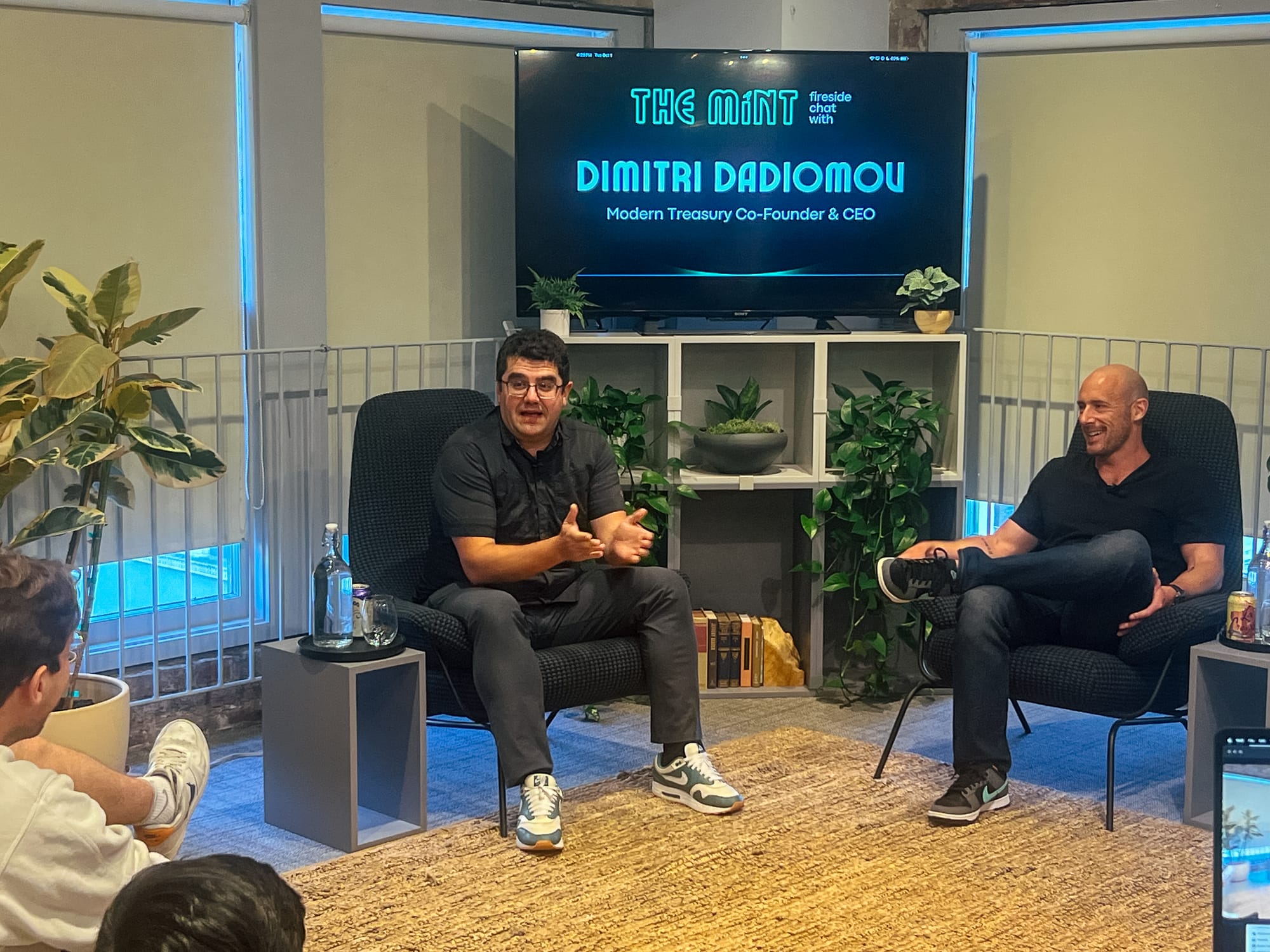
Listen to Dadiomov discuss early customers and the temperature drops from indignation to gratitude. At a 2024 fireside chat, he argued for keeping founders close to sales, product work and customer conversations. Small teams have a short route from a complaint to the person who can change the product. Additional layers can lengthen it.
His approach to early pricing follows the same logic. A customer should make a financial commitment, but extracting a large contract from the first buyer can get in the way of learning. Someone agreeing to use an unfinished product is accepting inconvenience. That contribution has value even when the invoice is modest.
It is an unusually considerate way to discuss a sale. The customer has work to do, colleagues to answer to, and an existing process that at least feels familiar. Moving to new infrastructure asks that person to spend time, take a risk and explain the decision internally. The founder gets feedback; the buyer gets the bugs.
Modern Treasury also found an audience by explaining the mechanics of money movement in writing. Its early content answered practical questions that were poorly covered online. The business went its first two years without hiring a salesperson, relying on inbound interest. For a company trying to name a category, a useful explanation could do some of the introductory work.
Dadiomov’s public conversations return to this habit of looking closely at other businesses. It suits a product used behind the scenes. A payments company learns about payroll when it serves payroll customers and about property when it serves lenders. The underlying transfer may look familiar while the reason for it changes completely.
There is a reader behind the operator
The writing extends beyond payment operations. Dadiomov has published annual reading reflections stretching back to at least 2018. His 2024 entry described a renewed appetite for fiction. His 2025 essay began with his enjoyment of Haruki Murakami’s A Wild Sheep Chase. A founder whose work involves keeping accounts straight also makes room for a novelist with rather different commitments to orderly explanations.
His company biography lists skiing, hiking, writing and reading among his interests. These details do not explain a balance sheet. They make the person behind it easier to see. Reading lists, in particular, record a kind of attention that a professional biography tends to miss: what someone chooses to think about when there is no immediate deliverable.
There is also room for a joke. Before appearing on Turner Novak’s podcast in 2023, Dadiomov ordered a hoodie covered in bananas, a nod to his host’s familiar motif. It failed to arrive in time. He opened the conversation by lamenting the missing outfit. Even a discussion of payment infrastructure can be delayed by an ordinary shipment.
A different chair at the same table
On July 8, 2025, Dadiomov announced that Marcus would become CEO. Dadiomov would take the President role, with Aarons continuing as CTO. After seven years leading the company, he had asked his co-founder to take over.
The reason he gave was a desire to concentrate on product innovation. The company was prioritizing product and engineering investment, while Marcus would focus on execution and the way it reached customers. Dadiomov identified customer first transactions and growing payment volumes as particular sources of satisfaction. The change put more of his working life near those interests.
“I’m not going anywhere,” he wrote. The sentence matters because a change in title can carry so many possible meanings. Here, the founders described a redistribution of work among people who had been building together since the beginning. The company had become more complicated; their responsibilities could change with it.
There is a practical question buried in that decision: which parts of a growing company should a founder personally keep doing? An early startup gives its founders nearly every job. A later one forces choices. Dadiomov’s stated choice was to spend more time making products, alongside the colleagues with whom he had first confronted the problem.
- Dadiomov
- President
Product innovation - Marcus
- CEO
Execution & go-to-market - Aarons
- CTO
Continues in role
Faster payments, more things to explain
The product agenda soon acquired another set of rails. In October 2025, Modern Treasury announced its acquisition of Beam, a platform for stablecoin and fiat payments. In February 2026, it introduced Payments, an integrated payment service provider intended to bring traditional transfers and stablecoins through a single API, with ledgering and compliance built in.
By October 2026, the company said it had powered more than $600 billion in payments. That figure describes cumulative payment volume, rather than revenue or Dadiomov’s personal wealth. It measures the scale of the activity passing through the infrastructure he helped start. Each additional payment still needs an intelligible record.
His own April 2026 writing returned to precisely that concern. A payment passes through several systems and stages, from validation and screening to execution, settlement and reconciliation. Different participants can report different statuses at the same moment. Making money move faster leaves the coordination problem very much alive.
On October 5, 2026, Modern Treasury announced an application to establish a national trust bank. The proposed entity would add digital-asset custody and related fiat services if approved and authorized by the Office of the Comptroller of the Currency. It was an application, with operations dependent on regulatory approval. The company’s ambitions were extending further into the infrastructure around a payment.
The distance from a marked-up bank statement to a proposed trust bank is considerable. Yet the recurring question is familiar: can a business say where its money is and account for what happened to it? Dadiomov’s career has made that question a product brief. The reward for answering it well is almost comic in its modesty. Somewhere, a meeting might finish on time.
Keep following the questions
- The founders’ letter: the July 2025 leadership change ↗
- Power Trips: Dadiomov’s essay on learning about energy ↗
- His personal essays and annual reading journeys ↗
- Watch: a conversation with Turner Novak on The Peel ↗
- Listen: Going Real-Time on Payments on Fire ↗
- Dadiomov on the lifecycle of a payment ↗
- The October 2026 trust bank application announcement ↗