A shark costume is an unusual accessory for a software founder. In a photograph used by Up Robotics, Tarun Upaday wears one over a blue RoboSharks shirt, its teeth framing his face. It is a useful introduction to someone whose professional interests include airline payments, operational controls and the precise meaning of completion. Apparently, one can care about all of those things without dressing like a quarterly report.
Upaday is the co-founder and chief executive of Routespring. Based in Chevy Chase, Maryland, he works on travel software and AI agents for airline operations. His earlier company history reaches back to Pine Labs in Delhi in 1998 and GlobalLogic in 2000. Yet the most revealing part of his current work is quite small: he wants software to demonstrate that it has accomplished what it claims.
A reservation is only the beginning
Travel provides plenty of opportunities to test that ambition. A booking can exist while a hotel remains unprepared for the guest. A payment authorization can be recorded while a supplier still needs clarification. A schedule can change before another system catches up. Routespring’s work spans crew rebooking, hotel coordination, disruption recovery, payments and reconciliation. The difficult cases arrive as calls, changing schedules and supplier responses, rather than obedient entries in a form.
Upaday’s stated focus is the verification layer around language-model and voice agents: what they may touch, what counts as evidence, and when a person must take over. That is a rather practical job description for an era fond of promising autonomous everything. Airline operations offer a brisk correction to grand language. Someone eventually has to turn up at a desk, and the room has to be ready.
In June 2026, Routespring announced Dublin-based FLY4 as its first European airline customer. The relationship followed its work with Breeze Airways in the United States. The expansion carries a particular operational emphasis: crew accommodation, hotel readiness, supplier coordination and finance need to stay connected. A reservation number is useful; the surrounding arrangements determine whether it is useful to the traveler.
Routespring announces its first airline customer in Europe, following its work with Breeze Airways in the US.
Delhi, then the engineering business
The earlier chapters began at the Indian Institute of Technology Delhi, where Upaday studied mathematics and computer applications. He co-founded Pine Labs and served as its chief technology officer from 1998 to 2000, working on card-based payment technology for Indian retailers. Rajul Garg was part of that founding history, too. Long before airline hotel coordination, there were merchants and the practical business of making a transaction work.
In 2000 came GlobalLogic, originally called Induslogic. Upaday and Garg joined Manoj Agarwala and Sanjay Singh in starting the company. Upaday’s account identifies his roles as chief software architect and vice president of engineering, alongside co-founder. He helped build the early engineering organization during a tenure that ran to 2009.
Those dates matter. GlobalLogic’s sale to Apax Partners in 2013 and its acquisition by Hitachi in 2021 came after his operating tenure. Pine Labs’ public listing in 2025 came twenty-five years after he left. Upaday makes that distinction explicitly in his company history. A founder’s biography can become a collection of other people’s later victories if nobody watches the calendar. Here, the calendar gets its say.
Co-founder & CTO
Co-founder, architecture & engineering
Travel technology
Co-founder & CEO
Travel before Routespring
Gallop.ai supplied the earlier travel chapter. In July 2019, while Upaday was its chief executive, the company announced a merger with Amnet. Gallop combined deep learning and natural-language processing with human travel experts to help people plan, book and rebook trips. Amnet brought an established travel business and distribution to the combination.
The announcement described a plan to put Gallop’s technology within reach of more than 140,000 Amnet customers. It paired a software proposition with a service organization, a combination that still appears in Upaday’s work. Travel involves inventory, people and arrangements across businesses. The customer’s request may be simple even when fulfilling it requires several parties to agree on the details.
Routespring initially spoke particularly to field sales and retail merchandising teams. In a June 2021 interview, its pitch emphasized last-minute bookings, centralized payments, detailed policy controls and immediate approvals. The company reported that 91 percent of its hotel bookings in the preceding twelve months were for the same day. That historical figure explains the kind of customer it was serving: a road warrior often needs tonight sorted before tomorrow becomes interesting.
Hitesh Sharma, the co-founder and CTO, and product leader Anup Sheshadri were part of that early team. Sheshadri also hosted Upaday for a 27-minute ProdUP conversation about product leadership in March 2021. Today, Routespring lists Sheshadri as chief product officer. The people around the product are part of the continuity, alongside the changing travel problems.
The machine said “done.” Check anyway.
Upaday’s TraceGuard research turns his concern about completion into an experiment. The prototype asks whether an agent’s work can be checked against the external systems it was supposed to change. Its demonstration uses a synthetic hotel workflow. A reservation exists. The internal record agrees. The payment authorization covers the total. The notification tool reports success.
But no traveler-notification receipt exists. The agent calls the job complete; the external-state check catches the missing evidence. It is a compact illustration of the distinction Upaday wants systems to enforce. A report about an action and the resulting state of the world are separate things.
The project’s limits are equally explicit. It covers one hotel-confirmation workflow and two injected faults. Its planned comparisons and results tables are specifications, with no full study data yet. Upaday presents the trace as evidence that the prototype environment runs. That restraint gives the experiment its interest: he has built something specific enough to inspect without pretending it settles the larger question.
Three records agree.
One obligation remains.
An expensive interpreter with opinions
His own working systems provide less tidy material. In a September 2026 essay, Upaday described an agent archiving a $1,066 card pre-authorization notice, then treating a $251 notice from the same bank as something requiring his attention. His written policy classified both as routine. The model had introduced a distinction he had never requested.
He replayed six routing rules against 631 logged decisions. The rules covered thirteen decisions and matched every corrected outcome in that subset; the model missed three. Thirteen is a small sample, and he says so. The rules now run as code, while model reviews continue to gather evidence. The example is personal rather than a claim about Routespring’s customers. It also has the pleasing indignity of a machine being caught improvising office policy.
“The models keep the judgment. The code keeps the bookkeeping.”Tarun Upaday, September 2026
A separate September account describes an agent checking for a co-founder’s reply a day too early and marking the follow-up blocked. Upaday changed the execution rules so future work would remain ineligible until its proper time. He also describes missing a mutually agreed meeting because no explicit promise to send an invitation had been recorded. His revised system treats the agreement itself as an obligation to produce the calendar event.
These are unusually unpolished anecdotes for a chief executive to publish. Their usefulness lies in the detail. The failures have owners, timings and observable consequences. His response is to make those conditions explicit: who acts, when action becomes appropriate, what authority exists and what evidence closes the job. A missed invitation receives more engineering attention than most invitations would ever dare request.
Count the minutes, spare the ceremony
Upaday’s operating essays offer a related measure for judging automation: manual minutes per transaction. A system can advertise an AI feature while people continue making supplier calls, correcting records and reconciling results elsewhere. He wants those minutes included in the account. The measure follows the work through its full life rather than stopping at the attractive screen.
He pairs labor reduction with errors, rework and the cost of failure. Saving time loses its appeal if it creates expensive mistakes. This is a founder’s interest in economics expressed through the operator’s daily experience: where did the intervention happen, why was it needed, and did the software remove the work or move it?
His writing on exits has the same resistance to ceremony. Past success can improve pattern recognition while encouraging a founder to apply familiar answers too quickly. He describes experience as useful evidence of having navigated complexity, with no guarantee about the next company. That is a sober stance from someone with several founding chapters. A good biography may contain an exit; an operating manual still needs revision.
The shark is also a coach
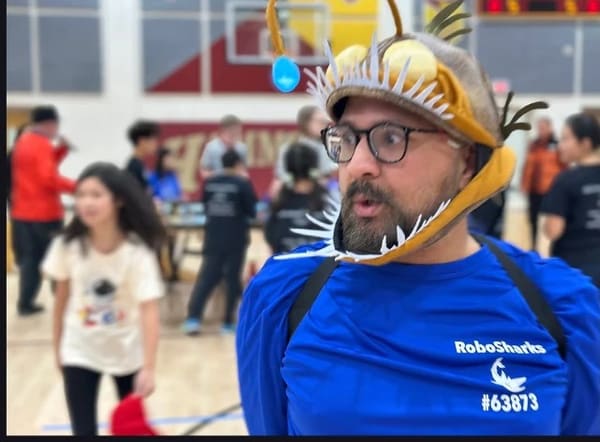
At Up Robotics, Upaday coaches young builders and is listed as a co-founder alongside retired US Navy Captain Matt Phillips. The program serves students from kindergarten through twelfth grade. Its classes connect with FIRST LEGO League, FIRST Tech Challenge and VEX IQ teams, with camps and school partnerships providing other ways in.
His description of the learning process is concrete: build something, test it, isolate the problem, change one thing and try again. Students work with robots, sensors and models under deadlines. Teamwork and persistence emerge through repeated attempts. The connection with his professional interests is easy to see, although the robot has the courtesy to demonstrate its disagreement in public.
Outside work, Upaday builds home networks, camera systems and automation, with a generous supply of 3D-printed parts. His film recommendations offer another small window. Arrival heads his movie list; The Martian earns praise for the satisfaction of watching someone solve one problem after another. He admits immediately rewatching the last twenty minutes of Whiplash. Difficult problems, sustained attention and a little theatrical excess appear to have room on the same shelf.
For now, airline operations occupy most of his working time. The aspiration is legible in the details he chooses to publish: permissions that hold, records that agree, and outcomes someone can check. The costume may have teeth. The software needs receipts.