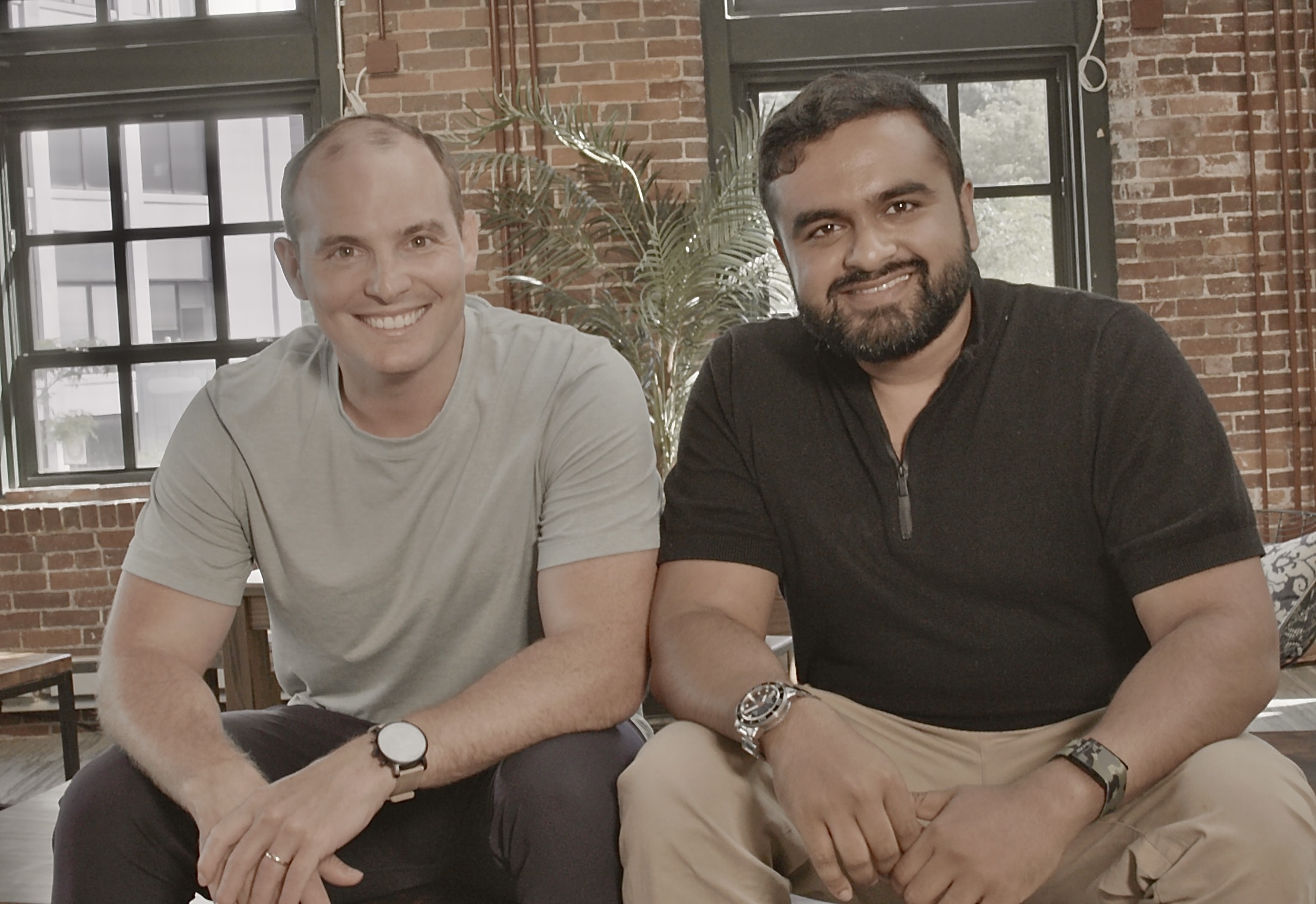
A Boston bakery wanted an ordering app. Its owners had planned for six months and a $300,000 budget. Brian Elliott and Sid Pardeshi, then Harvard students, built it over a weekend using multiple AI models, according to Forbes. The useful detail is the gap between the bakery’s expectations and the founders’ experience. Software had acquired a familiar price and a familiar waiting period. Suddenly, both looked negotiable. That experiment helped lead to Blitzy, founded in 2023. Its bigger opportunity would be inside companies whose software was already running.
- Blitzy maps existing code before agents change it.
- People approve the plan and review the returned work.
- The economics target enterprise projects, with Core listed at $500,000 a year.
01 / A bakery was the small problem
New applications make tidy demonstrations. Existing applications contain history: the exception added for one customer, the old interface another team still uses, the business rule nobody remembers writing. A feature can be correct in one file and disastrous three services away. Blitzy’s founding argument is that enterprise AI needs a working understanding of those relationships.
The founders brought different encounters with complexity. Pardeshi had worked at NVIDIA; Elliott was a West Point graduate and former Army Ranger. Their company’s September 2024 announcement already identified the commercial lesson: customers found particular value in connecting existing codebases and internal APIs. The bakery proved something could be built quickly. Corporate software offered a much larger problem to understand.
02 / First, teach the agents the neighborhood
Blitzy reverse-engineers a customer’s software into a knowledge graph, a connected representation of architecture and dependencies. The company says its platform can understand codebases exceeding 100 million lines and coordinate more than 3,000 specialized agents. Those are company claims about capacity. The underlying proposition is easier to grasp: agents making separate changes need a common map.
Engineers provide requirements and inspect the proposed Agent Action Plan. After approval, agents implement and validate changes, returning a pull request for human review. The work can run asynchronously for days. Compared with an assistant inside an editor, Blitzy puts more emphasis on delegating a defined project and receiving its results later.
Connect the codebase. Build a shared picture of its architecture and dependencies.
That puts it among coding agents such as Devin, Claude Code and Codex, while also competing for work that might otherwise go to internal teams or consultancies. The distinction buyers should test is project completion within their own system. A clever answer in a chat window is a different deliverable.
03 / The first obstacle was the brief
At Mexican insurer Grupo Nacional Provincial, the initial difficulty was learning to structure prompts and define requirements. Its CIO, Enrique Ibarra, told Forbes the founders helped engineers through that process. Skepticism eased after they saw the output. His account suggests an awkward truth about autonomous development: the machine still needs people to decide precisely what they want.
Blitzy’s own guidance gets refreshingly specific. State whether a scope list is exhaustive or merely examples. Pin important software versions. Give measurable acceptance criteria. Name behaviors that must survive the change. A reader can borrow those habits for an ordinary engineering brief. They force decisions into the open while changing them is still cheap.
The environment is another part of the brief. Blitzy asks teams to test whether it can build and run the existing application before generation begins. Its documented setup check typically takes 15 to 45 minutes. That preparation creates a feedback loop: an agent can discover a mistake by running the software, rather than handing the mistake to a reviewer. Missing access to a private package registry can matter as much as the wording of the request.
04 / The price of a postponed project
This is enterprise procurement. In October 2026, Blitzy’s homepage lists Core at $500,000 annually, Scale at a typical $1 million, and Transformation at a typical $10 million. A free Sandbox lets eligible organizations evaluate it on their own code. Paid engagements make sense only against a sufficiently valuable body of work.
Core tier · Homepage, October 2026
Galatea Associates shows where domain expertise fits. The financial-services consultancy became both a customer and implementation partner in 2025. Blitzy supplies development capability; Galatea brings knowledge of financial institutions and their requirements. Faster implementation still needs someone who understands the business being implemented.
Investors financed that ambition with a $200 million growth round led by Northzone in May 2026, at a $1.4 billion valuation. That funds a company, rather than proving an individual customer’s return. For buyers, the meaningful calculation remains the work accepted, the review required, and the cost of completing the project.
Blitzy also publishes experiments that make its capabilities inspectable. In March 2026 it reported rewriting curl from C into Rust in five days, with 7,312 passing tests. In June it reported an 84.95% SWE-Bench Pro Public score, describing validation by Quesma. These are useful pieces of evidence with different jobs: an experimental rewrite tests a migration approach; a benchmark tests performance on a defined task set. Neither, by itself, says how a particular insurer’s release will behave. The customer’s own acceptance process supplies that missing answer.
05 / Then the queue moved
By September, Blitzy was addressing a consequence of its own premise. Generate more code and people must understand more changes. PR Review explains what changed, why, and how it was validated. The feature makes the remaining human responsibility visible.
“The AI revolution has shifted the bottleneck in software development from writing code to reviewing it.”
Sid Pardeshi · CTO & co-founder
PR Review announcement, September 2026
October’s Chat to Prompt tackles the other end: discovering missing requirements before agents begin. Together, the releases suggest that Blitzy’s real product extends around code generation, into preparing and accepting the work. Its published culture emphasizes in-person collaboration and long customer relationships, a fitting preference for software that needs close coordination.
There is a concrete condition underneath the promise. Blitzy’s documentation says a failed environment test leaves it using static analysis, rather than the full build-and-test loop. Private dependencies, credentials and setup instructions matter. Teams still own production validation. A sensible trial therefore starts with a real, bounded project, a working environment and explicit acceptance tests. Let the agents run. Then judge what the engineers can safely accept.