code-generation
(18)
Aider Is the Coding Agent With Git Receipts
Aider edits the repo you already have, through the terminal you already use, with the model you choose. Its killer feature is less glamorous than autocomplete: every change leaves a clean Git trail.
MutableAI Put the Codebase on the Record
Before every coding assistant wanted to know your whole repository, MutableAI made the repository write its own field guide. The product is gone, but its sharpest idea now has a second life inside Google.

Phind Gave Coders the Answer. Then It Vanished.
Phind turned the web's scattered documentation into useful, cited answers for developers. Its brief run also became a neat lesson in how quickly a focused AI product can be copied, crowded out, and switched off.

ion design
ion design is a San Francisco AI company (YC W24) building tools that let non-engineers ship real UI changes to a live codebase. It started by turning Figma designs into clean React code, grew into a Figma-like visual editor that opens branches and pull requests against your GitHub, and now runs autonomous AI product-design agents that create and test on-brand pages to grow revenue. Founded in 2023 by Samraaj Bath, it targets the gap between people who can ship code and the PMs, designers, and marketers who cannot.
Tempo
Tempo is a Toronto-based, Y Combinator-backed (S23) AI development environment for React. It pairs a drag-and-drop visual editor with AI code and reasoning agents so founders, product managers, designers, and engineers can build and ship production-grade React apps from the same canvas. Optimized for Vite and Tailwind, it works on real production codebases rather than throwaway prototypes, and connects to backends like Supabase and payment tools like Stripe through its MCP App Store.

Cline
Cline is an open-source, autonomous AI coding agent that runs inside VS Code and other editors. It reads a codebase, plans changes, edits files across a project, runs terminal commands, and drives a browser - asking for the developer's approval at each step. Built to be transparent and model-agnostic, it lets teams bring their own API keys or run local models, and has grown into one of the most-installed AI coding tools with a Fortune 500 enterprise offering, Cline Teams.

Supernova
Supernova is an AI-powered platform that turns a company's design system into structured context that both people and AI coding agents can use. Founded in Prague and now building a U.S. headquarters in San Francisco, it centralizes design tokens, component APIs, documentation and rules as a single source of truth, then feeds that context into tools like Figma, Storybook, Cursor, GitHub Copilot and Claude Code so product teams can prototype, hand off and ship features faster. A Y Combinator alum, it is used by hundreds of organizations including Air France, KLM, Kraft Heinz, Paramount, Mozilla, LaunchDarkly and Skyscanner.

Josh Payne
Josh Payne is a builder and musician based in the Bay Area, founder of Coframe, an AI company building 'living interfaces' - websites that rewrite and redesign themselves in real time via a single script tag. Before Coframe he co-founded Autograph, a $2B+ company backed by a16z, and AccessBell, acquired by Tata Group. He holds 20+ patents and papers across AI, quantum computing, and information security, created the early coding agent GPT-Migrate that briefly topped GitHub trending, and guest-lectures on LLM code generation at Stanford, where he earned three degrees. He is also a working timpanist and jazz drummer who has performed with Josh Redman and So Percussion.
Inception
Inception builds diffusion-based large language models (dLLMs) that generate text in parallel instead of one token at a time. Its flagship Mercury family is positioned as the first commercial-scale diffusion LLM, reporting 5–10x faster throughput than traditional autoregressive models at competitive quality, with Mercury Coder targeting code generation and Mercury 2 reasoning workloads.

Windsurf
Windsurf (formerly Codeium, originally Exafunction) is a Mountain View-based AI coding company that built one of the first agentic AI-native IDEs, powered by its Cascade agent. Founded in 2021 by MIT classmates Varun Mohan and Douglas Chen, it grew to over 1 million developers and $82M ARR before a dramatic July 2025 split: Google paid roughly $2.4B to hire its founders and license its technology, while Cognition (maker of Devin) acquired the remaining product, brand, team, and customer base. In June 2026, Cognition relaunched the Windsurf IDE as Devin Desktop, an agent command center for managing local and cloud coding agents.

Imbue
Imbue is a San Francisco AI research lab building agents that can reason and code. Founded in 2021 as Generally Intelligent and renamed in 2023, the company is led by CEO Kanjun Qiu and CTO Josh Albrecht. After a $200M Series B that valued it above $1B, Imbue is focused on practical agent tools - most visibly Sculptor, a UI for running parallel coding agents safely in containers - guided by a mission to keep humans in control of powerful AI.

Poolside
Poolside is a San Francisco AI lab building foundation models purpose-built for software engineering. Founded in 2023 by former GitHub CTO Jason Warner and serial entrepreneur Eiso Kant, it trains its frontier models (malibu, point) with a technique called Reinforcement Learning from Code Execution Feedback - then deploys the whole stack inside customer environments for Global 2000 enterprises, financial institutions and the public sector.
Code Metal
Code Metal is a Boston-based AI startup building a verifiable code translation platform for mission-critical industries - aerospace, defense, automotive, semiconductors and robotics. Founded in 2023 by AI researchers Peter Morales and Alex Showalter-Bucher, the company combines large language models with formal verification so engineers can write software once and ship it - safely - to any chip.

Cursor
Cursor is an AI-first code editor built by Anysphere, a San Francisco startup founded in 2022 by four MIT graduates. Originally a fork of Visual Studio Code, Cursor has evolved into a full agent-based development platform where autonomous AI handles everything from autocomplete to end-to-end feature building. With $2B+ in annualised revenue, over half the Fortune 500 as customers, and a valuation that reached $29.3B after its Series D in November 2025, Cursor has become the fastest-growing SaaS company ever from $1M to $500M ARR - turning the IDE from a code-writing tool into an AI orchestration layer.
Factory
Factory builds agent-native software development for enterprises. Its Droids - specialized AI agents for coding, reliability, product, and knowledge work - take tickets, write code, open PRs, and triage incidents alongside human engineers. Founded in 2023 by Matan Grinberg and Eno Reyes, the San Francisco company raised a $150M Series C in April 2026 at a $1.5B valuation led by Khosla Ventures.

Matan Grinberg
Matan Grinberg is the CEO and Co-Founder of Factory, an AI platform that deploys autonomous agents called Droids to automate the entire software development lifecycle. A theoretical physicist who dropped out of his UC Berkeley PhD program in 2023 after a fateful three-hour walk with Sequoia partner Shaun Maguire, Grinberg built Factory from a 72-hour hackathon demo into a $1.5B unicorn backed by Khosla Ventures, Sequoia, Blackstone, and Insight Partners. Named to Forbes 30 Under 30 AI in 2025, he is one of the defining voices in the agent-native development movement.

Peter Morales
Peter Morales is the CEO and co-founder of Code Metal, a Boston-based AI company that hit unicorn status in February 2026 after raising a $125M Series B led by Salesforce Ventures. With a background spanning BAE Systems (F-35 ML optimization), MIT Lincoln Laboratory (counter-drone AI), and Microsoft (HoloLens computer vision), Morales built Code Metal to solve a gap he discovered firsthand: AI can generate code fast, but mission-critical industries — defense, automotive, semiconductors — need proof that code is correct before it ships. Code Metal's verifiable AI platform translates high-level code into hardware-optimized, mathematically verified production code for edge devices, drones, FPGAs, and autonomous systems. Customers include the U.S. Air Force, L3Harris, Raytheon, Toshiba, and Bosch.
Scott Wu
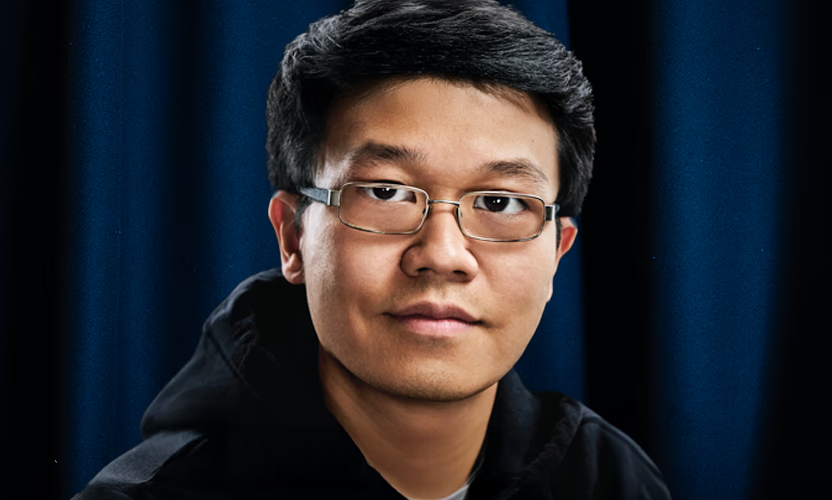
Scott Wu is the co-founder and CEO of Cognition, the AI company behind Devin - widely recognized as the world's first autonomous AI software engineer. A three-time International Olympiad in Informatics gold medalist from Baton Rouge, Louisiana, Wu started coding at age 9, interned at a fintech startup as a high schooler alongside future Scale AI founder Alexandr Wang, briefly attended Harvard, then spent five years building Lunchclub as CTO before co-founding Cognition in 2023 with fellow competitive programming champions. Under his leadership, Cognition grew from a 10-person apartment startup to a $10.2 billion company with over 200 employees, acquired Windsurf in July 2025, and raised $675 million in total funding - with Devin's annualized revenue surging from $1 million to $73 million in under a year.