Profile
The Kid Who Coded at Nine
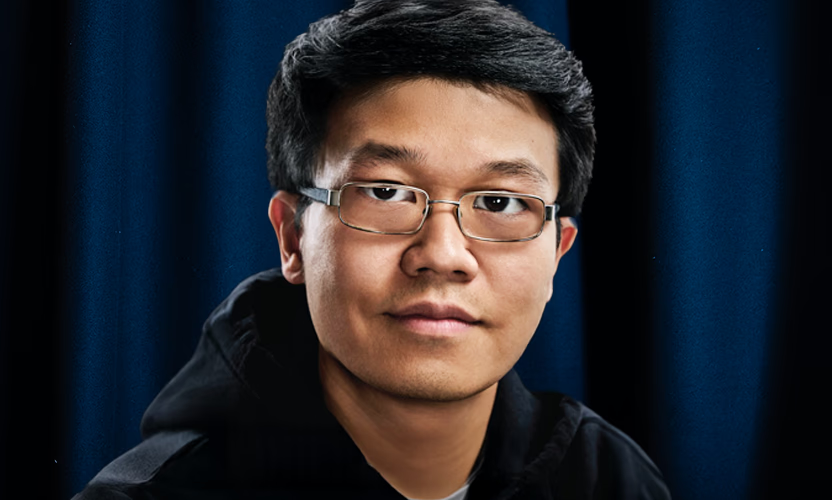
Scott Wu grew up in Baton Rouge, Louisiana, the son of Chinese immigrant chemical engineers. He started coding at nine. By eleven, he was winning national math competitions. By seventeen, he was doing software engineering work at Addepar alongside a teenager named Alexandr Wang - who would go on to found Scale AI. None of them knew it yet, but they were all in the middle of a decades-long story about what happens when the most technically obsessed generation in history decides to build things together.
Wu won the International Olympiad in Informatics gold medal three years running - 2012, 2013, 2014 - placing first overall in his final year. He went to Harvard. He stayed two years. He left. This is not unusual for people who are already operating at the ceiling of what any classroom can offer them.
At Harvard, he'd helped the team win a gold medal at the ICPC - the collegiate programming Olympics. He'd already competed at a level where the margin between first and second is a matter of nanoseconds and elegant algorithms. The classroom, by contrast, moves at a pace set for everyone.
I first learned to program when I was 9 years old and fell in love with the ability to turn my ideas into reality. Now, teaching AI to code at Cognition has been a dream come true.
- Scott Wu, @ScottWu46
From 2017 to 2022, Wu co-founded Lunchclub and served as its CTO - an AI-powered professional networking platform that matched strangers for video coffee chats. Lunchclub worked. It earned Wu a Forbes 30 Under 30 mention in 2020. But the more interesting pattern is what he was building toward, not what he was building.
In 2022, he walked away. And in January 2023, he co-founded Cognition with Steven Hao and Walden Yan - both fellow competitive programming champions - in an apartment in New York City. "We hunkered down and built the product we always wanted for ourselves," Wu later said. The product: an AI that could do the work of a software engineer.
Key Fact
Cognition's founding team of 10 collectively held 10 IOI gold medals - including Gennady Korotkevich, widely considered the greatest competitive programmer ever to compete.
The product they were building wasn't a code autocomplete. It was Devin: an AI that could take a natural language task, spin up its own development environment, write code, run tests, debug, iterate, and submit a pull request - autonomously, end-to-end. Not assistance. Agency.
When Devin launched in March 2024, the internet did what the internet does with things it doesn't have a category for: it went sideways. Some engineers celebrated. Some panicked. Everyone had an opinion. Cognition raised $21 million from Peter Thiel's Founders Fund almost immediately, then $175 million more a month later at a $2 billion valuation. The speed was dizzying. The product was real.
The Product
Devin: A Junior Engineer, Not a Shortcut
Wu is precise about what Devin is. He calls it "a junior engineer today" - not a replacement for senior engineers, but an agent that handles bugs, simple features, repetitive migrations, and version upgrades. The companies seeing the most value are the ones where Devin merges 30 to 40 percent of all pull requests. At Cognition itself, a team of Devins was already generating 25 percent of pull requests by mid-2025, with Wu targeting 50 percent by year's end.
The paradigm shift is not that AI writes code. It's that AI handles entire tasks. The difference between a code suggestion and an autonomous agent completing a ticket is the difference between a calculator and an accountant. One augments; the other acts.
Engineers are moving from bricklayers to architects - being able to focus on high-level design while AI handles implementation.
- Scott Wu, Lenny's Newsletter interview
Wu's prediction for the next 2-4 years: writing code directly will no longer be the primary interface for software engineers. Instead, engineers will describe systems and delegate implementation. He expects this to create more engineering jobs, not fewer, through what economists call Jevons paradox: when a resource gets cheaper, total consumption of it rises. More accessible software means more software gets built.
The framing matters. Wu is not selling displacement. He's selling a lever. The engineers who learn to wield it - who shift from writing every line to designing the systems that make the lines possible - are the ones who will matter most in the decade ahead.
The Acquisition
72 Hours to Close a $250M Deal
In July 2025, Google announced it was licensing technology from Windsurf, an agentic IDE with $82 million in annual recurring revenue and hundreds of enterprise customers. The Windsurf CEO described the mood inside the company as "very bleak." Wu heard about it on a Friday evening.
His internal calculus: Windsurf had the go-to-market muscle, the operator DNA, the enterprise relationships that Cognition - a research-heavy team that had grown from a shared house - was still building. If there was a move to make, it had to happen before Monday morning.
Handshake Saturday. All-nighter Sunday. Signed Monday at 9 a.m. The combined entity - Devin plus Windsurf - reached an estimated $155 million in combined ARR and a $10.2 billion valuation within two months. Wu raised another $400 million in September 2025 to fund the combined operation.
If there is something to do here at all, then it has to be ready to go by Monday morning.
- Scott Wu, on the Windsurf acquisition
The acquisition crystallized something about how Wu operates. The people around him describe an "extreme performance culture" - long hours, high standards, genuine buyout offers for employees who don't want to work that way. Wu publicly defended the culture in 2025, posting the internal communications directly to X. Transparency as a recruiting filter. Intensity as a feature, not a bug.
There's a theory Wu holds about how competitive spaces mature - what he calls the "Moneyballification" of everything. Poker, chess, Smash Bros: first they're won by feel and instinct, then by mathematical optimization. He thinks startups are going through the same arc. When the playbooks for fundraising and hiring and equity are all established, the edge migrates to execution speed and team quality. Which is, not coincidentally, exactly what he built.