Every product team runs the same relay race. A designer builds something clean in Figma. An engineer opens a ticket and rebuilds it, pixel by pixel, in code. The handoff eats days, and the final screen rarely matches the mockup. Tempo, a Toronto startup out of Y Combinator's Summer 2023 batch, was built to delete that relay race - not by making the handoff faster, but by removing the second runner entirely.
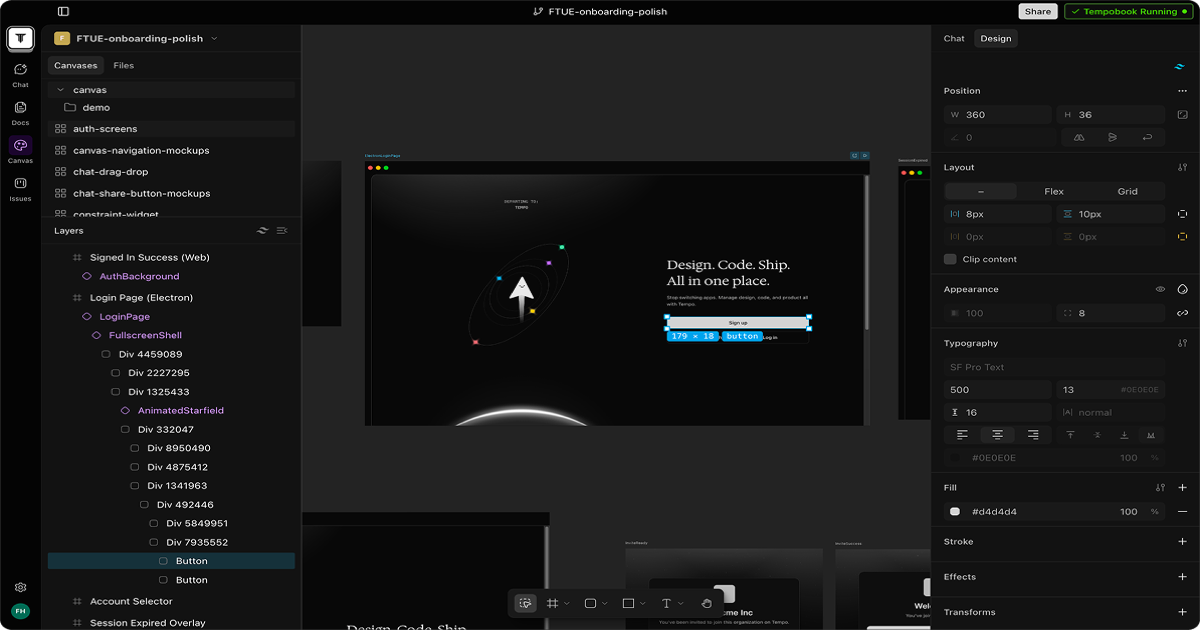
The idea is simple to say and hard to build: put the designer, the product manager, and the engineer on one canvas, editing the same React code. One person drags a component around a visual editor. Another opens the source. Change either, and the other updates. Underneath, AI code and reasoning agents do the heavy lifting - generating components, wiring up logic, and reasoning about the codebase they are editing.
01What it doesAn IDE dressed as a design tool
Tempo describes itself as a visual editor for React, powered by AI. The phrasing hides how unusual the product is. Most tools in this space pick a lane. Design tools like Figma produce beautiful mockups that can't run. Code editors like Cursor assume you already read source for a living. AI app builders like Bolt and Lovable turn a prompt into a fresh app you often throw away.
Tempo tries to hold two of those worlds at once. It has the familiar feel of a design canvas - panels, drag handles, pixel-level controls - but under the hood it behaves like an IDE, editing real React components. The company optimized it for Vite and Tailwind CSS, the stack a lot of modern front-end teams already use, and built it to work on existing production codebases rather than sandbox demos.
02The foundersTwo people scratching an old scar
Tempo's founders did not stumble onto the design-to-code gap. They lived inside it. Kevin Michael, the CEO, was a founding engineer and head of product at Perpetua, an ad-optimization company that reportedly exited for around $150M; earlier, he worked on Microsoft's Visual Studio team and at Social Capital. Peter Gokhshteyn, the CTO, led engineering at Perpetua from its earliest days, with prior stints at Google, Bloomberg, and Zynga.
Between Visual Studio and years of shipping product, the two had watched the same tax get paid over and over: good design stalling at the border of code. Michael's earlier startup, Six Club, had even reached the YC S17 finals before Tempo made it into the S23 batch. The through-line is a founder who keeps circling the same territory - how software actually gets built.
03Who it's forThe person who can't read a pull request
Tempo's customers are product teams building React apps: founders prototyping a first version, product managers who want to shape a screen without filing a ticket, designers tired of watching their work get lost in translation, and engineers who would rather review AI output than hand-build every button. The common thread is a team where not everyone lives in the terminal.
That framing matters, because it explains who Tempo is really chasing - the designer or PM who has strong opinions about an interface but can't open a code editor. Serve that person well, and you become the tool the whole team gathers around.
04The marketA crowded, noisy knife fight
The AI app-builder space is loud. Cursor owns AI pair-programming for engineers. Bolt.new prompts, runs, and deploys full-stack apps fast. Lovable pitches itself as an AI full-stack engineer. Replit offers instant hosting and multiplayer coding. Vercel's v0 turns prompts into UI. All of them ship features weekly, and all of them want the same developers.
Tempo's differentiator is not raw speed or a cleverer prompt. It is the shape of the customer. Where most rivals aim at engineers or at solo prompt-to-app builders, Tempo aims at the whole product team on one canvas, working on real code. In a crowded market, that is a positioning bet: don't be faster, serve the person everyone else ignored.
05ProductsFrom editor to full-stack, in clicks
The core product is the visual editor, but Tempo has been widening it. A Figma plugin converts designs into React code that stays editable inside the canvas - the two-way street competitors tend to flatten into one direction. In June 2025, the company launched an MCP App Store, which lets users connect backends like Supabase, payment tools like Stripe and Polar, and other APIs to an app in a few clicks. It also added React Native and Expo support, pushing the same workflow toward mobile.
06Business modelWhen the premium tier is a person
Tempo sells software the usual way and then does something less usual. The self-serve plan is credit-based: you buy AI credits and use the code and reasoning agents yourself. Above that sits Agent+, a high-touch, human-in-the-loop service where Tempo's own engineers and designers build features directly for customers.
In a market sprinting to remove humans from software, Tempo kept one in the loop and charged more for it. It is a candid admission that AI coding agents still hit walls - and a business model built around bridging them, rather than pretending they don't exist.
07The honest partWhat reviewers actually say
The public feedback is a useful corrective to the hype. Reviewers consistently praise Tempo for front-end work: it generates UI and components quickly, lets people refine them visually or in code, and speeds up prototyping and styling. The same reviewers also report the AI getting stuck in loops, missing requirements, stumbling on auth setup, and occasionally claiming changes it didn't make.
None of that is unique to Tempo - it is the current state of AI coding tools generally. The teams that win this era will be the ones who close the gap between the polished demo and the ordinary Tuesday fastest. Tempo's Agent+ tier is, in part, an answer to exactly that gap.
08The backingA seed round with conviction
Tempo raised a $5M seed round to fund what it calls the "design engineering" movement. The investor list reads like a bet on the workflow itself: Y Combinator, General Catalyst, Golden Ventures, BoxGroup, Webflow Ventures, and iNovia, with angels including Lenny Rachitsky and Varun Anand. Webflow Ventures on the cap table is a small tell - a company that built its business on the design-code boundary backing another one that wants to erase it.
Whether "design engineering" becomes a real category or stays a fundraising frame is the open question. But the underlying complaint - that beautiful designs die in translation - is one every product team recognizes. Tempo's wager is that the fix isn't a better handoff. It's no handoff at all.
Follow Tempo
- Web tempo.new
- LinkedIn /company/tempolabs
- X @tempo_labs
- YC Company profile
- Product Hunt Tempo Labs
- Blog The $5M seed
- Founder Kevin Michael
- Jobs Work at Tempo
Watch & demos: search "Tempo Labs demo" and Kevin Michael's "Introducing Tempo Labs (YC S23)" post on LinkedIn for product walkthroughs. Figures on team size vary by source (~8 per YC profile); funding and product details drawn from public sources as of July 2026.