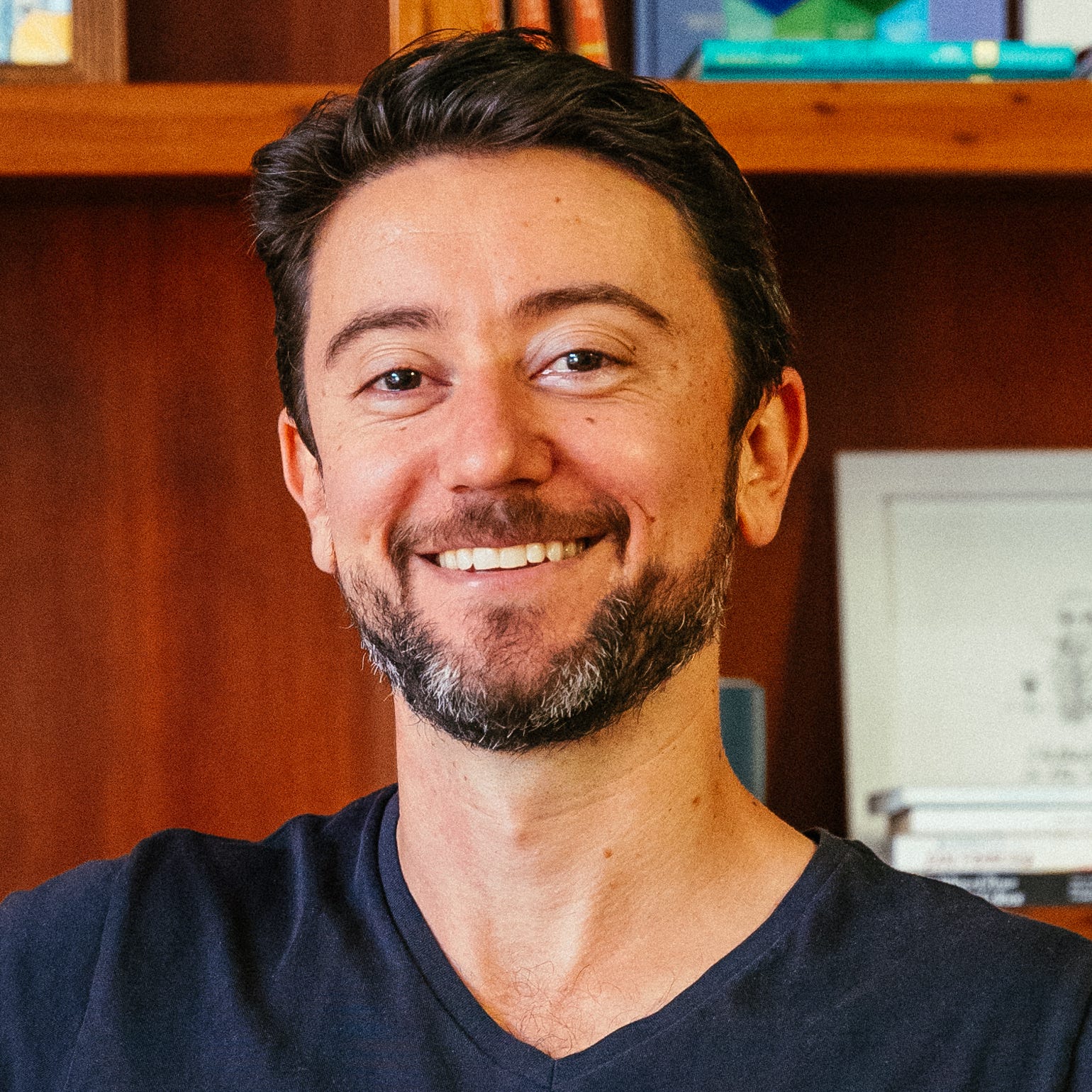
The most influential voice in product management today runs a lean operation. No VC fund. No big team. No standing desk with a panoramic view of San Francisco Bay. Just a home studio in Marin County, a digital fireplace, and a no-meetings-before-3pm rule that Lenny Rachitsky enforces like a religious conviction.
What he has built is remarkable not for its scale alone, but for the discipline behind it. Lenny's Newsletter passed one million subscribers in March 2025, making it the largest product-focused publication on the internet. His podcast ranks in the global top ten for tech. He has backed 130+ startups. He earns over $3 million a year. And he does it all while picking up his son from school in the afternoon.
This is a man who spent nine years writing code at a web monitoring company before anyone outside of San Francisco knew his name. When he finally left for a startup, it was at the urging of a Canadian entrepreneur who convinced him to move to Montreal in winter to pursue a location-based Q&A app at an incubator. That startup, Localmind, sold to Airbnb in 2012. And that is where the education that eventually became a newsletter began.
Seven Years That Changed Everything
Airbnb in 2012 was a rocket ship that people were still debating would survive. By the time Lenny left in 2019, the company was worth over $30 billion and had fundamentally restructured how humans think about hospitality. He was there for nearly all of it. "Did I intend to stay there for seven years?" he once wrote. "Hells no. But man, it's a tough place to leave."
His crowning achievement at Airbnb was the Instant Booking transformation. When he took on the initiative, fewer than 5% of bookings on the platform were instant - meaning guests had to send a request and wait, often for hosts who would ignore them entirely. More than half of guest booking requests were rejected or left unanswered. The conversion rate for guests who actually completed a booking was under 50%.
Two and a half years later, over 80% of Airbnb's bookings were instant. Guest conversion had risen past 80%. The project required years of product intuition, stakeholder persuasion, and a willingness to push through an initiative that many at the company weren't sure guests actually wanted. It is, by any measure, one of the more consequential product changes in consumer tech history.
The Newsletter Was a "Life Experiment"
When Lenny left Airbnb in 2019, he had no clear plan. He split his time between advising startups, making small angel bets, and writing. He launched the newsletter on Substack that August, describing it as a "life experiment" aimed at avoiding what he called "getting a real job." The tone was direct, the research was deep, and the content landed squarely on the desk of every ambitious product manager who had been starving for something more substantive than Twitter hot takes.
He went paid on April 7, 2020. Within months he had earned $65,000. By the end of year one, that figure had crossed $300,000. He had not gone viral. He had not been on a major podcast. He had simply published deeply researched, rigorously quality-checked writing for an audience that trusted him - and told their colleagues about it.
Growth was slow, deliberate, and almost entirely word-of-mouth. The hockey stick came later, when Substack's Recommendations feature introduced him to new audiences. But the foundation was pure distribution through trust. "Growth comes from publishing something valuable," he says, "that people want to share with their friends and colleagues, over and over."
Quality as a Religion
Most writers review their work two or three times before publishing. Lenny reviews each newsletter approximately 50 times. Some posts take him over 100 hours to research and write. He spends between 10 and 30 hours on every issue, a pace that makes the quality make sense but the business model seem improbable - until you consider that each issue reaches over a million people who paid to read it.
This is not incidental. His wife Michelle, who is an author, describes him as "Mary Poppins" - an almost unsettling degree of discipline wrapped in a friendly exterior. His studio walls bear small plaques: one reads "Have fun," another reads "Breathe." There are also notes to himself about how to improve as an interviewer: "Push back more." "Difficult parts / stories." "More IC folks." It is the note-keeping of someone who takes craft seriously, not someone who stumbled into prominence.
A Reluctant Media Empire
Lenny will tell you he is not trying to be an influencer. He says it frequently enough that you start to believe him - and then you look at the numbers. The podcast launched in 2022 and now pulls 100,000 to 200,000 downloads per episode. YouTube has half a million subscribers. The Slack community holds 40,000 product professionals. He has built an AI chatbot called Lennybot trained on every word he has ever published. He launched a second podcast specifically about AI adoption called "How I AI." He hosted a summit in 2024 that drew 1,200 people.
All of this from a home studio. The digital fireplace backdrop, now inseparable from his brand identity, started as a practical fix: his original setup had mirrors that created reflections on camera. He replaced the background with a looping fireplace video. It survived five studio moves. At some point it became less a workaround and more a trademark - the cozy hearth of a man inviting you to sit down and talk seriously about product strategy.
The Immigrant's Foundation
Lenny grew up in Odesa, in Soviet Ukraine, in a family that had formally requested to emigrate - a declaration that Soviet authorities treated as near-treasonous. His father, a mechanical engineer, lost his professional standing. His parents were refuseniks, and their names were on record with the state. When Lenny was six, his parents heard at a party about a new window to apply for exit. They took it. The family left for the US via Italy, with help from the US Jewish Federation.
His mother, an economist in Ukraine, rebuilt her career in the US as a CPA while barely speaking English. His father drove taxis and limousines while working his way back into engineering. "My mom has had a lot of influence on the way I am," Lenny has said. "She prioritized income and making money because that drives safety, security and opportunity." There is a quiet chip on his shoulder in everything he builds - the sense that you do not take opportunity for granted, because some people waited years at significant cost just for the chance.
The Flywheel Model
What Lenny has constructed is not just a newsletter. It is a flywheel. The writing builds an audience. The audience creates credibility. The credibility drives deal flow. The investing gives him proximity to the companies and problems he writes about. The proximity makes the writing better. Each part strengthens every other part, and the whole runs on less than a handful of full-time employees - mostly freelancers, lean by design.
He rejects over 200 requests per week and claims to have never regretted a single "no." He has never taken outside funding for the media business. He takes four weeks of vacation per year. He goes on afternoon walks with his family. His dog is a Bichon-Maltese named Einstein.
When Seth Godin - arguably the person who invented the idea of permission marketing, the philosophical ancestor of the modern newsletter - sent Lenny a handwritten note reading "Go Lenny Go!", Lenny kept it. It says something about the company he keeps, and the standard he is working toward. Not virality. Not scale for its own sake. Just the long game of building something genuinely useful, for people who are paying attention.