At LG Ads, the sales team had grown from two people to more than 80. The travel process had become harder to control: corporate cards, manual reconciliation, expenses visible after the decision to spend. Employees in India also faced the burden of paying upfront. In Routespring’s customer account, the telling experiment was a marketing event. LG Ads tried the platform there, testing spending rules and tracking. It gave finance an earlier intervention point. A trip could be considered before it became a charge.
- Book travel with company rules and approvals built in.
- Have the business pay for covered bookings directly.
- Connect the reservation to the payment and finance record.
That last connection is easy to underestimate. Buying a ticket feels like the main event. Yet a business trip also creates obligations: somebody approves it, somebody funds it, somebody checks the invoice. Routespring’s proposition is to keep those people working from the same story.
Who is lending whom the money?
Routespring is a travel technology company co-founded in 2020 by Tarun Upaday and Hitesh Sharma, its CEO and CTO. It combines booking and travel policies with centralized payments, reporting and support. The intended buyer is an organization coordinating other people’s movement. Airlines make the point especially clearly: the person arranging a room may be sitting at an operations desk, nowhere near the person who needs to sleep in it.
The company’s expense offering captures platform bookings, categorizes spending and connects corporate card transactions with receipts. For covered travel, company payment removes the employee’s need to advance the money. That changes the practical meaning of an approved trip. Permission to travel becomes permission backed by a payment arrangement, rather than a promise of reimbursement later.
“Before, it was too late to see it.”
Sharon Zung · VP Accounting, LG Ads
The customer mix extends beyond aviation. Routespring names healthcare staffing business PRS Global, battery company Gotion and speech technology company Deepgram among its users. PRS Global’s particular requirements included booking for minors. Such details suggest a useful buying question: can the software handle the travelers your organization actually moves, including people who are not employees?
The room exists. Can the crew get in?
In June 2026, Routespring announced FLY4 as its first European airline customer. The Dublin-based operator supplies aircraft capacity through ACMI arrangements: aircraft, crew, maintenance and insurance. Here, a hotel booking belongs to an operating schedule that can change. A delayed movement can change where people need rooms, when they arrive and which desk must solve the problem.
Routespring’s FLY4 workflow focuses on a wonderfully mundane difficulty. A reservation alone does not establish that the property has the payment authorization and check-in details it needs. Pre-arrival checks connect those arrangements and surface discrepancies for operations. The useful status is whether the room is ready for the crew. Anyone who has stood at reception while a clerk searches for an authorization form will understand the distinction.
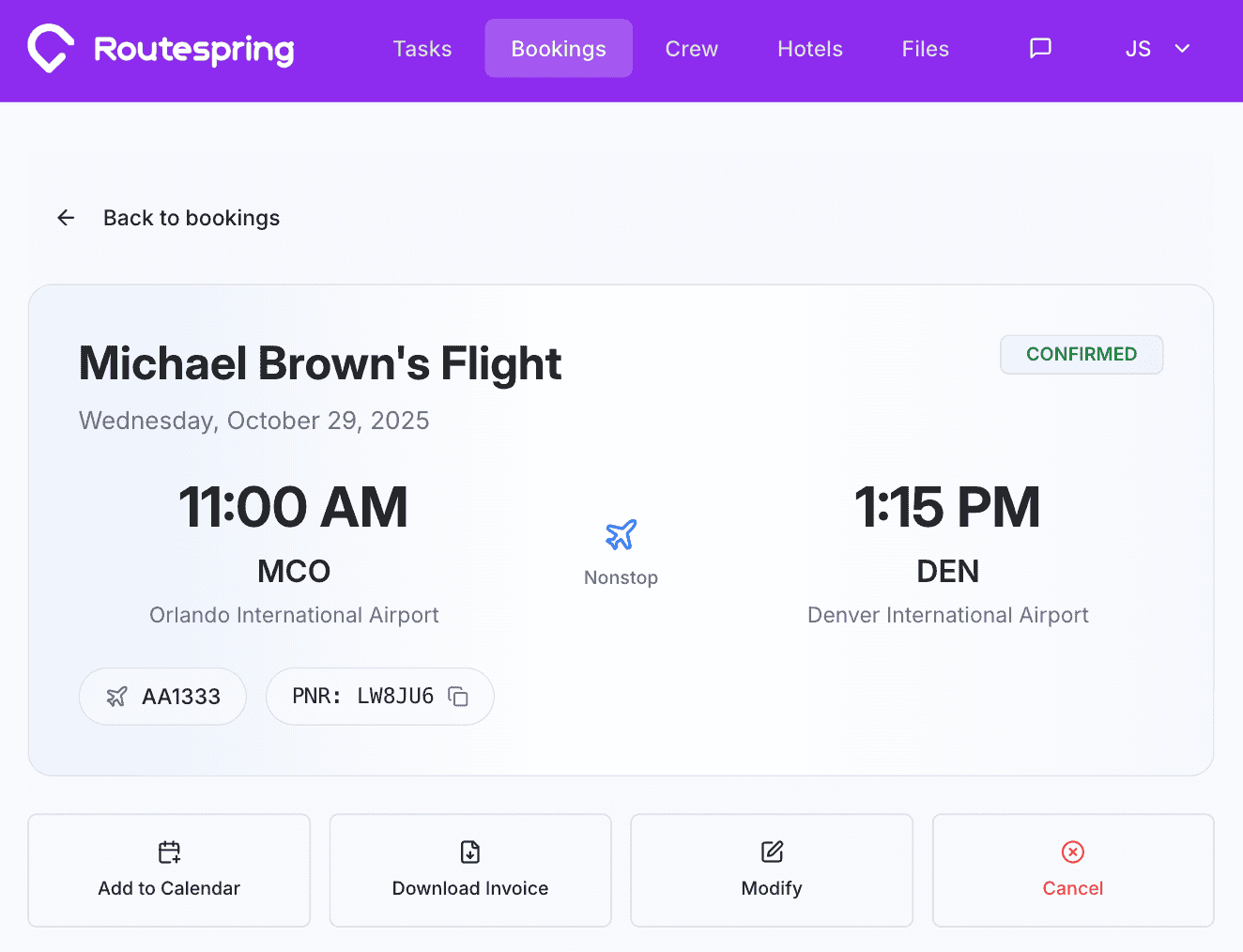
This is where Routespring seeks its place between broad corporate travel software and specialist crew travel services. Its pitch brings crew and corporate travel into one environment, with separate policies and approval flows. A buyer comparing it with Navan, SAP Concur or a crew agency should test that operational handoff directly: what changes when a schedule moves, and who sees the unresolved work?
Give the robot the hotel bill
The company’s ReconAI product takes on another uncelebrated job: obtaining the hotel’s itemized bill, or folio. Its named agents divide the labor. CompilerAI organizes outstanding records. VoiceAI and EmailAI follow up with hotels. ExpenseAI reads and categorizes charges. Contract checks flag items that should have been included in the agreed rate. A breakfast charge can become a discrepancy to review, rather than a line someone overlooks.
- 01RetrieveRequest the missing hotel folio.
- 02ReadItemize room, tax and extras.
- 03CheckCompare charges with the contract.
- 04ResolveRoute discrepancies for follow-up.
Routespring describes AI-assisted operations with an explicit human boundary. Agents can recommend rebookings, check policies and draft traveler messages; people review decisions and communications where required. This matters when reading the automation pitch. The work still depends on accurate booking context, available inventory and someone responsible for exceptions. A recommendation cannot create a hotel room that does not exist.
The procurement questions are equally practical. Routespring’s security page reports SOC 2 Type II audits and ISO/IEC 27001:2022 certification, with documentation available to qualified buyers. Crew schedules contain sensitive information about where people will travel and rest. For an airline, deciding which teams can access that information belongs in the same evaluation as booking speed. Convenient software still needs a carefully defined audience.
The price follows the operation
Routespring sells business software alongside operational services. Its current airline pricing is scoped by room nights, disruption coverage, hotel sourcing, integrations, payment arrangements, reconciliation and support. That makes the commercial conversation an exercise in defining responsibility. An airline buying routine lodging automation is buying a different workload from one requiring emergency sourcing and around-the-clock help.
There is a concrete funding marker behind the business: TEDCO announced a $500,000 investment in May 2023. At that time, the investor reported more than 30 customers and emphasized workforces whose travel could not simply stop, including nurses and airline pilots. The airline emphasis now visible on Routespring’s website fits that operational theme.


Start with one difficult handoff
The next step is visible in the Crew Travel API v1 documentation published July 25, 2026. It covers schedule-driven bookings, disruption actions, audit events and exports. The integration guidance asks teams to name their source systems, map identifiers and assign ownership of review and failure states before production. Those are substantial implementation tasks. Poor schedule data and unattended exception queues would undermine the promised coordination.
The company also lists accounting connections including QuickBooks, NetSuite and Zoho Books. The buyer’s task is to follow one actual transaction through that connection: its project code, approval, payment and eventual invoice. A list of integration logos tells you where a system can connect. Following the record tells you whether the connection removes work. That is a useful demonstration to request before expanding a pilot across departments.
For a reader, the transferable idea is modest enough to try. Choose one recurring trip or event. Establish the rules before booking, arrange company payment, and follow the resulting record into accounting. Measure the work left for people. For organizations moving crews repeatedly, that work may be considerable. For an occasional traveler with straightforward needs, an extensive operational setup may buy little. The sensible test begins at the handoff everyone currently has to chase.