white-label
(34)
Truepill and the art of disappearing
Truepill built the pharmacy behind other people’s health brands. Its expansion, retreat and second life inside Fuze Health reveal how much work hides behind a convenient prescription.

The Tow Truck Was Never the Whole Story
HONK began with a dead battery and an awkward question: why was summoning a car easier than rescuing one? Its answer became a roadside network that insurers could make their own.

MarketU wants you to own the editing room.
A $65 short-form edit is the easy part to understand. The more interesting business is helping customers move from buying finished videos to running the operation that makes them.
BetConstruct sells the machinery behind the bet
The Armenian-born technology supplier lets operators assemble a gambling business from software, games and services. Its next wager is that customers will buy more of the operation, from AI-assisted marketing to prediction markets.
The Goldman Quants Who Turned Tax Losses Into a Selling Point
Two ex-Goldman quants built software that automates the boring, expensive part of managing money - and got a $1.3 trillion asset manager to buy the whole thing.

The Chemical Engineer Who Roasted Her Way From a Kitchen in Rural Virginia to a National First
Candy Schibli left engineering and international development to build Southeastern Roastery - now the first Black-woman-owned certified organic coffee co-packer in the country. The method is part chemistry, part conservation.

The Saskatoon Company Quietly Selling Software to the People Who Sell Software
Vendasta doesn't sell to small businesses. It sells to the roughly 60,000 companies that already do - handing them a rebrandable marketplace, a CRM and, now, a payroll of AI employees to put their own logo on.
The Website Builder That Walked Away From Half Its Customers
Founders Itai Sadan and Amir Glatt stopped chasing do-it-yourself small businesses and bet the company on the professionals who build websites for a living. Fourteen million sites later, the decision reads as deliberate.

The Rails Under Your First Slice of SpaceX
Templum is the roughly 30-person infrastructure company quietly wiring private markets - the reason a SoFi member can now buy into OpenAI, Anthropic, or Stripe without a private banker.

The Warranty Company You’ve Probably Bought From Without Knowing It
Safe-Guard sits behind the dealership finance desk, turning flat tires, cracked glass and repair anxiety into a white-label business used by more than 12,000 dealers. Its real product is not a warranty - it is the machinery that makes dozens of protection programs feel like one brand’s own.

Zapnito
A personalized community & knowledge hub for every customer.
Pointerpro
Pointerpro is an all-in-one platform to create attractive online assessments and automatically deliver personalized advice reports in PDF or .ppt. Now with optional AI enhancement.

LearnWorlds
The Greek-Cypriot company betting that online courses should feel less like a video dump and more like a school - and giving 12,000 creators the tools to build one.

Hivebrite
The community platform built for impact - combining a flexible engagement engine, AI agents, and expert support to help organizations turn scattered members into active networks.

Gradual
Gradual is the seamless place to host events, educate and engage members, and grow your brand.
Disciple
The London company behind branded community apps for the Rolling Stones and hundreds of quieter passion groups wants creators to stop renting their audiences from Facebook.
Lenk
Lenk is a Latin American loan-origination platform that lets banks, financial entities, and fintechs digitize the entire credit lifecycle - from lead capture and onboarding to underwriting and disbursement. Its white-label, modular software automates commercial, consumer, mortgage, automotive, and leasing credit with configurable workflows and dozens of pre-built integrations to regional registries and bureaus. Founded in 2021 and backed by Y Combinator (W22), Lenk says it serves 20+ institutions across three countries, processing roughly 500,000 applications and $2B in transactions a year.
mx51
mx51 is a Sydney-based fintech that provides a bank-grade, cloud-native Payment-as-a-Service platform. Spun out of Assembly Payments in 2020, it gives banks, acquirers and payment providers white-label, multi-channel payment infrastructure - in-store terminal software, merchant and support dashboards, analytics and 150+ point-of-sale integrations - so they can serve merchants without building the technology themselves. Its customers include Commonwealth Bank and Westpac, and the platform has processed billions of dollars in transactions across the Asia-Pacific region.
Pomelo
Pomelo (Pomelo Group) is a London- and Singapore-based payments technology company that provides a unified, API-based Payment Platform-as-a-Service. It gives financial institutions, fintechs and enterprises ready-to-use payment rails, merchant onboarding and management, transaction monitoring, and a range of acceptance methods - from QR codes and tap-to-pay to payment links and card issuing - under a single white-label platform. Founded in 2017 as Pomelo Pay, the company has grown into a regulated e-money issuer serving 2,000+ businesses across the UK and Southeast Asia.

Ash
Ash (poweredbyash.com) is a New York-based health technology company that gives healthcare organizations a customizable, white-label platform for at-home diagnostic testing. Founded in 2019 as a direct-to-consumer sexual health testing service for the LGBTQ+ community, Ash pivoted to a B2B model that lets health plans, digital health companies and public health agencies launch branded testing programs across 100+ biomarkers in all 50 states. The company handles kit design, a vetted lab network, multilingual patient engagement, logistics and real-time reporting through one API, and has shipped more than 500,000 kits while helping organizations close care gaps and improve HEDIS and Star Ratings measures.
Avtal
Avtal is an Austin-based fintech that builds an AI-powered, white-labeled digital engagement platform for third-party debt collection agencies. Combining automated email and SMS outreach with a compliant, self-serve consumer payment portal, Avtal layers onto an agency's existing phone and mail operations to lift liquidation rates by 50%-75%. The company charges only a performance-based percentage of what it collects, and raised $24 million in Seed and Series A funding led by S3 Ventures in March 2026.

Fintiv
Fintiv is an Austin-based fintech infrastructure company that builds patented, white-label digital wallet ecosystems for telcos, banks and brands. Formerly known as Mozido, it pioneered the Trusted Services Manager (TSM) system for NFC tap-and-pay and says it has deployed wallet ecosystems across more than 35 countries. Today it positions its stack as a bridge from Web2 payments to Web3, adding digital-asset tokenization, real-time clearing and cross-border rails alongside its long-held mobile-wallet patent portfolio.

Medallion
Medallion is a New York-based music technology company that gives recording artists a white-label digital hub to build and monetize their own fan communities. Founded by former Songkick CEO Matt Jones and launched in 2022, the platform lets artists promote releases, tour dates and merch drops, sell digital collectibles and 'Digital Deluxe' albums, and offer exclusive access to their most devoted superfans - all under the artist's own branding rather than a third-party social feed. Backed by $22.7M in funding from investors including Dragonfly, Lightspeed Faction, The Chernin Group and Metallica's Black Squirrel Partners, Medallion powers communities for artists such as Jungle, Disclosure, Greta Van Fleet, Sigur Ros and My Morning Jacket.
Synup
Synup is a local marketing and digital presence platform that helps agencies and multi-location businesses manage listings, reviews, and social media from one place. Founded in 2013 and headquartered in New York, the company started as a way to keep business location data accurate across hundreds of directories, then expanded into reputation management, local SEO, and AI-driven review responses. In 2025 it launched Synup OS (Agency OS), an operating system that adds CRM, sales pipeline, invoicing, and client-lifecycle tools so agencies can run their whole business - not just their clients' local presence - in a single platform.

Clockout
Clockout is a fintech company that lets banks and credit unions offer earned wage access (EWA) directly inside their own mobile and online banking apps, so customers can tap a portion of their pay before payday without waiting on their employer. Founded in 2022 by childhood friends from Venezuela, Clockout started as a traditional EWA service for South Florida restaurant groups, then pivoted in 2024 to become the embedded infrastructure layer - often described as the 'Zelle for earned wage access.' The platform connects to more than 1,600 payroll systems and plugs into major core banking providers including Q2, Jack Henry, Alkami and Candescent, letting an institution launch EWA in roughly ten days. Clockout closed a $2 million seed round in June 2025.
Legal Karma
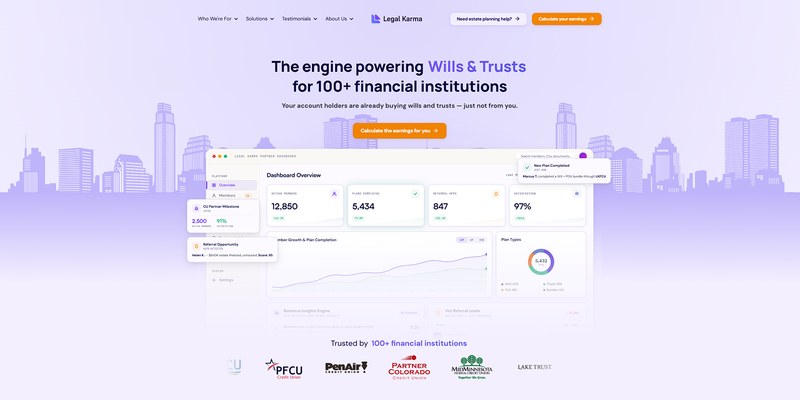
Legal Karma is an Austin-based B2B legaltech company that gives banks and credit unions a white-label engine for offering wills, trusts, and powers of attorney directly to their account holders. It handles the document automation, 50-state attorney-reviewed legal infrastructure, compliance, member support, and marketing so a financial institution can stand up a profitable estate planning department in about four weeks - while keeping 100% of the revenue and ownership of the customer relationship.

MAGIIS
MAGIIS is a white-label, AI-powered operating system for people-transportation providers - the chauffeur, limo, taxi, paratransit and non-emergency medical transport operators who move passengers for hire. Founded by serial entrepreneur Leonardo Gannio, the B2B SaaS platform bundles autonomous dispatching, omnichannel booking, fleet and driver management, integrated payments and an affiliate marketplace so small and mid-size fleets can run like ride-hailing giants without building the tech themselves. Headquartered in the Miami area with operations across Argentina, Colombia, Bolivia and Peru, MAGIIS charges a 5% pay-as-you-go fee for small fleets and annual subscriptions for larger ones.

Penelope
Penelope is a New York fintech that makes 401(k) retirement plans practical for the businesses that usually get ignored - the corner shop, the two-person startup, the solopreneur. Founded in 2021 by former Wall Street executive Jean Kim Smart and named after her daughter, the company started as a low-cost, self-service platform offering Pooled Employer Plans, traditional 401(k)s and Solo 401(k)s, and has since built a cloud-native, API-first, SECURE 2.0-ready recordkeeping platform that independent recordkeepers and benefit providers can run under their own brand. The pitch is unglamorous but real: automate the paperwork, cut the cost, and let roughly 60 million Americans who work for small employers start saving.

Uprise - Embedded Tax and Advisory
Uprise is a San Francisco fintech that embeds full-service tax filing and financial advisory into the SaaS platforms small business owners already use. Its model pairs AI-generated first drafts with review from Certified Financial Planners and tax professionals held to a fiduciary standard, letting partners like Rippling, Carry, Heard and HoneyBook launch white-labeled, premium tax-and-advisory services in weeks rather than years.

zavvie
zavvie is a Boulder, Colorado proptech and fintech company that gives real estate brokerages and mortgage lenders a white-labeled marketplace of modern buying and selling solutions - cash offers, buy-before-you-sell bridge products, and iBuyer options - all designed to keep the agent and loan officer at the center of the transaction. Founded in 2015 by Lane Hornung and Stefan Peterson, zavvie turns ordinary buyers into cash buyers and helps lenders capture more mortgage business through its AI-powered HomeFAI platform.