The name on the bottle is the least interesting name in this story. A patient orders medication from a familiar health brand. A package arrives. The branding agrees with the website; the experience feels reassuringly continuous. Somewhere behind it, a different company has done the dispensing. Truepill built a business around that disappearing act.
- Truepill sold pharmacy infrastructure to other healthcare businesses.
- Its customers could keep their own branding while borrowing the machinery behind it.
- Expansion brought cost reductions and serious compliance obligations.
- After the LetsGetChecked acquisition, the business entered a new chapter inside Fuze Health.
For anyone building a health service, this is a useful company to study. The attractive part of the proposition is obvious: launch a patient experience without constructing a pharmacy operation from scratch. The harder part is deciding which responsibilities can travel with the contract, and which still require someone at your company to pay attention.
One pharmacist, one unsolicited message
Umar Afridi knew the pharmacy from the inside. Sid Viswanathan wanted to learn the industry. In a 2021 interview with The Tech Tribune, Viswanathan described spotting Afridi’s LinkedIn profile, with its combination of pharmacist and entrepreneur, and sending him a message out of the blue. An introduction became a partnership. Truepill was co-founded in 2016.
Afridi brought experience of manual processes, old technology, stressed pharmacists and patients waiting for prescriptions. Viswanathan had worked at Johnson & Johnson and LinkedIn; his earlier company, CardMunch, had been acquired by LinkedIn. The pairing joined knowledge of the bottleneck with an appetite to build around it. LinkedIn, for once, produced something more useful than a congratulatory comment.
The founders were earning revenue before entering Y Combinator’s Summer 2017 batch. In an interview with The Business of Business, Viswanathan recalled an early concern with getting the operation working before making fundraising the main event.
“We really wanted to just get the mechanics of the business right”Sid Viswanathan, speaking in 2021

Those mechanics were the product. A health brand could attract patients and design its service. Truepill would provide pharmacy infrastructure behind the scenes. Forbes reported in 2019 that the company filled and delivered prescriptions for Nurx and Hims. That arrangement made a narrow, slightly unfashionable activity into something other businesses wanted to buy.
The brand stays. The machinery travels.
Consider the work between a prescription and a delivery. Patient information must reach the right operation. The prescription must be handled. Payment needs a route. Medication must be dispensed and packaged. The patient may need an update, a transfer or a conversation with a pharmacist. A handsome checkout page is a rather small participant in this procession.
interface02Prescription
intake03Dispensing
& routing04Delivery
& support
A conceptual workflow, not a promise that every program follows identical steps.
Truepill organized these services for business customers. Its 2020 funding announcement named GoodRx, TherapeuticsMD, K Health, hims & hers, Nurx and Simple Health. The list explains its market position better than a slogan: consumer brands and established healthcare companies could use the same underlying operational partner.
The current pharmacy offering, marketed as FuzeRx, preserves this approach. Partners can integrate through APIs or use a configurable Virtual Pharmacy storefront. The latter supports a branded interface, prescription onboarding, payment choices and order notifications. The former suits teams that want to build their own experience and connect it to fulfillment.
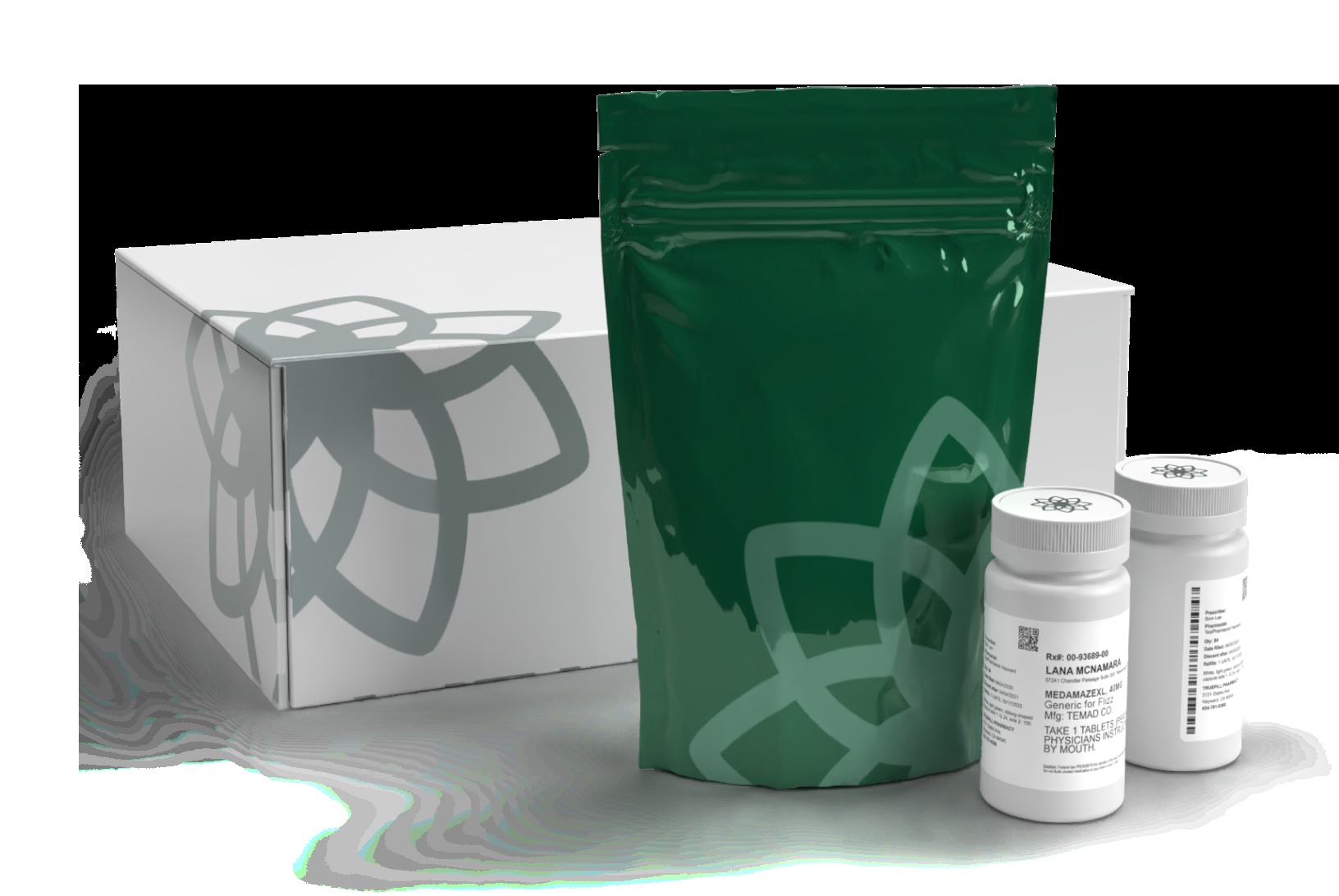
That is the business model in miniature. Truepill sold infrastructure and services to organizations that wanted to serve patients. Its commercial relationship was B2B, even when the parcel was delivered to a consumer. The current sales process asks buyers to discuss a configured program. Buyers should evaluate the dispensing, integration, support and delivery requirements together; a software budget alone would miss much of the work.
The pandemic enlarged the invitation
In July 2020, Truepill announced a $25 million Series B. In September, a $75 million Series C supported plans for an at-home lab testing network. Pharmacy was becoming one component of a broader proposition: connect the consultation, the test and the treatment.
The commercial logic was plausible. A patient might receive advice online but then be sent somewhere else for testing, somewhere else again for medication. Each transition meant another organization, another exchange of information and another opportunity for the patient to lose patience. Truepill wanted partners to assemble the pieces through one platform.
New capital at a $1.6 billion valuation. Both figures describe a historical financing, not today’s business.
The company’s October 2021 announcement put cumulative funding at $256 million. It also described an ambition to add hundreds of roles and open six pharmacy and over-the-counter fulfillment facilities. An infrastructure company was acquiring the appetite of a much larger healthcare operation.
There was a cultural clue in a company-published founder Q&A that September. Viswanathan admired businesses willing to make venture bets that changed their scope, even when their existing market was large. It is an appealing philosophy in an investor presentation. It also creates a demanding question for an operator: how many different systems can you improve at once?
The first visible retreat was operational
By 2022, the direction had changed. Sid Viswanathan became CEO in February. Later that year, Truepill reduced its workforce as it focused on its core pharmacy business and costs. Becker’s reported the company’s explanation that its fourth reduction affected approximately 20% of employees.
The public record supports a retreat in scope and spending. It does not establish one universal cause for everything that followed. For readers trying to copy the business, that distinction matters. A broader menu of services may make a sales pitch more attractive while making the operating company harder to manage. The narrower business still needs to work.
Then came a separate, more serious reckoning. In December 2022, the DEA issued an order to show cause over alleged unlawful dispensing of prescription stimulants. In November 2023, the agency said Truepill had accepted responsibility for operating an unregistered online pharmacy, exceeding Schedule II prescription supply limits and filling prescriptions from providers without required licenses.
The settlement required revised policies, pharmacist training and four years of heightened compliance measures. This was a concrete correction to how the pharmacy operated. For a prospective partner, it shows why prescriber checks and dispensing controls deserve the same scrutiny as delivery speed.
A different risk surfaced in the 2023 PostMeds data incident. The subsequent class-action settlement website describes a $7.5 million settlement concerning potentially compromised personal and health information. Its FAQ says the defendant denied wrongdoing and liability; the settlement itself was not a court determination of wrongdoing. Shared infrastructure can also concentrate the consequences of a failure.
The pieces reunite under another name
LetsGetChecked announced completion of its acquisition of Truepill on October 1, 2024. The buyer’s explanation centered on extending home testing into treatment and ongoing care. A diagnostic result could lead into the pharmacy capabilities of the acquired company.
Axios reported a $525 million headline deal value; the announcement of completion did not disclose financial terms. Acquisition value is not annual revenue, fresh venture funding or proof that the operating model has reached profitability.
On May 21, 2025, Fuze Health launched from the Truepill-LetsGetChecked combination. Alto had joined that week, adding local medication delivery and expertise in women’s health. By October 2026, Truepill’s website redirected to FuzeRx. The company that helped other brands present a continuous experience had become part of a larger collection of healthcare capabilities.
The current FuzeRx fulfillment site reports more than six million patients served and 25 million prescriptions shipped. These are the company’s cumulative claims under today’s offering, rather than independently audited totals for standalone Truepill. They indicate substantial activity without answering every question about the economics.
Copy the handoff discipline
A useful lesson lies in the architecture. Find a repeated operational problem that customers would rather buy than rebuild. Make it accessible through software. Give buyers a ready-made interface as well as the option to integrate. Let their brand carry the relationship, and make the underlying service dependable enough to deserve that trust.
The conditions matter. This arrangement suits organizations willing to coordinate with an external pharmacy and define responsibilities for patient data, prescribing, support and exceptions. It becomes awkward when a buyer needs full operational control, requires capabilities outside the agreed program or assumes every prescription belongs on an automated path.
Before signing, walk a difficult case through the system: a prescription needing clarification, an insurance problem, a delayed shipment, a patient wanting a transfer. Establish who responds, who decides and who tells the patient. The original promise was convenience. Its most useful test is what happens when convenience runs out.