Here is a small, annoying fact about American healthcare: the moment a lab test tells you something true, the system tends to hand you the finding and walk away. You get a number, a positive, a negative - and then you are on your own to find a clinician, book a visit, argue about a prescription, and hope the whole chain doesn't drop you somewhere in the middle. A test result, in other words, is often just anxiety with a timestamp.
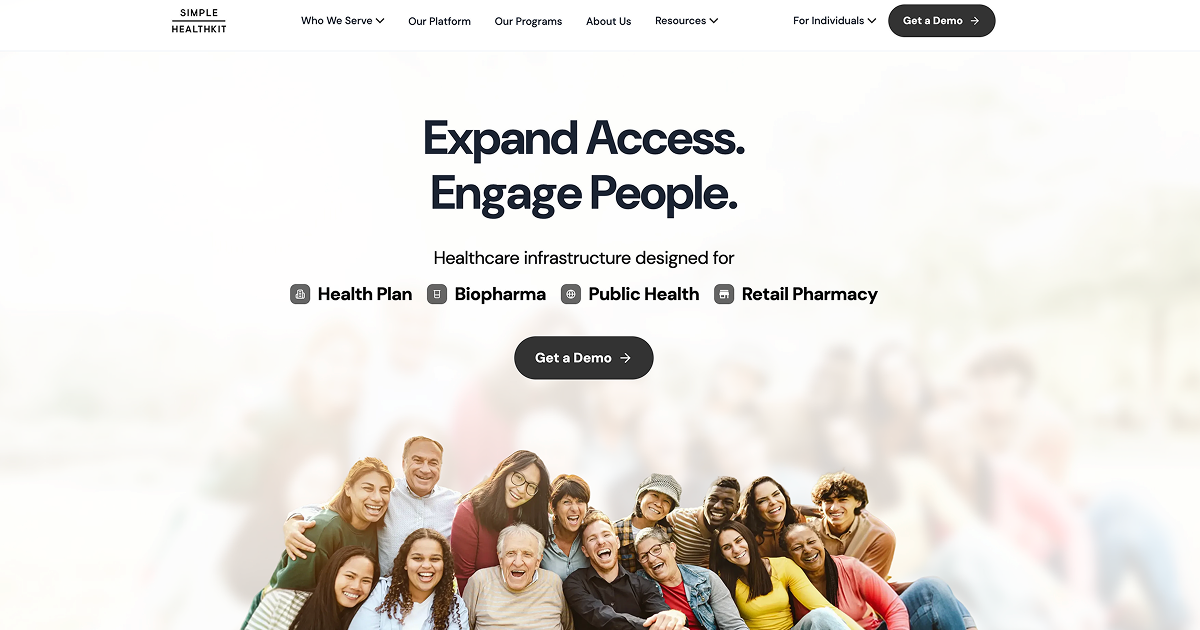
Simple HealthKit is a company built around the conviction that this is a design problem, not a law of nature. Founded in 2018 and headquartered in Milpitas, California, it sells what it calls end-to-end healthcare infrastructure - a way to run a patient from screening to lab to telehealth visit to treatment without the usual four handoffs to four different vendors. The pitch is less exciting than a moonshot and more useful than most of them: connect the parts that already exist.
The founder, Sheena Menezes, has a PhD in biochemistry and bioengineering, which is a credential that usually keeps a person at a lab bench rather than in a boardroom. She left the bench. Her diagnosis of the industry is blunt and, if you have ever navigated a test result, familiar. "When organizations build testing, labs, telehealth and prescriptions," she has said, "it is often built in silos." Simple HealthKit is her attempt to knock down the walls between those silos and charge for the hallway.
What the company actually sells
The product is a stack. At one end are diagnostic tests you can take at home, in a clinic, or at a pharmacy - for sexual and women's health, for respiratory illness, for chronic conditions like diabetes. In the middle sits a CLIA-certified, CAP-accredited laboratory that the company runs itself, promising results in roughly 24 hours. At the far end are telehealth visits and prescriptions that connect directly back to whatever the test found. There is also an API, so a retailer or a health plan can bolt the whole thing into its own workflow rather than sending patients elsewhere.
Owning the lab is the part worth pausing on. Plenty of testing startups rent their lab capacity, which makes them faster to launch and slower to control. By running its own CLIA lab, Simple HealthKit buys itself turnaround time and a tighter grip on quality - the unglamorous infrastructure that competitors often lease and later regret leasing.
Who it's really for
It would be easy to file Simple HealthKit under direct-to-consumer wellness, but that undersells the business. The company sells mostly to organizations - health plans, large retailers and pharmacies, employers, schools including HBCUs, and public health agencies. Those buyers care about things with acronyms: HEDIS quality scores, gaps in care, member engagement. Simple HealthKit's programs, the company says, reach communities of more than 1.5 million people. That is the number it leads with, which tells you something about how it keeps score.
The health-equity framing is not a foundation tacked onto a for-profit. It is closer to the go-to-market itself. The conditions the company chose - sexual health, respiratory illness, chronic disease - are common, stigmatized, or both, and they fall hardest on people the system already tends to miss. Building a business on the underserved is a harder sell to some investors than building one on the worried well. Simple HealthKit made the harder sell.
The money, briefly
In February 2023, the company announced an $8 million Series A led by Initialized Capital, with participation from Kleiner Perkins, Kapor Capital, and Quest Venture Partners - bringing total funding to roughly $12 million. The cap table carries some weight: Garry Tan of Initialized (also president of Y Combinator) and Kleiner's Mamoon Hamid. For a diagnostics company that owns its own lab, $12 million is a lean number, which suggests the operation is being run with more discipline than the category's flashier names.
The timing was its own kind of product decision. The company's respiratory panel - COVID-19, flu, and RSV in one - reads like a direct response to the "tripledemic" winter when all three arrived at once. A crisis for the public was, for Simple HealthKit, a clarifying use case.
What comes next
More recently, Simple HealthKit teamed up with Doctronic to bring AI into at-home testing. Notably, it didn't rebuild the company around a chatbot; it layered intelligence onto working rails. That sequencing - infrastructure first, then the smart layer - is the kind of restraint that is easy to describe and hard to practice.
None of this guarantees anything. Connected-care is a crowded field, reimbursement is a maze, and "end-to-end" is one of the most over-promised phrases in health tech. But the underlying bet is legible and, for once, modest: that the pieces of healthcare should be connected, that a test result should lead somewhere, and that the somewhere should be reachable by the people who usually get left at the finding. It is not a revolution. It is plumbing. Sometimes plumbing is what's missing.