A software deal can be won and still be stuck. The buyer likes the product. The seller likes the buyer. Then come the vendor forms, the contract, the budget question. Tackle.io has built a business in this awkward interval, helping software companies sell through the cloud providers their customers already use.
- Find buyers likely to purchase through a cloud marketplace.
- Connect sellers, cloud partners, and negotiated offers inside Salesforce.
- Run the channel with software, coaching, and operational support.
01 The budget was there. The route was missing.
Cloud marketplaces offer an appealing possibility: purchase third-party software through an existing cloud relationship. Eligible spending can count toward a customer’s cloud commitment, subject to the provider’s rules. Procurement gets a familiar route. The software vendor gets a way into an existing budget. Tackle organizes the seller’s side of that transaction across AWS, Microsoft, and Google Cloud.
Think of the marketplace as a railway station. Building a station does not tell every passenger which train to catch. Somebody must connect the listing, pricing, partner conversation, order, and payment record. Tackle’s territory is that connection. Its customers are software vendors; the people using it include sales representatives, alliance managers, revenue operations teams, and finance staff.
02 A listing was only the beginning
Dillon Woods and Brian Denker founded Tackle in 2016. The first idea was practical: replace the custom engineering needed to connect software to cloud marketplaces. Tackle’s early description was “middleware for Marketplace.” When it took the product to market in 2018, New Relic became its first lighthouse customer.

In a public interview, CEO John Jahnke recalled New Relic’s frustration with its existing marketplace work and an immediate purchase order. The early team then repeated the pattern with more customers. That is an unusually useful startup test: find a tedious job that several companies are already trying to finish.
Customer feedback widened the assignment. Getting listed created demand for private offers, reporting, usage metering, and support across additional clouds. Tackle followed those requests into the daily operation of the channel. The insight was modest, and commercially important: the integration was the entrance. Running the business would require more tools.
03 Three clouds. One working day.
Tackle Prospect scores accounts by their likelihood of buying through particular marketplaces. Its model considers factors including purchasing history and cloud investment. A seller can upload company domains or score opportunities in Salesforce, then choose where to concentrate attention. A propensity score helps prioritize a conversation; it does not guarantee a purchase.
Co-Sell handles the partner handoff: registering opportunities, synchronizing updates, and keeping Salesforce connected to cloud partner portals. Offers handle negotiated pricing and commercial terms. Marketplace connections support listings and metering. Reporting lets operations teams reconcile what was booked and disbursed. Strategic Services adds coaching and managed operations for teams that need help doing the work.
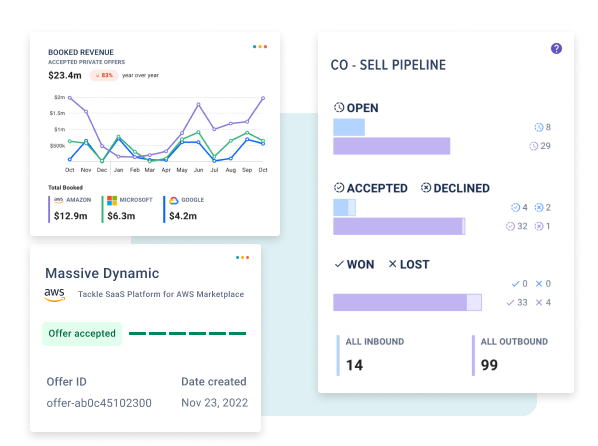
The Salesforce integration matters because salespeople already have somewhere to work. Putting marketplace tasks there reduces the need to learn another portal. Alternatives including Clazar and Suger also automate cloud selling. Tackle’s case rests on its combination of buyer intelligence, transaction experience, embedded workflows, and services. Listing automation alone is a crowded proposition.
04 The program that barely moved
The Bugcrowd customer account shows why software alone is insufficient. Its cloud program had stalled: the technical review was unfinished, operational support was limited, and sellers lacked conviction. Jacques Lopez, its alliances leader, worked with Tackle on objectives, training, and AWS qualification. “We built a plan of action,” he said.
“We built a plan of action.”Jacques Lopez / Bugcrowd
Bugcrowd also kept resellers involved through partner private offers and used performance data to make the internal investment case. Tackle reports AWS Marketplace revenue moving from $34,500 to $1.126 million in one year. The transferable lesson is the sequence: establish ownership, finish the prerequisites, train sellers, and show the numbers. The result belongs to this customer, under those conditions.
Vendor-published case study. Bars share a zero baseline.
05 The price of a new route
Tackle sells subscriptions; enterprise pricing is quoted on request. A published Accelerate² package advertises $10,000 a year with a minimum two-year commitment for qualifying customers. That means at least $20,000 in subscription commitments under that offer. It is a specific program price, rather than a price tag for every deployment.
The operating bill also includes internal effort. Somebody must own the cloud relationship, align finance and legal, and teach sellers when to use the channel. As a practical inference, a vendor with few marketplace-ready buyers or little eligible budget may struggle to justify that investment. Automating the checkout does not create product demand.
Investors financed Tackle’s expansion: a $7.25 million Series A in 2020, a $35 million Series B in March 2021, and a $100 million Series C that December. The last round valued it at $1.25 billion. That was a financing valuation in 2021, not the price of its eventual acquisition.
06 A wider map after AppDirect
AppDirect announced the acquisition agreement on December 1, 2025; Tackle confirms it was acquired that month. The strategic argument was distribution. Tackle brought hyperscaler marketplace connections. AppDirect brought storefronts and an ecosystem that included more than 14,000 technology advisors. Together, they proposed more routes for vendors to reach buyers.

Its 2026 release notes show the continuing detail work: Microsoft offers in additional currencies, AWS billing adjustments and cancellations, and custom payment terms. February’s Revenue Insights update brought cloud sales performance into Salesforce. These are useful clues to the company’s role. Once software has a buyer, somebody still has to make the purchase work.