It is Tuesday, 7:58 a.m., and a sales manager opens her laptop to a brief she did not write. Last night's calls are summarized. Three deals have moved. One has gone suspiciously quiet, and a note flags it in orange. Nobody on her team typed a word of this. The work was done by Oliv - a company whose entire product is a team of colleagues that happen to be software.
Oliv AI sells a simple, slightly uncomfortable idea: most of what sales reps do all day is not selling. It is updating the CRM, prepping for meetings, chasing notes, building forecasts, and reconstructing what was actually said on a call three weeks ago. The data that results is, to put it kindly, optimistic. Pipelines look healthier on Friday than they turn out to be on Monday.
So Oliv built agents to do that work instead. They capture what the company calls Deal Intelligence from every meeting, call, and email - without asking a rep to lift a finger. The agents read the room and then write it down: who was on the call, what they committed to, what the next step is, and whether the deal is genuinely progressing or merely being polite.
The bet underneath all of it is that a CRM should reflect reality rather than wishful thinking, and that the fastest way to get there is to remove the human from the data-entry loop entirely. Reps are wonderful at building trust and terrible at logging it. Oliv leaves the first job to people and quietly takes the second.
It is a SalesTech company headquartered in San Francisco, with roughly 53 people and a founder who lists his title, without apparent irony, as Chief Mad Scientist and Reluctant CEO. That tells you most of what you need to know about the house style: engineering-first, allergic to ceremony, and happy to let the software do the talking.
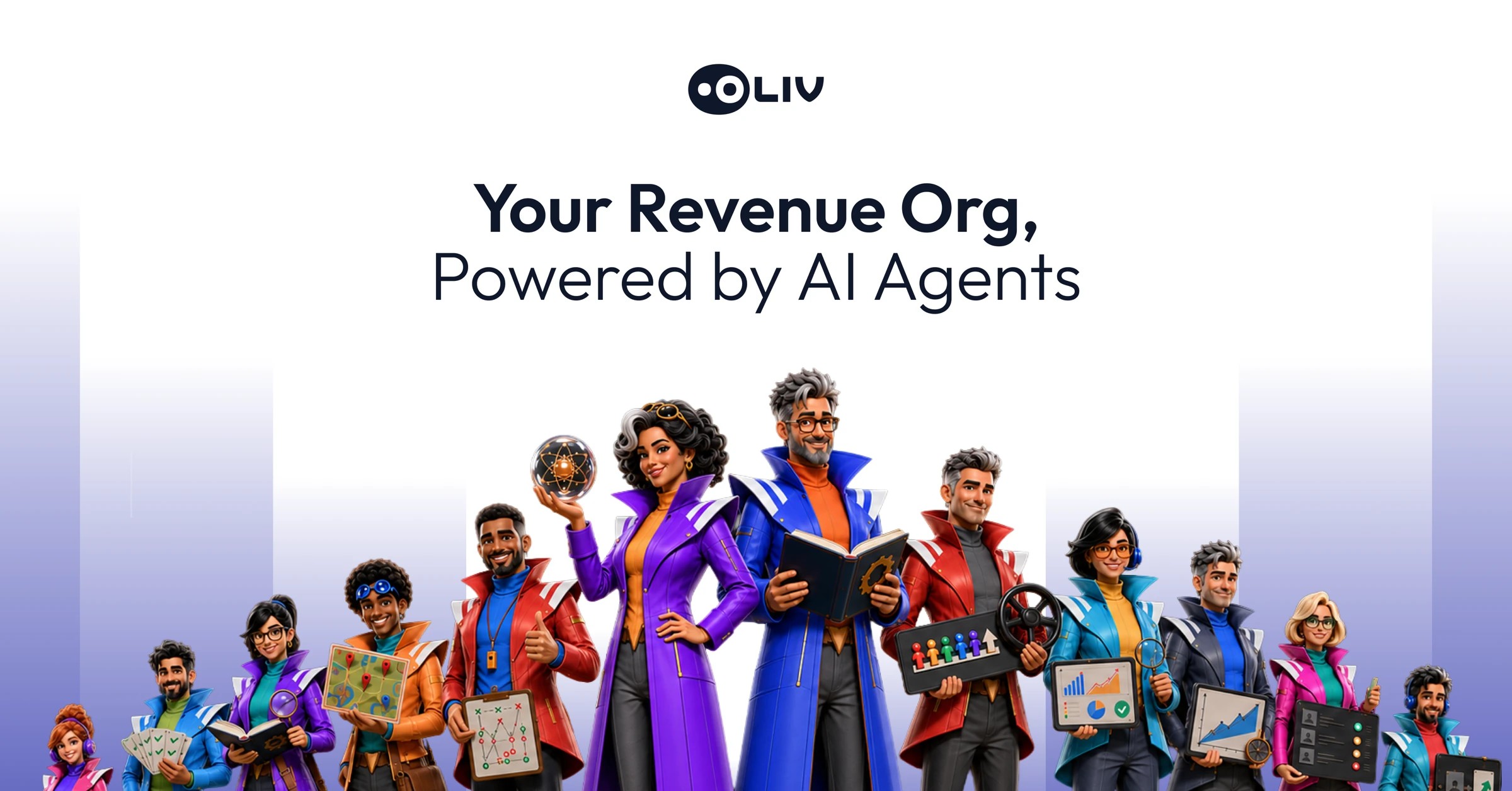
Most AI tools give you one assistant and a chat box. Oliv gives you an org chart. Two “Super Agents” coordinate, and a suite of specialists do the work - each mapped to a real revenue role.
The Chief AI Staff. Dispatches tasks across the organization so the right agent picks up the right job at the right moment.
The Chief GTM Engineer. Encodes your company's processes and methodology into rules the other agents follow.
Tracks deal progress and surfaces unbiased insight, presenting each opportunity as a scorecard built on MEDDICC, BANT, or SPICED.
Keeps Salesforce and HubSpot accurate automatically - no more Friday-afternoon data hygiene sprints.
Pulls context from the web, LinkedIn, Crunchbase, and even SEC filings to qualify and brief before anyone dials.
Builds forecasts grounded in real signals and coaches reps after the call, with a Meeting Assistant taking notes throughout.
The plumbing has a name: the GTM Context Graph. It stitches together an Object Graph (the accounts, contacts, and deals), a Signal Graph (what is happening to them), and a Process Graph (how your company actually sells). Context flows in from email, calendar, meetings, chat, and the CRM.
Rather than route every question through one enormous model, Oliv runs more than 100 small language models, each fine-tuned for a specific revenue question. It is a fleet of specialists instead of a single generalist - which is, fittingly, the same philosophy behind its agents.
The practical payoff arrives in unglamorous places. A morning brief that highlights the meetings that matter. Meeting prep assembled while you sleep. Notes that write themselves. Salesforce updated before you remember it exists. Deals scored the moment a demo ends. The grunt work, handled - so the selling can stay human.
That is the line Oliv keeps drawing: agents that own a responsibility from start to finish, not bots that wait to be prompted. The difference sounds like marketing until the CRM is right on a Monday for the first time in living memory.
Oliv raised a $5.2M seed round announced in early 2023, led by Foundation Capital with Spider Capital alongside. The figures below visualize the round's reported composition.
Bars are illustrative of round structure, not exact dollar splits. Source: Crunchbase, Dealroom, Wellfound.
Oliv's agents are pointed at sales managers, account executives, and RevOps - the people most buried under the admin of selling. A sample of named customers:
Ishan Chhabra leads Oliv as co-founder and CEO, though he prefers the label Chief Mad Scientist and Reluctant CEO. An engineer by training who started in machine learning, he came at the sales problem the way an ML person would: as a data quality problem dressed up as a people problem.
His diagnosis is consistent and slightly contrarian - deal data is unreliable not because reps are careless, but because the system asks humans to be diligent clerks on top of being persuasive sellers. Remove the clerical demand, capture the truth automatically, and the forecast stops being fiction.
The company he is building reflects that worldview. It does not try to make reps better at admin. It tries to make admin disappear.
Revenue intelligence is busy real estate - Gong, Clari, Outreach, People.ai, and Salesforce's own Einstein and Agentforce all live nearby. Oliv's wager is positioning: not a single copilot bolted onto the CRM, but a team of agents that own roles outright. Whether buyers want colleagues or tools is the question the whole category is now asking.
Profile compiled from public sources. Figures and dates are approximate where noted.