Here is a fact about enterprise software that is both obvious and, somehow, worth billions of dollars: salespeople do not want to update the CRM. They will happily do the actual selling - the calls, the demos, the negotiating, the closing. What they will not reliably do is go back into Salesforce afterward and type the outcome into the correct field. This is not laziness, exactly. It is that the reward for a rep is the deal, and the reward for a clean CRM record accrues to somebody else - the manager, the forecast, the board deck. So the record rots.
Scratchpad is a company built on the theory that you should stop trying to fix this with willpower. Founded in 2019 in San Francisco by Pouyan Salehi and Cyrus Karbassiyoon, it started as a modest Google Chrome plugin - a faster, friendlier surface for taking sales notes and pushing them into Salesforce without the multi-click misery of the native interface. The bet was small and specific: if you make the chore twenty seconds instead of two minutes, more of it gets done.
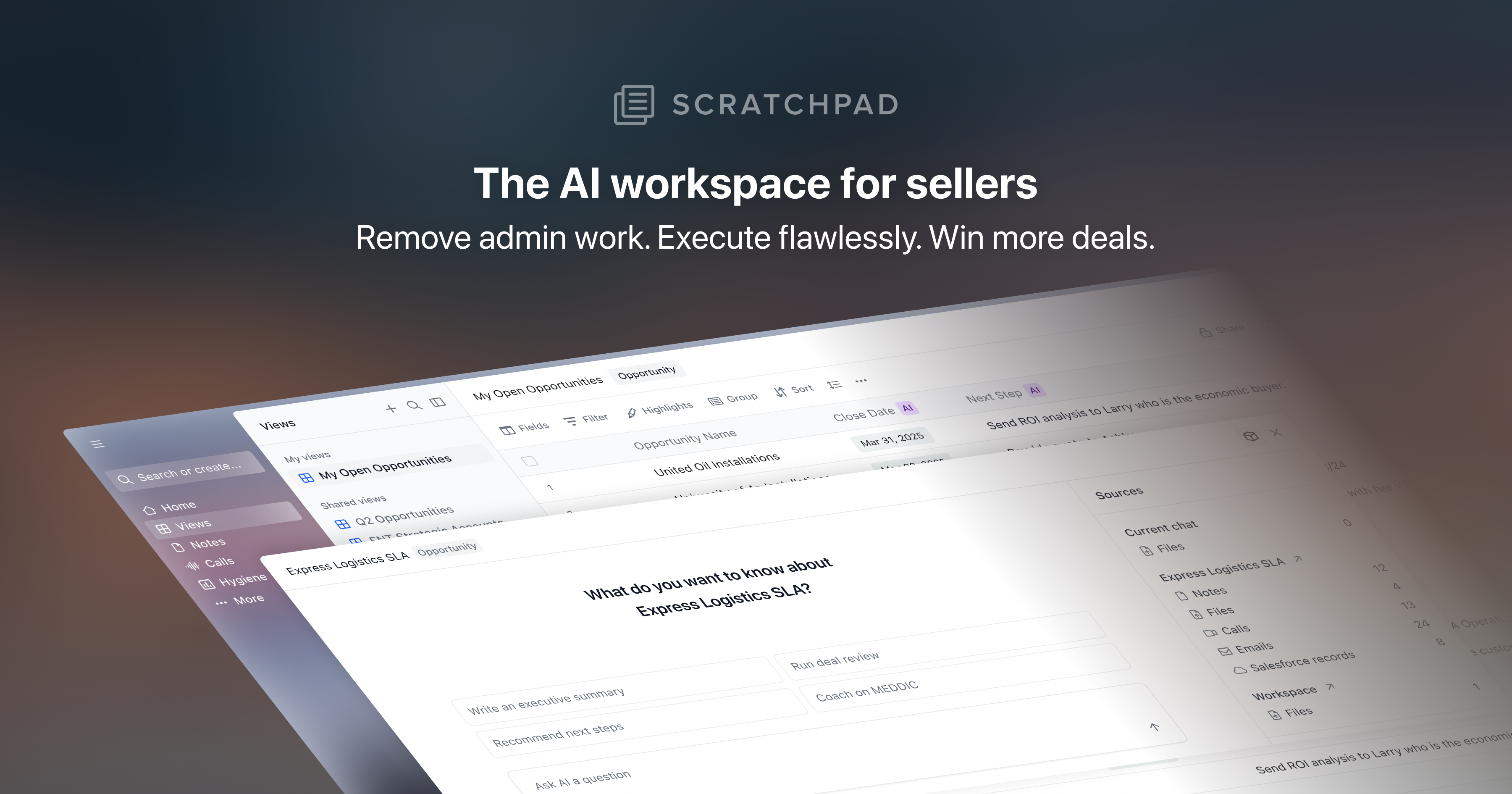
That is a reasonable bet, and it worked well enough to raise money. But the more interesting move came later, when Scratchpad stopped asking reps to do the chore faster and started removing the chore entirely. The current product describes itself, cheerfully and without much hedging, as "the AI workspace for sales." Its agents listen to calls, read emails, ingest notes, and then propose - or simply apply - the structured Salesforce updates that a rep used to type by hand. The philosophy underneath is worth stating plainly, because most sales software dresses it up: sellers should sell, and the software should handle the paperwork.
Remove admin work. Execute flawlessly. Win more deals.
Why keep Salesforce at all?
The tempting version of this company is the one that tries to replace Salesforce. Scratchpad conspicuously does not do that, and the restraint is the strategy. Salesforce remains the system of record - the thing legal, finance, and the CRO trust. Scratchpad positions itself as the layer on top: the place reps actually want to work, backed by the database everyone else insists on. This is a shrewd place to stand. Replacing a company's CRM is a knife fight that takes years and usually ends badly. Making the CRM bearable is a much easier sale, and it puts you inside the daily workflow of every seller without asking anyone to rip anything out.
It also means Scratchpad's value grows in a direction Salesforce structurally struggles with. Salesforce is a database that wants to be filled in. Scratchpad is a workspace that assumes nobody wants to fill it in, and treats that reluctance as the core engineering problem. Those are different companies pointed at the same table.
The founders have done this before
One reason to take the company seriously is that Salehi and Karbassiyoon are not first-timers wandering into sales tooling. Salehi left Apple in 2010 to co-found StackMob, a mobile startup later acquired by PayPal. He started Lera Labs, and then, in 2014, teamed up with Karbassiyoon to build PersistIQ, a sales-engagement tool. By the time they started Scratchpad in 2019, they had spent most of a decade circling the same question from different angles: why is it so hard to get salespeople and their tools to cooperate? Scratchpad is the most direct answer they have shipped.
That history shows up in the investor list, too. Craft Ventures led the seed, then the Series A, then the Series B. When one firm keeps leading consecutive rounds, it usually means one of two things - either they are protecting an earlier check, or they genuinely believe the wedge widens. In Scratchpad's case the rounds got bigger each time, which is the tell you want.
What you can actually do with it
Stripped of the marketing, the product does a handful of concrete things. It gives reps a spreadsheet-like workspace over Salesforce - grid views, bulk edits, notes, a command bar, Slack integration - so a whole book of deals can be updated in one place instead of clicking through records one at a time. It records and transcribes calls, with a meeting bot and Zoom integration, and turns that transcript into structured context. Its AI agents take that context and populate Salesforce fields, so the "did you update the opportunity?" conversation stops happening. And it enforces methodology - MEDDPICC, SPICED - not by nagging reps in a quarterly review, but by checking whether the required qualification data actually exists.
That last part is quietly the most valuable, because it is aimed at a different buyer. A rep wants the admin to disappear. A sales leader wants to trust the pipeline. Scratchpad's hygiene monitoring is the feature for the second person: it surfaces missing fields, stale opportunities, and at-risk deals in real time, so the number in the forecast is one the CRO can defend. It is a boring feature that prevents an expensive surprise, which is roughly the definition of good enterprise software.
The AI workspace for sales.
Clearskies, and the bet on context
The newest layer is called Clearskies, and it hints at where the company thinks the moat is going. Rather than another feature bolted onto the workspace, Clearskies is described as a context layer: it connects the CRM, call transcripts, email, calendar, and Slack into one place, then uses that to generate pre-call briefs, detect pipeline risk across channels, run win-loss analysis from actual conversations, and surface coaching moments with timestamps. The underlying wager is that in a world where every sales tool has AI, the differentiator is not the model - it is the context you can feed it. The product that already knows what happened on the last three calls wins the fourth.
The shape of the company
Scratchpad is not a large organization, and that is part of the story rather than a footnote to it. Public estimates put headcount around 47, and the company operates remote-first, which is a reasonable configuration for a product whose customers live inside a browser tab. Third-party trackers peg annual revenue somewhere in the low millions, which you should read with the usual skepticism attached to any private-company estimate. The more reliable signal is the funding cadence and the customer roster, both of which suggest a company that has found a real problem and is choosing to widen it deliberately rather than sprint at a valuation.
There is a temptation, with a company this size sitting on nearly $50M of capital, to assume the interesting decisions are all about growth. They are probably about focus. Every RevOps tool faces the same gravitational pull: a rep-facing note-taker wants to become a forecasting platform, a forecasting platform wants to become a data warehouse, and eventually everyone is building the same overstuffed suite. Scratchpad's discipline so far has been to keep pointing at the same table - the daily friction between a seller and their CRM - and to add intelligence to that friction rather than sprawl away from it. Clearskies is the test of whether that discipline holds as AI makes it tempting to promise everything.
The competitive weather
Scratchpad does not have the field to itself. Gong and Clari loom large in adjacent lanes - call intelligence and forecasting respectively - and Salesloft and Outreach sit in engagement. Salesforce itself keeps building native automation. Scratchpad's answer is positioning: it is the seller-facing workspace that makes the CRM pleasant, rather than a system of record, a dialer, or a forecasting engine bolted on from outside. Whether "the nicest place for a rep to work" is a durable category or a feature others absorb is the open question, and it is the one the next few years will answer.
For now, the customer list does the arguing. Brex, Vercel, Clio, Crunchbase, Cognism, Dialpad, MaintainX, Settle - modern software companies with modern sales teams have signed up, and earlier names like Twilio, Segment, Ironclad, and Quora appear in the company's history. Scratchpad has reported that its users made more than two million Salesforce updates through the product in a single year. That is a lot of paperwork that a human did not have to think about, which was, from the very first Chrome plugin, the entire idea.
The elegant thing about Scratchpad is that it never argued with human nature. It did not build a better guilt trip for lazy reps. It looked at a refusal that every sales organization on earth quietly accepts as a cost of doing business, and it built a company in the gap between what managers ask for and what people actually do. That gap is not going away. Neither, probably, is the market for closing it.