A delivery has two reassuring moments: somebody sends it, and somebody receives it. The middle is where Sunghoon (Ben) Bae found his business. Working in fresh-food distribution, he encountered goods whose journey was harder to establish than their destination. The paperwork could arrive with the cargo. A convincing account of what had happened along the way was another matter. For a distributor, that gap sits uncomfortably close to the money.
Bae had operated Seohyun, a fresh-food distribution company. Being in the field exposed him to blind spots in the movement of goods. He began working on condition monitoring, eventually co-founding Willog with Jihyun Yoon, known in English as Daniel Yun. The company was incorporated in May 2021. Its early product, OTQ, made a shipment’s recorded conditions accessible through a QR code. The box, in effect, acquired something to say for itself.
That is a useful place to begin understanding Bae: with a working problem that became a technical one. His career did not require a sudden discovery that logistics existed. He already knew the business of moving goods. He wanted clearer information about the process, including the awkward intervals that a tidy dispatch record can leave out. A parcel seldom offers an eyewitness account. Bae set about equipping it with a record.
A piece of paper on a locker
Before the sensors, there was a sheet of paper. During military service, Bae densely wrote down thoughts about business ideas and human needs, keeping the page on his locker. He was looking for a business he could pursue over the long term. The detail is pleasingly ordinary. No theatrical garage is required. A locker and a question provided enough space to begin.
After his discharge, distribution gave that question a concrete setting. He saw information asymmetries and opaque practices, including misrepresented histories. The attraction of transparency became a reason to build. There is a distance between wishing a market worked better and deciding to spend your days on the machinery that might improve it. Bae crossed that distance through the work itself.
He later graduated from the first cohort of Hanyang University’s Entrepreneurship Convergence department. By April 2026, when he discussed his entrepreneurial beginnings, he was describing an IoT and AI business concerned with practical financial losses. The subject had become more technical. The purpose remained recognizable: make an inconvenient part of ordinary commerce easier to understand and act upon.
“You need a clear reason for starting a business.”
Sunghoon Bae, April 2026 interview · translated from Korean
His advice to would-be founders follows that progression. Establish why the work deserves doing and what the business is fundamentally about. That advice gives the locker sheet its significance. The page was an early attempt to choose a problem worth staying with. The company is a much more elaborate way of continuing the attempt.
Five centimetres of accountability
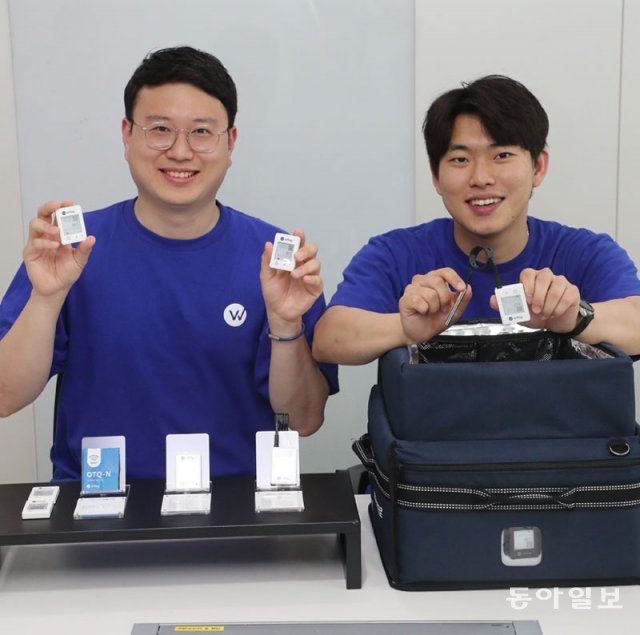
In 2021, Willog presented OTQ as a device about five centimetres across. It recorded conditions including temperature, humidity, shock, light and location. A phone scan connected those records to software. Bae and Yun described the aim as transparency through the logistics journey, with the Willog name eventually carrying an association with trust. A small instrument was being asked to support a fairly large promise.
The appeal of the design lay in bringing information closer to the goods. Different customers cared about different measurements. Some needed temperature and humidity; others were primarily concerned with shock. Willog described beginning with consultation and adapting its solution to a customer’s logistics environment. A useful record has to answer the question the customer actually faces. An extra column of numbers can be very impressive while remaining entirely unhelpful.
The QR interaction supplied another practical choice. Familiarity matters when a product reaches people who must fit it into an existing job. A scan gives the recorded journey a way into someone’s working day. The chain therefore includes hardware, a person retrieving information, and software that makes it usable. Each has to do its part. A sensor cannot persuade a warehouse team to enjoy an unnecessary task.
The logistics black-box comparison followed naturally: preserve a record that can help explain the journey. It also describes the limits of an arrival notification. Knowing that an item has reached its address does not tell you whether it was dropped or exposed to unsuitable conditions. Bae’s business concentrates on those questions between the endpoints. They are less cheerful than a delivery confirmation, and often more useful.
Two signatures, a shared ambition
Bae and Yun met through a gathering of entrepreneurs. Their connection included a wish to help young people through a foundation or school. Bae linked his interest to financial difficulty in his childhood. The company’s commercial project thus sits beside an ambition that extends beyond cargo. It is an ambition he has expressed, rather than an institution already completed.
The founders also made trust an operating choice. In 2022, they explained that each could make decisions independently. Bae handled technology and the domestic market; Yun handled sales, operations, marketing and overseas work. Their explanation was speed supported by mutual confidence. The arrangement gives each founder room to act, a useful quality in a business asking customers to change how they work.
There is a quiet connection between that structure and their product. Both concern what allows another party to proceed with confidence. A logistics customer wants information that remains useful across a handover. A co-founder wants a colleague who can take responsibility for the next decision. The mechanisms differ, but dependable relationships are part of the job in both cases.
The argument inside the invoice
Bae has argued that cold-chain management deserves to be treated as an investment. Buying equipment alone does not finish the job. The solution must help a company detect an issue, respond, and reduce the chance of encountering it again. Returns, discarded goods and disrupted stock have costs of their own. An inexpensive monitoring arrangement can look rather different after an expensive failure.
This is where his distribution background becomes useful to the sales argument. The point of collecting data is to improve an operation. A shipment record should lead somewhere: a decision about a handling process, a closer look at a route, or a clearer discussion of responsibility. The dashboard is an intermediate stop. The customer still needs to do something with what it shows.
That line of thought also explains the move from monitoring into intelligence. Sensors gather observations; analysis can help turn those observations into decisions. The distinction matters in Bae’s business because the buyer is managing real goods, staff and losses. A beautifully organized account of yesterday’s damage has value. The ability to avoid another occurrence gives the work a further purpose.
- 01RecordDevices capture cargo conditions.
- 02RespondMonitoring supports action.
- 03EstablishData supplies evidence.
- 04CompensateInsurance joins the process.
The question travels
Willog’s ambitions extended overseas early. In October 2021, the company’s history records the establishment of a US branch. By 2025 it had established subsidiaries in Singapore and Japan. Its current office list spans Seoul, Torrance, Singapore and Tokyo. The geographical spread makes the original problem more demanding: a useful cargo record must survive changes of organization, transport and language.
Growth supplied a new scale for that work. In May 2026, Willog announced Series B-2 investment backed by seven investors, including KB Investment, IBK Capital, Muirwoods Ventures and Big Basin Capital. The company reported more than 200 enterprise customers and five consecutive years of zero customer churn. Those are company-reported figures. They describe adoption of the business Bae co-leads, rather than a measurement of his personal fortune.
May 2026 investment announcement
The announced use of funding included predictive AI. The idea is to combine condition data with operational context, supporting earlier responses and broader supply-chain decisions. For Bae, that extends the usefulness of the record. The more consequential question becomes what a logistics team can reasonably anticipate, and how it can act before an exception becomes another invoice to argue over.
Four desks, one set of facts
September 2026 brought a more explicit expression of the idea. Willog launched Vision, connecting recording, response, evidence and compensation. Its structure brings together devices, Control Tower software, intelligence and insurance. Bae described the existing fragmentation of these functions as a cause of operational inefficiency. The intended benefit is a connected process that lets logistics staff concentrate more on anticipating risk and making decisions.
The sequence is easy to understand. Something is recorded; somebody must respond; the record may be needed to establish what occurred; compensation may follow. If each step lives in a different system, the person handling the incident must carry the facts between them. Bae’s product direction seeks to connect those steps around the same data. The ambition is administrative as much as technological, which may be why it sounds familiar to anyone who has chased a claim.
A separate agreement signed on September 15 paired Willog with KTNET for a joint international cargo-visibility pilot. The plan links condition information collected through IoT with existing trade and logistics data. Bae emphasized testing practical application. That is an appropriate verb for this stage of the story: test. An agreement offers a route toward integration; the work is to see how the route performs.
Bae’s stated longer-term aspiration is for Willog data to become a shared standard in logistics. It takes the original difficulty he saw in distribution and asks whether many organizations could use the same basis for confidence. His career has moved from handling goods to building records, and from records to connected decisions. The delivery still has its beginning and end. He remains occupied with making the middle answerable.