Dinner is an unusual thing to find in a software company’s account of its progress. There are more conventional subjects: investment rounds, customers, expansion plans. Shamir Rahim had those to discuss in 2018. VersaFleet had raised S$2.8 million. Yet the detail he singled out was drivers thanking the team because more efficient work meant they could get home for dinner. It is a small domestic endpoint for a business devoted to moving things. It also makes his story easier to understand. Somewhere beyond the route plan is a person who would quite like to finish the day.
Rahim founded VersaFleet in Singapore in 2012. The beginning was close to home: his family’s logistics business needed a faster way to plan drivers’ routes, and he wrote a program to help. The useful little program acquired a much larger job. Over time, it became transport management software for scheduling deliveries, assigning work, tracking progress and recording completion. The company grew out of an operational nuisance, the sort of problem that rarely arrives wearing a sign saying “business opportunity”.
There is a pleasing modesty to that starting point. A family business provides an unforgiving audience for software. People still have jobs to do after the demonstration ends. A clever idea must survive contact with the day’s work. Rahim’s route into entrepreneurship puts that practical test near the beginning, before the expansion plans and the award ceremonies. It gives the later vocabulary of artificial intelligence a recognisable purpose: help someone organise a difficult working day.
“I am a very pragmatic guy.”
Shamir Rahim, 2019
The business hiding in the family business
Rahim was a science graduate who had also spent time learning entrepreneurship abroad. His NUS Overseas Colleges year took him to the University of Pennsylvania and Wharton, where he completed a technopreneurship minor. In Philadelphia in 2006, he worked as a data analyst intern at First Round Capital. That combination placed the study of how things work beside the business of deciding which new things might work. An internship in venture capital is one vantage point on a startup; writing software for people you know is another.
He did not rush straight from university into founding. In his 2019 reflections, he described the ordinary obligations around the decision: study loans and his parents’ expectations. He worked before starting his own business. That admission is useful ballast in a genre that can make a founder’s life sound predestined. There were bills. There was a family. There was a decision about timing. Entrepreneurship might be fashionable, he cautioned, but the fashion did not make it suitable for everyone.
His family nevertheless appears to have recognised the inclination. When he announced that he was incorporating a company, he later recalled their response as “Finally!” In a 2018 profile, he compared the urge to create a business with the urge to paint. The image gives his practicality a companion. He could weigh responsibilities and still want to make something. The family’s reaction supplies the joke: what he was announcing as a new chapter apparently struck them as an overdue development.
The early company was known as Sypher Labs. By 2015, it had licensed real-time map-matching technology from NUS through the university’s NEAT IP initiative. Rahim also demonstrated VersaFleet to Vivian Balakrishnan at InnovFest that year. The program was moving into a wider network of research and enterprise. A route planner needs more than an attractive line on a map; improving the underlying tools was part of making the product useful beyond its original setting.
Growth has to leave the dispatch room
In May 2018, the S$2.8 million financing round gave VersaFleet money to expand and develop its AI capabilities. At the time, it was serving about 100 companies. Rahim spoke about increasing the team and extending operations in Malaysia and Indonesia. NUS incubation had helped the business begin on campus; it subsequently moved through LaunchPad at one-north and into Henderson Industrial Park. The geography is prosaic and revealing. Building a software business also involves finding somewhere for everyone to sit.
Its product now describes a command-centre view across drivers, vehicles and orders, including operations that combine an internal fleet with outside transporters. The appeal is easy to picture without making dispatch seem easy. A planner wants to know what has been assigned, what is moving and what has happened. A customer wants an update. A completed delivery needs a record. Each function addresses a question somebody would otherwise have to ask somebody else.
Rahim was discussing those connections with Portcast’s Nidhi Gupta and Kara Marketing’s Raymond Kok in a joint webinar in November 2020. The conversation joined the middle and last miles of transportation. Kok described implementing VersaFleet remotely and the support needed from stakeholders and the software team. It adds a useful complication to the software story: adoption requires cooperation. However elegant the system, people must learn to work with it together.
Reported in a founder interview at the time. A measure of the company’s reach, with its date attached.
By March 2024, a founder interview described VersaFleet as supporting more than 8,000 drivers across over 150 companies. Rahim discussed FairPrice Online’s nationwide delivery operations and MonotaRO’s work in Indonesia. He also explained that operations teams retained discretion over routing recommendations. That is a consequential design choice. A suggested route enters an existing workplace, with people responsible for exceptions and customer interactions. The planner remains part of the plan.
A pirate ship needs a navy
Rahim has a more entertaining way of explaining organisational growth. In 2019, he compared the changing founder’s job to a pirate ship becoming a naval force. The founder might begin as a product manager, then work as an engineer; as the company grows, the method of running it must change. A pirate captain is a marvellous figure for an origin story. A navy has rather more need of coordination, and rather less tolerance for everyone improvising at once.
The people who help make that transition have their own histories. In November 2024, Rahim posted about meeting Alvin, VersaFleet’s first full-time developer, after ten years. Alvin had rewritten the code that became the company’s SaaS transport management system. By their reunion, he was CTO at Ruangguru, leading more than 100 software engineers. Rahim’s post celebrated that career and the achievements of other former colleagues. The company had produced a product; it had also been a place where people began something.
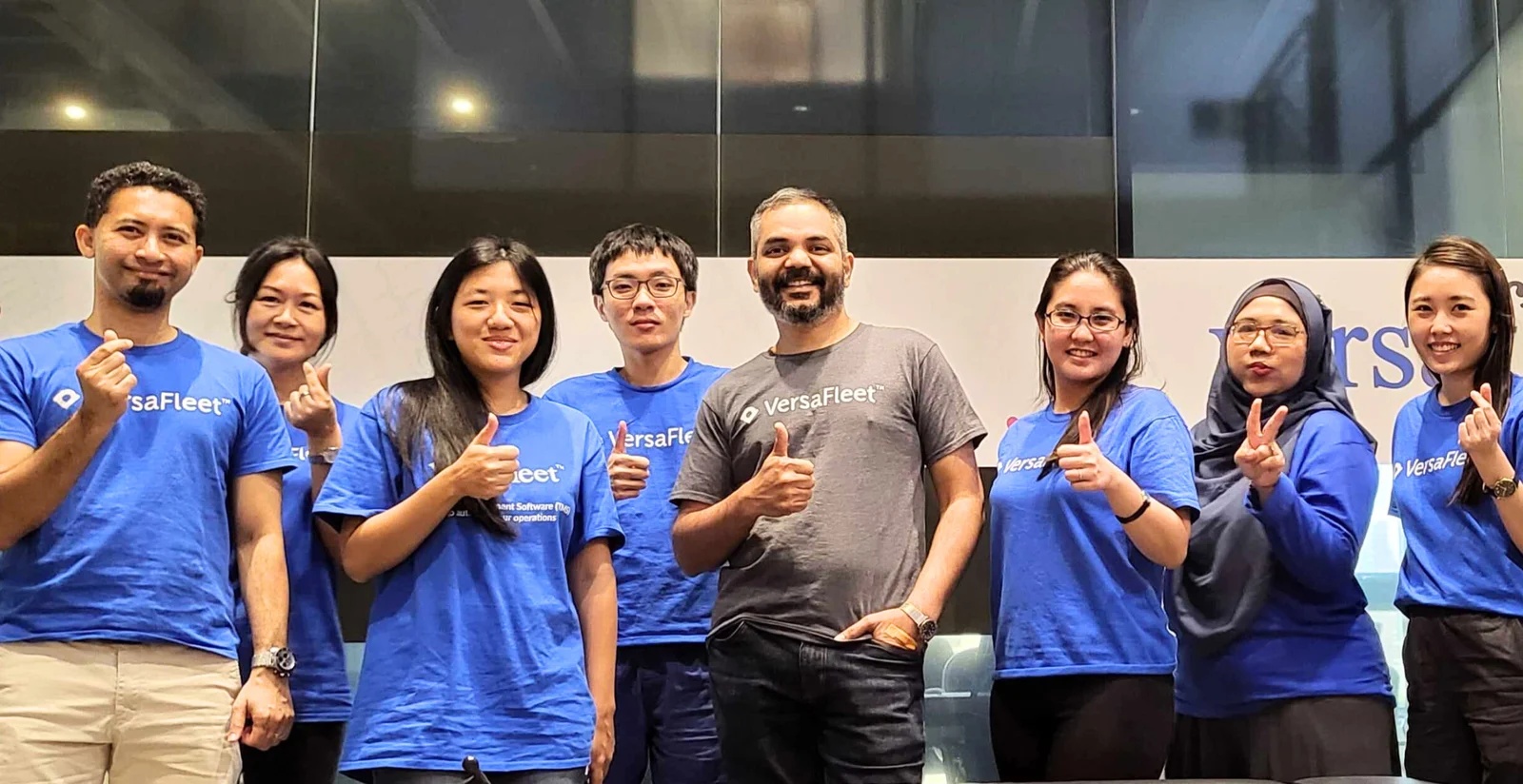
His later comments about leadership favour building rapport and helping people lead without waiting for a title. He has described the effort required to reassure established executives about unfamiliar technology. Persuasion belongs in the job description alongside architecture. For a founder selling changes to an existing operation, the relationship is part of the work. The people who know the operation have knowledge a software diagram cannot supply.
Same question, different water
GotSurge took Rahim’s interest in logistics toward the harbour. He joined Eric Chean and Naazira Nasir as co-founders. Chean brought commercial experience in marine deliveries; Rahim brought technical and logistics experience. Their meeting followed Chean’s earlier attempts to build a business in the sector. Rahim was looking for someone with industry knowledge to help develop a maritime delivery platform. They had complementary reasons to understand the problem.
The proposition involved giving customers and suppliers a shared view of deliveries from a single dashboard. GotSurge won the 2022 PIER71 Smart Port Challenge, taking the S$10,000 top prize. It was acquired by Yinson GreenTech, and Rahim’s subsequent work included solution architecture and the product roadmap after the acquisition. Roads had given way to a different delivery setting. The recurring question was still how to coordinate work that crosses several people and organisations.
- 2012VersaFleet begins with family-business routing.
- 2022GotSurge wins the Smart Port Challenge.
- 2024Rahim begins an industry PhD at NUS.
A founder takes a seat in the classroom
Rahim earned a master’s in supply chain management while running VersaFleet. In August 2024, he began a part-time industry PhD at NUS’s Institute of Operations Research and Analytics. His research interests include vehicle routing, demand-responsive transport and last-mile supply chains. The subjects sit close to the problems he has worked on commercially. A return to university can look like a detour on a career chart; here, the questions travel with him.
He has also taken seats around public and institutional tables. His CPF Board term ran from July 2019 to June 2023. He joined the NUS-ISS Management Board in 2022, and Singapore’s government directory lists him on the DSTA board. These responsibilities place him among people making decisions beyond his own companies. His earlier presidency of the Singapore Malay Chamber of Commerce and Industry, from 2017 to 2019, similarly connected business-building with the business community.
At a NUS-ISS graduation in May 2024, his advice was to keep learning from others. Awards from NUS and Supply Chain Asia had already recognised his work in 2019. Yet the invitation to graduates pointed toward the next encounter, rather than the previous accolade. It is sensible advice from someone whose career has repeatedly changed the setting in which he learns. A founder can bring experience to a classroom and still have reasons to take notes.
The creativity behind the calculation
In July 2026, Rahim appeared on a NoTapis live panel at a youth festival at the Malay Heritage Centre. The subject was Malay cultural heritage and how to reach younger audiences through digital media. He argued for meeting them on the platforms they use and connected culture with creativity, communication and the ability to convey ideas. The discussion widened the picture of a technologist whose public identity is often attached to delivery software.
That interest belongs comfortably beside the self-taught piano and rapid and blitz chess he lists among his pursuits. Making things, studying systems and communicating ideas need not occupy separate lives. Rahim’s story offers plenty of technical vocabulary, but its memorable details remain ordinary: a program for the family business, a reunion with an early colleague, another period of study. And dinner. For all the calculations that go into a route, the destination that makes the story human is still home.
Follow the next turn
Explore Rahim’s work, conversations and public profiles.