An empty stretch of a truck is an unremarkable sight. It is also a bill somebody has to pay. For Sandeep Deshmukh, the question was whether that unused space could help goods reach a shop that conventional distribution found too expensive to serve. A small order, a long road, an available vehicle: the pieces existed. Getting them to cooperate was the business.
Deshmukh co-founded ElasticRun in Pune in 2016 with Shitiz Bansal and Saurabh Nigam. The enterprise would become associated with rural kirana stores, the neighbourhood grocers that make retail feel local even when the products come from far away. Its organising idea was shared capacity. Software would coordinate physical resources belonging to different participants, giving brands access to a network they could use without building every part themselves.
There is something appealingly unromantic about this ambition. The product might be a packet of biscuits. The obstacle might be the cost of getting it onto a shelf. A founder could spend years improving that journey and still have to explain at dinner why it deserved so much attention.
The engineer learns what a business costs
Deshmukh grew up in Buldhana, Maharashtra, and studied engineering at the Government College of Engineering, Jalgaon. His working life took him through Infosys in Pune, DHL in Malaysia and Apple in California. He returned to India, completed his management education at IIM Ahmedabad, and moved into Amazon’s operations in Bengaluru. The future business began to look possible when technology experience met the responsibility of running things.
That earlier engineering work already involved more than code. Former colleague Brian Dote recalled Deshmukh helping develop an offshore team for Apple’s MobileMe applications and coordinating work across two countries. Another colleague, Ken Goto, praised his attention to business goals, deadlines and budgets. The recommendations describe someone accustomed to making several obligations coexist, a useful apprenticeship for a company whose service would depend on many independent participants.
His PGPX class at IIM Ahmedabad graduated in 2011. Deshmukh later described management school as a place where he came to understand what kind of work would keep him engaged. Building something appealed to him. Amazon then supplied practical experience of business execution. He had arrived with an engineer’s analytical habits and acquired another set of questions: would the service work, would customers want it, and would its economics hold?
The first ElasticRun office was his two-bedroom Pune apartment. He recalled roughly 40 to 50 people working there before the team moved nearby after its initial funding. That is a rather literal way to bring work home. Behind the cramped beginning were months of refining the idea and the uncertain business of getting customers, investors and prospective employees to commit.
A shelf cannot stock an advertisement
An essay Deshmukh republished in 2018 gives a clear view of his thinking. It had first appeared the previous December. He approached logistics through imagined business customers: an established brand unable to fulfil all its orders, a company struggling to expand into smaller markets, a food entrepreneur wanting national distribution. Each had a different frustration, but each needed a dependable route between a product and its buyer.
The examples were hypothetical, and their purpose was practical. Advertising could create interest that distribution failed to satisfy. A successful local product could remain local because its maker lacked the access that larger companies had accumulated over decades. Deshmukh proposed a shared network with physical infrastructure, a coordinating technology layer and services on top. Businesses could plug into it as demand changed.
By late 2022, he was explaining rural fulfilment in similarly concrete terms. Small purchases and long distances demanded a different cost structure. The promise to the retailer was availability that could be relied upon. The unused capacity in existing logistics could help reduce the burden of paying for a half-empty vehicle. A shopkeeper’s replenishment order may be modest; the work required to make it economical deserves less modest attention.
Conceptual illustration of the shared network model.
The spare seat in the supply chain
ElasticRun’s early rural model linked consumer goods companies with grocers through an asset-light network. Local transport businesses could put idle or underused vehicles to work between warehouses and stores. The platform coordinated those journeys. This was a way of assembling reach from resources that already existed, rather than requiring a brand to construct an entire distribution system before entering a market.
The village grocer sat at the centre of Deshmukh’s explanation. Stores beyond conventional distribution often bought through wholesale markets in larger towns. That arrangement also limited a brand’s view of how its products reached those customers. Connecting the participants offered both a delivery channel and information about demand. The vehicle carried the goods; the transaction left a record that could improve the next decision.
In February 2022, ElasticRun’s funding put its valuation at $1.5 billion. The closed round was announced at $330 million, with SoftBank and Goldman Sachs among the investors. Deshmukh’s explanation of its rural position stayed grounded in distance, order size and fulfilment cost. He described the company as extending brands’ access to shops beyond their existing distribution coverage. The capital enlarged the opportunity. The shops still needed their orders.
“At the end of the day, it is an operations and cost game.”
Sandeep Deshmukh · March 2024
The spreadsheet gets a vote
A company’s history looks tidier if one stops at the funding round. ElasticRun’s next chapters involved choices that complicate that picture. In 2023, it ended a pilot serving urban retailers and returned its attention to its rural core. Deshmukh said the changing economic environment had influenced the decision. He also acknowledged that the restructuring meant parting with almost two per cent of employees.
The distinction matters. A network designed to solve one distribution problem does not automatically win in another market. Urban retail already had established supply arrangements and competition. An expansion can sound plausible and still demand more capital than its returns justify. Ending the pilot was an operating decision with a human cost, and it belongs alongside the more celebratory milestones.
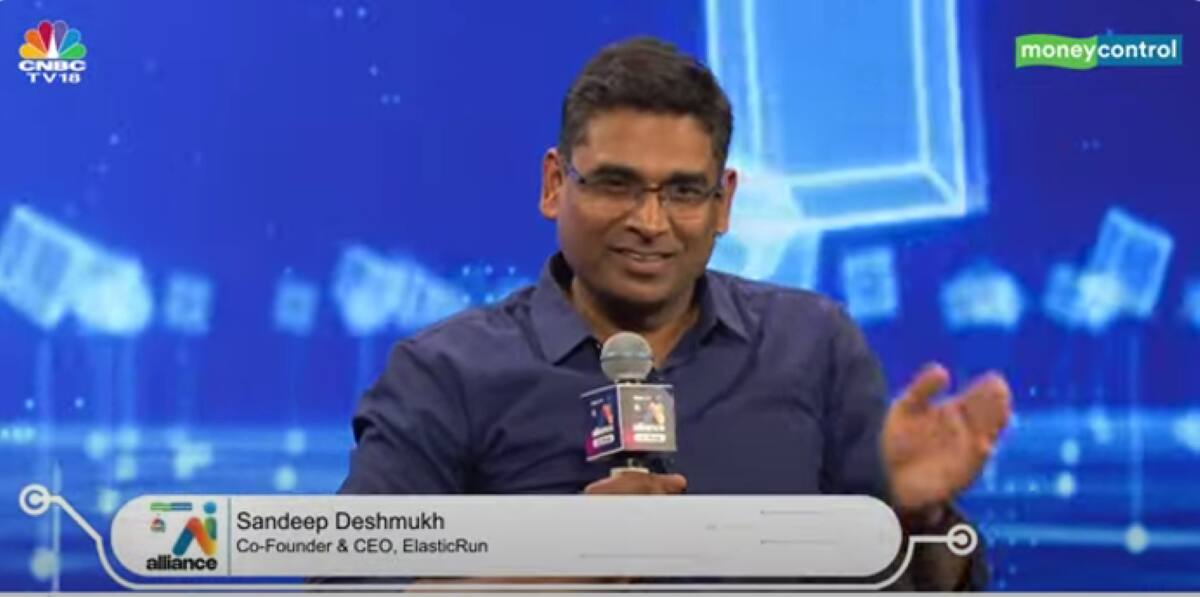
Speaking in Pune in March 2024, Deshmukh said ElasticRun had adjusted its plans to extend its financial runway. He emphasised execution and cost discipline, and said the company had spent zero dollars on marketing. That statement described his priorities at the time. The spreadsheet, in his account, had to reconcile the service with what it cost to provide. It makes a demanding audience: applause does very little for a negative margin.
Small brands, different arithmetic
The distribution business then changed its assortment. ElasticRun put more emphasis on regional brands, whose economics offered higher margins. By October 2024, it was discussing a group of at least 24 brands it called “Crorepati” brands. Its reach could help those businesses sell beyond their home territories. A network built to move products into overlooked places could also give overlooked producers access to new customers.
Deshmukh explained the change as a reversal of the earlier sequence: first build a network with better economics through local and regional brands, then broaden the mix. He said the shift increased the platform’s take-rate, the money it earns per transaction. That is an unusually useful detail in a founder interview because it locates the improvement inside the transaction rather than leaving it in a general promise about efficiency.
The FY24 accounts show the tradeoff. Revenue from operations fell to approximately ₹2,435 crore from ₹4,738 crore in FY23. Net losses narrowed to approximately ₹360 crore from ₹619 crore. Lower losses and lower revenue arrived together. It would be misleading to draw only the upward-pointing part of that story. The company was revising which business it wanted to do.
Less revenue. A narrower loss.
Rounded reported figures. Revenue and loss pairs use separate scales; bars compare years within each pair.
His ambition remained substantial. In November 2024, he described a goal of reaching $10 billion in annual revenue within five to six years while becoming profitable. It was an aspiration, with the usual distance between a founder’s target and a future set of accounts. He also saw existing dark stores as candidates for conversion into facilities supporting quicker deliveries. Once again, the question was what more the available infrastructure could do.
The clock starts in the warehouse
By February 2026, Deshmukh was discussing SwiftER, ElasticRun’s fulfilment offering for brands selling through their own websites and apps. It supported different delivery speeds, including two-hour, same-day and next-day services. The arrangement allowed brands to keep the customer relationship while using a shared network for storage, dispatch, delivery and returns. Faster service had become another application of the capacity-sharing idea.
A February integration with Unicommerce’s Shipway opened same-day and next-day delivery services across six cities: Delhi, Mumbai, Bengaluru, Hyderabad, Pune and Kolkata. The initial rollout concerned movements within those cities. It gave sellers another route into ElasticRun’s network, with tracking and performance information accompanying the physical service. The parcel and its data continued to travel together.
In July, the company reported more than five million daily shipments across its network. Deshmukh described an ambition to develop a fast fulfilment engine over the following 18 months. He wanted further reach into semi-urban and rural markets while maintaining service quality. Those plans connect the company’s recent emphasis on speed with the geography that shaped its earlier business.
A decade later, still arranging the pieces
His August 2026 discussion of AI returned to the work behind a delivery promise. ElasticRun was using forecasting at product, postal-code and day level to help decide where inventory belonged. Address intelligence, delivery-partner allocation and monitoring were other parts of the system. Deshmukh also described an aspiration for language models to build software from business specifications. These are specific jobs for technology inside an operation with many moving parts.
The emphasis fits his earlier view that supply chains depend on timely data. In his conversation with Vivek Prasad, he explained technology as a way to collect information across the network and respond to anomalies. He also stressed testing demand in the market. A forecast must eventually meet a purchase; a routing decision must eventually meet a road. The engineer and the operator continue to need each other.
Deshmukh has received IIM Ahmedabad’s Young Alumni Achiever’s Award in entrepreneurship. His advice to would-be founders is brisk: “If you want to do it, do it now.” He has warned that additional years in an established job cannot spare someone the learning required to start from scratch. It is an interesting admission from a founder whose own preparation crossed several companies and countries.
After a decade, his work is still concerned with arranging the pieces: a product, a location, available space, a person who can deliver. The expectations around them have changed. The small rural order and the impatient online buyer now appear in the same company’s work. Somewhere between the two sits the original question about unused capacity. An empty truck offers plenty of room for an idea. Making the journey pay is another matter.
Follow the routes
Writing, conversations and further reading.
- ElasticRun website
- Sandeep on LinkedIn
- His essay on distribution
- Watch: IIM Ahmedabad interview
- Watch: conversation with Vivek Prasad
- Early years and the Pune apartment
- The regional brand strategy
- FY24 accounts and the revenue decline
- SwiftER and brand-owned delivery
- July 2026: the fast fulfilment plan
- August 2026: forecasting and AI
- ElasticRun on X
- ElasticRun on Instagram
- ElasticRun on Facebook
- ElasticRun on YouTube