A temperature record can look impeccably respectable. It has numbers, a date, perhaps a signature. It may even have the peculiar authority that attaches to anything printed by a machine. Jihyun Yoon had worked in food distribution long enough to ask a less polite question: did the record describe the journey, or merely make the journey look acceptable?
He had seen transport temperature logs completed after delivery, adjusted to fit the required account. In October 2026, recalling the experience, he described the feeling of discovering an alibi where useful evidence should have been. A document could exist while the explanation of an accident remained out of reach. For someone trying to preserve the value of a shipment, that was a rather expensive distinction.
Yoon is now a co-founder and co-CEO of Willog, the Seoul company connecting cargo sensors, monitoring software, analysis and insurance. On LinkedIn, he uses the name Daniel J. Yun. The business has changed considerably since its beginnings in fresh food. His central question has stayed remarkably practical: what can people actually do with the record of a product’s journey?
The work before the title
Yoon’s earlier ventures included giving foreigners Korean names and running a restaurant business in Vietnam. He took lessons about researching demand from both. As a university student, he sold payment terminals and street accessories, and packed goods at a logistics centre on weekends, to fund an exchange in France. He also worked for a French trading company.
He met Sunghoon Bae through a founders’ gathering. Both hoped eventually to support young people through a foundation or school. Yoon traced his interest in giving to childhood memories of his parents buying Children’s Day gifts for disadvantaged children. By 2022, their working arrangement gave each independent decision-making authority: Bae covered technology and domestic business; Yoon covered sales, operations, marketing and overseas business. Trust, they explained, helped them move quickly.
It is an unusually concrete prelude to a software company. A warehouse had already been a workplace for Yoon before it became a market. Selling had already involved finding out whether anybody wanted the thing on offer.
A camera, a code, a difficult question
The food-distribution business began in 2017. Yoon later explained that a producer could make a good product and a distributor could invest in storage, yet the transport connecting them to the customer remained an opaque part of the arrangement. Quality had been paid for at either end. The middle still needed attention.
His account also included a South American customer transporting fruit sensitive to temperature and humidity. The customer thanked Willog for protecting its value. That detail brings the business down to the size of an actual consignment. A grower’s work travels inside the box, too. By the time the fruit arrives, a bad journey can have undone a good harvest.
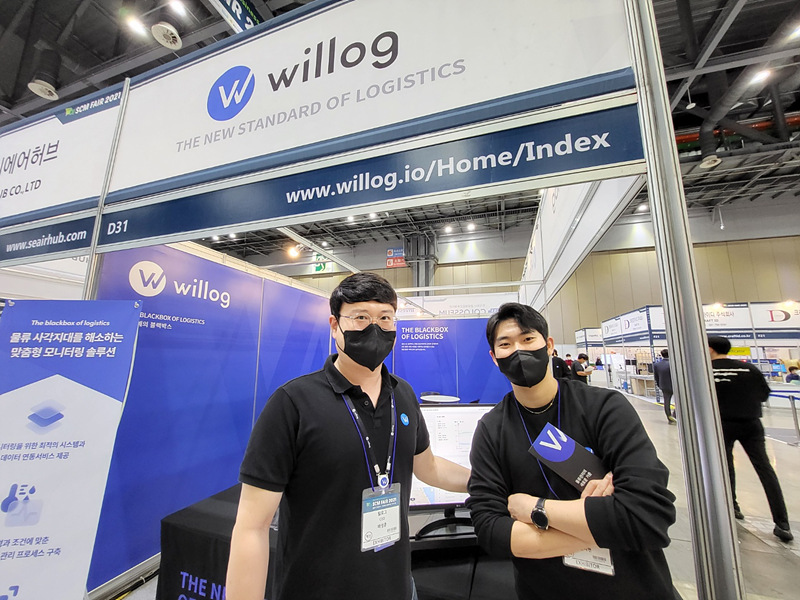
The early OTQ device recorded cargo conditions and displayed a QR code. A smartphone camera gave people access to the history. In explaining the system, Yoon contrasted the scan with the routine of plugging in and retrieving USB recording devices. Electronic shipment documents could follow the same workflow.
There is a pleasing lack of ceremony to the camera. Drivers and recipients already have jobs to do. A product that asks them to perform another small administrative ritual has to earn that request. Willog’s early design made the record easier to retrieve at the point where somebody needed to make a decision.
The ambition grew beyond the box
Willog’s Korean company was established in May 2021. A Series A investment followed that July. Its history records a US branch later that year. These dates give the venture a formal beginning, while the food-distribution experience explains why its founders arrived with a problem already in hand.
Yoon and Bae were building across hardware and software from the outset. The company’s early public ambition was to create a dependable standard for logistics. That aim is more demanding than getting a sensor to produce a number. The number must remain useful as responsibility moves between people and businesses.
A shipment changes custodians. So does the question of who should respond when something goes wrong. Each handoff is an opportunity for the history to become awkward to retrieve, or for two parties to be looking at different records. Willog’s product choices put that shared history at the centre of the work.
By 2023, the company had completed a Series B round. Its announced uses included developing technology, improving service, hiring and expanding internationally. Yoon described the investment as support for strengthening the platform and its reach. Raising money added capacity; the daily task remained making the system usable in somebody else’s operation.
Even logistics people need introductions
In February 2023, Willog announced Mentor Talk, an interview series about jobs in logistics. The first planned conversation featured Jeong Sang-bong of Hanjin’s parcel-planning team. The audience included people already working in the industry, job seekers and people considering a change of career.
Yoon’s explanation was straightforward. The industry was changing quickly enough that workers could struggle to understand roles outside their own. Applicants faced a similar difficulty finding practical information. The series would explain the jobs, their actual duties and the capabilities required.
It is a revealing detour in the story of a sensor business. A company concerned with visibility chose to make work itself easier to see. A job title can be as unhelpfully compact as a shipping label: enough to identify the category, too little to explain what happens during the day.
Mentor Talk dealt with that gap through conversations with practitioners. For Yoon, whose responsibilities had included selling and operating the company, the initiative sat close to the human side of adoption. Someone still has to understand the other person’s work before proposing to change it.
The risk that remains
Monitoring can help people act earlier. It also produces an uncomfortable remainder: accidents can still happen. Yoon has spent roughly three years preparing the insurance business, including discussions with insurers. His explanation in October 2026 was that prevention leaves risks which insurance can address.
The records now had a second audience. Customers needed them to manage shipments. Insurers could use them to examine the customer’s operating history and the circumstances of a loss. Yoon’s proposed connection put the same evidence to work before and after an incident.
That requires negotiation as well as technology. An insurer has to accept the evidence and agree the conditions under which a claim can be assessed. A sensor cannot sign a contract, however diligently it has spent the week observing a box.
The shift helps explain Willog Vision, officially launched on September 17, 2026. The platform brings together four parts of the company’s offering: devices, monitoring, intelligence and insurance. The intended sequence runs from recording conditions to responding, assembling evidence and supporting compensation. Previously separate tasks share a data foundation.
Yoon’s own account of the launch was refreshingly less tidy than the product diagram. He described repeated reconsideration and rebuilding, thanked the team, and stressed the difficulty of making connections useful across real operations. The important unit of progress was the decision a customer could make.
“We’ve stumbled, rethought, and rebuilt more times than I can count.”Jihyun Yoon / Daniel J. Yun, on the Willog Vision launch
A different room in London
In September 2026, Yoon stood before an audience at Lloyd’s Lab in London. The photograph shows him on a blue platform, presenting to rows of people with laptops and notebooks. On a banner beside him, the accelerator offers the prospect of ten unusually demanding weeks. Insurance has its own sense of welcome.
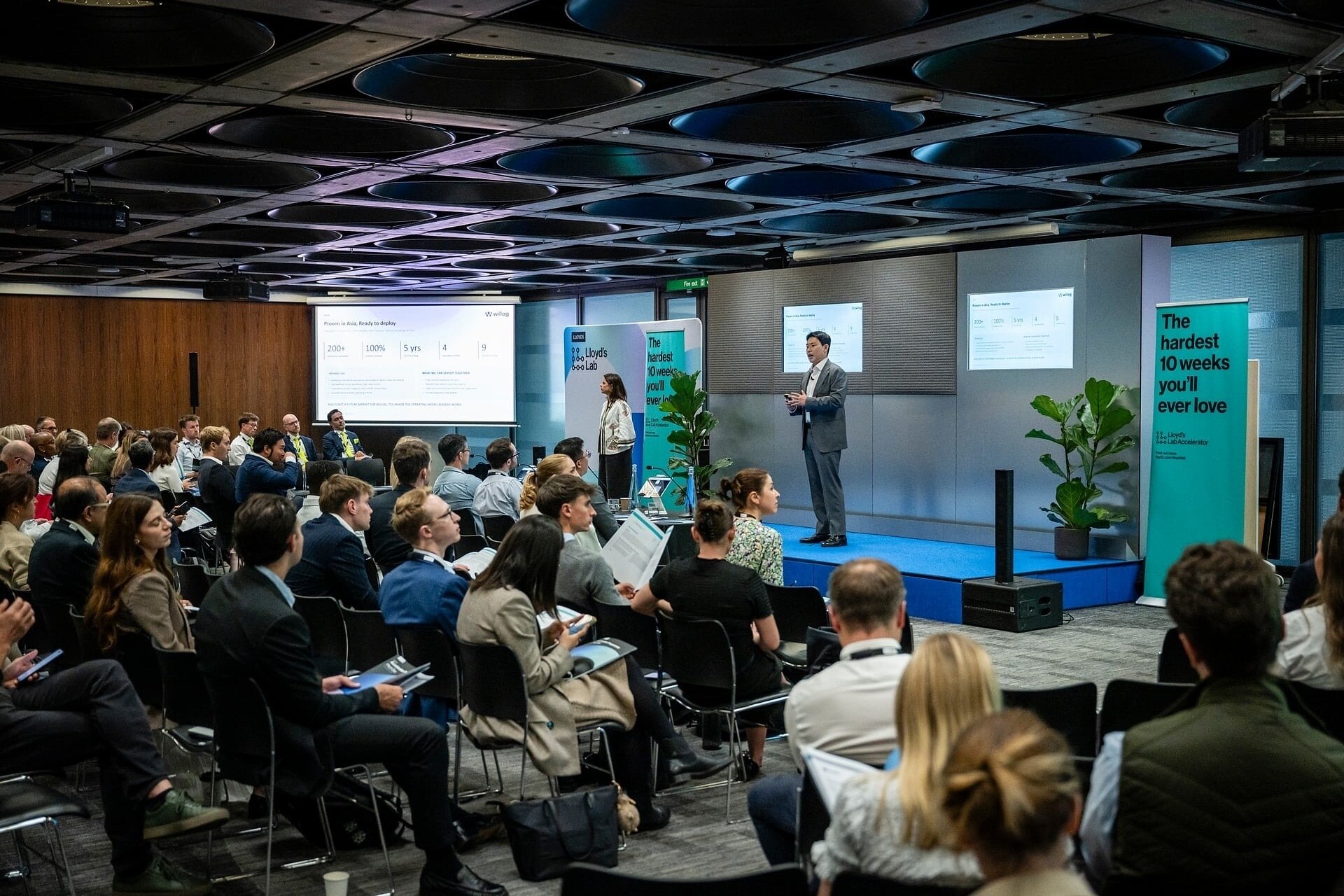
Lloyd’s announced Willog among the ten companies selected for Cohort 17 after fifteen pitched for places. The ten-week programme brings participants together with the insurance market to develop, test and refine their ideas. Willog’s entry concerned using shipment-monitoring devices and logistics data for loss prevention, pricing and parametric insurance.
The setting changed the people asking the questions. A logistics manager wants to know what happened to a shipment and whether action is needed. An underwriter wants to understand the risk being accepted. Willog’s wager is that sufficiently useful cargo records can support both conversations.
The company described plans to find insurance partners and prepare a product suited to its field data during the programme. Those are tasks to be completed, rather than accomplishments conferred by admission. For Yoon, the London pitch marked a chance to test the next use of the record.
Give the record something to do
Recognition had arrived before London. Willog received a Presidential Commendation at South Korea’s 2025 venture-startup promotion awards for logistics innovation and job creation. Its device range had also expanded beyond QR to Bluetooth Low Energy and LTE communications. The tools were changing as the uses became broader.
Yoon’s present ambition is to make the combined model of devices, software, analysis and insurance work across countries. There is a long distance between a credible reading and an accepted claim. Along that distance sit operating practices, contracts, different teams and different jurisdictions. His company is trying to connect them through a record people can use.
The early food shipments keep the ambition legible. Somebody has made something valuable. Somebody else must move it. If the journey goes badly, a reassuring sheet of paper is poor company. Yoon’s career has brought him from selling and packing to a London insurance pitch, but the useful question is still waiting beside the delivery: what happened, and what should happen next?