In June 2003, Younghoon Park’s company had a new handheld device to show off and an unusually revealing name for its customers. They were “Cellvians.” CellVic, formerly JTel, planned to bring them to Seoul’s Hilton Hotel, introduce its MyCube smartphone, hear their experiences and let them question management. Park was scheduled to present the company and its products himself. The people buying the machines would have their turn at the microphone.
He described those users as the company’s “number-one department” - an English translation of his Korean remark. It is a small detail from the age of personal digital assistants, when putting a telephone inside a pocket computer still counted as a product announcement. Yet it offers a useful entrance to Park’s career. A business can make something clever. The more awkward work begins when someone outside the business has to want it.
Over the following two decades, Park moved through consulting, corporate venture investment and startup support. His titles changed; the problem of connecting a company to the world around it kept appearing. At dcamp, the bank-backed Korean startup foundation, he would turn that problem into a more concentrated approach to helping companies grow. The approach attracted founders. It also helped provoke a dispute about whom the foundation existed to serve.
Before the pitch deck became familiar
Park joined Samsung C&T in 1993 after studying business at Seoul National University. In his later account, an American venture-investing assignment took him to Boston for roughly two years. Young founders presenting ideas to investors made an impression on him. He had entered a large corporation and found himself learning how much smaller companies obtained the money to build.
His next experience put him on the other side of the conversation. In November 2001, JTel appointed him chief executive. He came from Boston Consulting Group, and two fellow consultants joined the leadership team. The company already made PDAs; its shareholders were looking toward enterprise solutions and mobile systems integration as well as consumers. This was a business with products, people and strategic choices already attached.
The television business looks beyond television
Park subsequently held senior roles at Monitor Group and Accenture. In 2014 he joined GS Home Shopping. Here, the growth problem belonged to an established company. Television retail had a working commercial engine, but online commerce was changing the environment around it. Investing in younger businesses offered access to ideas, services and technology that the company did not have to invent entirely inside its own walls.
By June 2020, GS Home Shopping’s reported direct and indirect startup-investment footprint covered about 600 companies, with approximately ₩360 billion invested cumulatively. Those were company-wide figures, rather than Park’s personal portfolio or personal wealth. He oversaw venture investing and framed the activity as a response to commercial pressure. The logic was practical: a profitable business still had to prepare for customers moving elsewhere.
An investment could open a relationship as well as purchase a stake. For a startup, an established retailer could offer customers or operating knowledge. For the retailer, the startup could supply a different way of doing business. The appeal depended on both sides having something useful to exchange. A logo on a presentation slide would be a rather expensive substitute.
In 2021, the planned integration of GS Retail and GS Home Shopping placed Park in charge of the combined digital-commerce business unit. It brought the investor back into a broad operating role. The job connected digital sales with the resources of a retail group - another attempt to make separate capabilities work together. His subsequent move to dcamp brought that experience into an institution with a different purpose and different obligations.
A logo on a presentation slide would be a rather expensive substitute.
On the work behind a corporate connection
A lesson delivered before the argument
There is an earlier window into how Park explained change. At Korea University Business School on May 10, 2018, he spoke about technology, consumer behavior and the skills students should acquire. He described marketing becoming more personal and businesses becoming more interconnected. His examples included platforms and the connections between services. Students were being asked to think beyond the boundaries of their academic majors.
He also addressed resistance. Technological change, he told the audience, encounters technical, social and ethical objections. Managing that resistance mattered to making progress. Read alongside his later career, the lecture raises an interesting question: how does a leader move an organization toward a new opportunity while keeping the people inside it involved? The question would become especially pressing at a foundation whose mission was itself part of the debate.
His public LinkedIn profile adds a few less corporate details: a Level 1 ski-instructor certification issued in 2014, a PADI Master Scuba Diver credential and a publication entry concerning twentieth-century contemporary music. They make the biography less monochrome. They do not establish a theory of his temperament. A certificate tells us something he learned; it cannot tell us how he behaved in a meeting.
Twelve months, fewer companies, more attention
Dcamp announced Park’s selection in March 2024, with a three-year term beginning April 1. The foundation had been established in 2012 through contributions from 19 financial institutions. Its activities included startup investment, workspace and programs connecting founders to other people. Front1, its startup center, opened in 2020. Park arrived at an organization that already had relationships and a recognizable place in Korean entrepreneurship.
The proposed change became public in October 2024 under the name dcamp 2.0. The batch program would concentrate on pre-Series A and Series A businesses: companies past the first idea, trying to build a larger customer base and a more substantial business. The announced investment package started at up to ₩500 million, with initial and follow-on investment potentially reaching ₩1.5 billion. Mentors and business support accompanied the capital.
This is also where the choices become uncomfortable. Concentrated help requires selection. A program can devote more time to each company while admitting relatively few. Both the admitted founder and the founder outside the door have a stake in that decision. A bank-backed nonprofit must weigh those consequences alongside the prospect of a stronger business. The same selection process can look like focus from one position and a narrowing entrance from another.
A longer runway
A stopwatch beside the applause
On January 29, 2026, Park presented results from the first batch at d.day in Seoul. He reported 1,628 hours of mentoring over a year. The cohort had selected nine companies from 566 applications, and six businesses presented at the event. Park also reported an average 400% attainment of the companies’ agreed target indicators.
That last figure needs its full label. The companies had different targets, set with mentors and tracked over the program. Four hundred percent was a reported average against those indicators. It should not be treated as a common revenue-growth rate, an investment return or evidence that every business advanced at the same pace. The mentoring hours describe effort; the target attainment describes a particular measurement of results.
By June 2026, the first seven batches had received 4,087 applications from 2,707 distinct companies and selected 55 companies. The reported average competition was 74 applications per place. Repeated applications are part of that picture, so application volume and individual-company interest need separate labels. The figures show considerable demand for the program while making its selective nature visible.
D.day changed too. Its 2026 format gave batch graduates a place to discuss decisions and results, then seek investment and business connections. That creates a different kind of stage. The audience can ask about the work behind the outcome, rather than judge only the promise of an idea. A useful demo day should leave room for the sentence that begins, “We tried this, and it did not work.”

Mentoring over one year. A measure of time committed, alongside company-specific targets.
The next customer might be in Tokyo
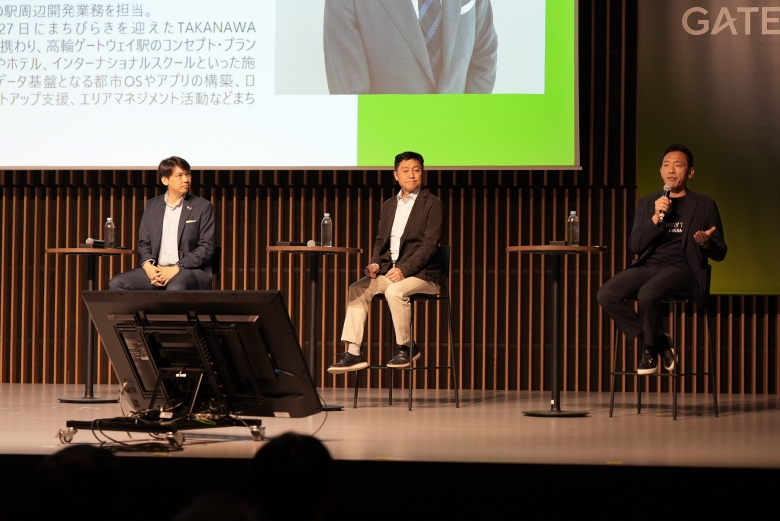
The growth agenda also extended beyond Korea. In May 2025, Park participated in GATEWAY Tech Takanawa, a JR East startup event in Tokyo. Fellow panelists included Benjamin Tee of NUS Enterprise and Masayuki Kimura of Deloitte Tohmatsu Venture Support; JR East’s Yoshiya Amanai also took part in the discussion. The event linked startup communities with an urban-development project and possible corporate partners.
A year later, dcamp and JR East ran a smart-city open-innovation program at LiSH in Takanawa Gateway City. Seven Korean startups were connected with opportunities to test technologies in a Japanese urban setting. That is an institutional program result, rather than evidence that Park personally secured every connection. It does, however, show the kind of practical overseas access the organization was pursuing during his leadership.
The people inside the institution
By June 2026, that change of direction was the subject of an open internal dispute. Employees had formed a union and raised concerns about dcamp’s mission and management. Critics questioned the shift toward more established startups, arguing for its earlier role supporting very young teams. Management defended concentrated support as a way to help companies through the difficult stretch between early funding and sustained growth.
An internal audit also examined governance and workplace allegations. Those allegations should be understood as reported allegations, rather than findings this profile can independently establish. In April, Park’s side said he had provided explanations during the process. The disagreement had moved beyond which companies to select; it concerned how decisions were made and how the institution was run.
Park submitted his resignation on July 10. On July 20, dcamp’s board accepted it and moved toward finding a successor. Under the transition arrangement, four department leaders took responsibility for operations; Park would retain the title on paper pending a successor while being excluded from practical duties. The board opted against a separate disciplinary process after accepting the resignation and discussed measures to prevent recurrence.
That ending belongs in the account alongside the program’s reported results. Park brought years of corporate investment and operating experience to dcamp and helped establish a sustained growth program. The resulting conflict shows that an institution’s direction is also a question for the people entrusted with carrying it out. His 2018 lecture had already acknowledged the need to manage resistance. At dcamp, that challenge became part of his own record.
Return to the Cellvians for a moment. In 2003, customers were invited to question the management of a young device company. More than twenty years later, Park’s story still turns on who gets heard as a business changes. Founders, customers, employees and financial backers arrive with different needs. Helping a startup grow means making room for those needs in the plan - and dealing with them when they refuse to fit neatly on the slide.
Interviews, events & connections
Follow the career, the programs and the leadership transition.
- Park’s 2024 career interview ↗
- JTel’s 2001 leadership appointment ↗
- The 2003 Cellvian event ↗
- Venture investment at GS Home Shopping, 2020 ↗
- Korea University’s 2018 lecture account ↗
- The dcamp 2.0 announcement, October 2024 ↗
- First-batch results, January 2026 ↗
- Application data across seven batches, June 2026 ↗
- The dispute over dcamp’s direction ↗
- The audit and Park’s response, April 2026 ↗
- Resignation accepted, July 2026 ↗