Jaiseung Choi had a clever idea, and the clever idea required people to take out their phones. At a café counter, customers would unlock the screen, open an app and collect their points. Somewhere behind them, another customer was waiting. The software had a theory of social shopping. The queue had a theory of getting on with it.
The early Spoqa app, released in November 2011, allowed a purchase to benefit the buyer’s social-network friends too. Choi wanted to encourage repeat visits and introduce shops to new customers through people they knew. It was a reasonable ambition. But by August 2012, he was describing the checkout process as long and awkward. Users were increasing; the spectacular growth curve he had hoped for was missing.
His response was to make the service almost foolishly simple. Dodo, launched that April, initially used a QR-coded card and an iPad at the shop counter. Customers presented the card; points accumulated. The tablet-and-phone-number version would become familiar across thousands of stores. Each revision cut down the little ceremony between buying something and receiving credit for it.
That willingness to revise his own proposition is the thread running through Choi’s career. He is also known as Richard, and remains Spoqa’s co-founder and co-CEO alongside Grant Sohn. Today the company works on ingredient purchasing through Kitchenboard. The distance from coffee stamps to restaurant supply orders is shorter when measured in chores.
A researcher with a café problem
Choi was born in Seoul, spent his teenage years in Hong Kong, and went to the United States for university. He studied biomedical engineering at Johns Hopkins, followed by a master’s at Cornell. In 2007 he returned to Korea and joined SK Chemicals’ research and development division. His path had already crossed three countries before the shop counter became his subject.
There were signs of entrepreneurial interest before Spoqa. During his Johns Hopkins years, he won a university business invention competition. Later, while working as a researcher, he kept thinking about café loyalty cards. The apparently minor annoyance had the advantage of being visible, repeatable and close at hand. A wallet full of paper was an unusually portable business problem.
In a 2012 interview, Choi described wanting shopping to be both enjoyable and useful. He was trying to join the practical reward of a stamped coffee card to the social energy of an app. The first design expressed that ambition quite literally: friends could receive benefits together. The difficulty was making the ambition fit into an ordinary purchase.
His friendship with Sohn supplied another part of the business. The two met in 2008 while doing part-time work as English instructors in Korea. Sohn had studied economics at Stanford and worked at McKinsey. By 2011, Choi, Sohn and technical co-founder Jaeseok Kim were building Spoqa. Their backgrounds differed; the shopkeeper’s working day gave them a common subject.
The first sale took longer than the pitch
Choi remembers the first café contract near Seoul’s Dosan intersection. He had to explain that a business already spending roughly 10,000 to 20,000 won a month on printed coupons could put a similar expense toward customer management. The arithmetic was simple. Persuading someone to change a familiar routine took time.
Choi and Sohn also rode a motorbike around the streets near Hongik University, approaching about 200 stores. Sometimes owners mistook them for salespeople from the discount-driven social-commerce businesses then courting local merchants. They could be sent away before getting to explain themselves. Their product had a new proposition; their arrival resembled an old interruption.
Hardware made the work more demanding. Choi later recalled tablets costing about 300,000 won each, and spending his days explaining the strategy to shop owners and investors. A tablet on every counter was a concrete commitment. Someone had to pay for it, install it and make a case for leaving it there.
The story gives a useful scale to the word founder. Here it includes a motorbike, a misunderstood sales call and a conversation about the price of printing paper. A café owner did not need to admire the technology. The owner needed a reason to make room for it beside the register.
Let the shop keep its personality
Dodo’s utility did not require every participating shop to behave alike. Owners could choose their rewards. One early example offered an extra tequila if the customer beat the proprietor at rock-paper-scissors. Another proposed a visit to the owner’s British holiday property after 200 visits. Loyalty could evidently become a very long game.
The arrangement preserved something that a rigid rewards system might flatten: the owner’s character. A transaction could be recorded consistently while the promise attached to it remained peculiar to the place. That distinction mattered to a company trying to serve local shops rather than turn them into identical branches of an imaginary chain.
By 2015, Choi was speaking to marketing teams about connecting the offline experience to an online relationship. The August seminar included a discussion with Ji-hwan Sung of 72 Seconds TV. His framework moved through collecting information, choosing a target audience and creating content. The counter could begin a relationship that continued after the customer left.
In 2016 he was still insisting on simplicity, and on serving smaller merchants that lacked software. Spoqa’s Dodo Academy gave owners a way to learn how to use the service and exchange methods. Putting a tablet in a shop was only part of the job. Helping the person behind the counter use what it collected was another.
“I’m deliberately going with a simple model.”Jaiseung Choi · 2016 interview · translated from Korean
An impatient person builds a patient business
Choi once described himself as someone who would leave a three-hour film if its first hour was uninteresting. It is a pleasingly expensive way to review cinema. The remark also makes his long involvement with Spoqa more interesting: he could abandon a seat at the movies while continuing to work on the same class of everyday business problem.
He and Sohn, he said, shared a tendency to tire of uninteresting work and a need to try things themselves. In June 2016, he opened another interview with a boxing image: he believed he could get up after being knocked out three times. Those are his own descriptions of temperament. Together they suggest enthusiasm that survives a change of plan.
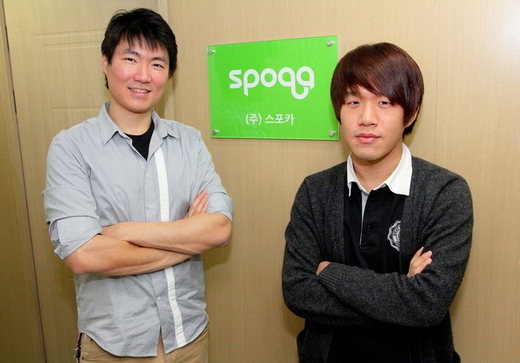
Early photographs supply a less formal view. Choi and Kim sit with laptops on bright beanbags; diagrams cover the wall behind them. In another they stand beside Spoqa’s green sign. Neither image needs the furniture of executive grandeur. There is work to do, and the office appears prepared to let people sit down and do it.
On his public LinkedIn profile, Choi calls himself a founder backing other founders and a techno-optimist. The same profile lists the Cornell Alumni Association of Korea’s Cornellian of the Year award for 2018. The researcher who returned from America had become a founder with both a merchant network and an alumni connection.

Who gets the value of a purchase?
Choi’s work with offline commerce also led him into Carry Protocol, which he co-founded with Sohn. By 2018, the project was asking who should benefit from the transaction data generated when people shop. Its proposal was to let consumers control and receive rewards for sharing that information with advertisers.
The connection to Spoqa was direct. Loyalty software had put the team close to purchases happening outside the browser, across cafés, restaurants and other stores. Carry applied a blockchain model to that setting. The ambition reached beyond recording points toward changing the relationship between shoppers, merchants and the organizations buying access to commercial information.
In 2019, Choi spoke publicly about Carry’s plans and the possibility of reaching overseas markets, including Southeast Asia. A June 2020 disclosure signed in his capacity as Carry’s co-CEO announced plans to begin collecting offline data through the Dodo Point partnership. These were dated plans and project developments, rather than evidence that every ambition had been fulfilled.
Carry belongs in his story because it follows a question already present at the register: what becomes possible once a purchase leaves a usable record? Dodo gave that record a loyalty purpose. Carry proposed a different allocation of its value. The shopper remained central to the argument, even as the machinery became more complicated.
Around the counter, into the kitchen
Spoqa’s next substantial turn came from the people it already served. Restaurant and café owners had ingredient work to do after serving customers: check what remained, record what was needed, contact suppliers and reconcile costs. The company launched Dodo Cart in 2020, initially emphasizing the analysis of ingredient statements and spending.
Choi identified a gap between the size of that expense and the tools available to understand it. In 2021 he described ingredients as accounting for 40 percent of store operating costs, yet lacking a suitable tracking tool. The precise share would vary by business. His argument was that a consequential expense was still being handled with inadequate visibility.
In 2022, Spoqa transferred Dodo Point to Yanolja F&B Solution and concentrated on the ingredient business. Choi later explained that the team had seen rapid adoption of the newer service and chose focus over stretching itself across both operations. Letting go of the product that established the company was a larger version of editing the early app.
Dodo Cart became Kitchenboard in September 2022. Its ordering function let restaurants select familiar items and quantities, with a channel for further requests. By December that year, monthly orders had reached 11,807. Ordering, payment and record keeping became the next sequence to make easier. The customer had changed position: now the restaurant itself was buying.
- 2012Dodo Point launches
A simpler loyalty routine - 2020Dodo Cart opens
Ingredient costs enter the picture - 2022Kitchenboard becomes the focus
Dodo Point transfers to Yanolja F&B Solution
A familiar question, a different order
Kitchenboard continued to add working details rather than stop at taking an order. Spoqa’s product history records payments in 2023, followed in 2024 by advance ordering, item-information management and unpaid-balance management. In August 2025, the company shared news that Kitchenboard was handling around 40,000 ingredient orders a month.
The milestones describe a business built around repeated tasks. An order is useful only if its details reach the supplier in a usable form. A payment feature matters when someone must match money to an outstanding balance. For Choi, this is familiar terrain: the success of the idea depends on what another person has to do to make it work.
His earlier ambition was to give shops tools that genuinely helped them manage customers. The current company proposition applies that practical aim to ingredient worries and the time spent placing orders. His story contains a social app, a loyalty platform, a data project and a purchasing service. The recurring setting is the working shop.
The first Spoqa app asked a customer to participate in a clever system. Choi’s subsequent decisions increasingly paid attention to the effort participation required. There is a useful test here for anyone inventing something: imagine the person using it has a queue behind them, or a kitchen to close. How much of their evening does the idea deserve?
Follow the work
- Spoqa ↗
- Richard Choi on LinkedIn ↗
- X profile listed in his public directory ↗
- Facebook profile listed in his public directory ↗
- 2012: the first checkout rethink ↗
- 2016: friendship, research and starting again ↗
- 2016: the first café contract ↗
- 2017: Startup Grind speaker biography ↗
- 2019: Carry interview ↗
- 2023: the move into ingredient ordering ↗
- Spoqa’s development blog ↗