At the end of a Dell marketing internship cohort in 2024, Sudharsan Rajagopalan did something executives often find surprisingly difficult. He made his advice short. There were seven notes: accept non-linear growth, build competence rather than merely collecting skills, find rituals that restore energy, acquire the intangibles of work, survive the crests and troughs, tell your own story, and ask for what you need. It reads less like a commencement speech than a set of instructions left beside a complicated machine. That seems appropriate. Rajagopalan has spent more than two decades learning how the marketing machine works - where it draws power, where it loses pressure, and which gauges deserve attention.
His latest control room is in Singapore. In 2025, after more than 21 years at Dell, he became Vice President of Marketing with a global remit spanning product marketing for Infrastructure Solutions, demand intelligence and run-the-business operations. The title is grand; the verbs are practical. Infrastructure must be explained. Demand must be read. A large organisation must keep moving on ordinary Tuesdays, not only on launch days.
This is the less photographed side of marketing. Campaigns get the case studies. Operating cadence gets the calendar invitation. Yet Rajagopalan's public record is unusually legible in numbers: more than 500 basis points of improvement in marketing revenue contribution, double-digit compound buyer growth, better retention and net promoter scores, and stronger returns for partners. These measures do not replace taste or storytelling. They force both to live in the same house as accountability.
A career built sideways before it went global
Rajagopalan began in corporate strategy at Honeywell, then entered Dell through its Leadership Acceleration Program. He was an alumnus of the Symbiosis Institute of International Business, and his early assignments gave him several views of the company: brand, pricing, integrated programs, commercial customers, consumers and channels. By 2015 he was appearing publicly as Dell India's Commercial Marketing Director. He later served as the India chief marketing officer, helping recast the company from a maker of hardware into a provider of broader technology solutions.
The distinction matters. A laptop can be described by its processor, dimensions and battery. A technology solution begins with somebody else's problem. The marketer has to leave the product sheet, enter the customer's operating world and return with a story that engineers, sellers, partners and buyers can all recognize. Rajagopalan's 2016 articles show him practicing that range in public. One week the subject was India's future in cloud computing; another brought e-commerce customer experience, enterprise laptops or the rush around Pokémon Go. Servers and Pikachu make odd desk-mates. A curious marketer keeps a crowded desk.
Corporate strategy at Honeywell, followed by Dell's Leadership Acceleration Program.
Commercial marketing leadership in India and a broader solutions story for Dell.
APJ and Greater China channel marketing through the Dell-EMC integration.
Marketing operations, mid-market, channel route-to-market and global programs.
Vice President of Marketing for Infrastructure Solutions and run-the-business work.
The merger happened in the channel
The Dell-EMC combination created a corporate landmark in 2016. For channel partners across Asia-Pacific, Japan and Greater China, the landmark arrived as a list of immediate questions. Which program applied? How would two portfolios fit together? Where should a partner place attention, training and budget? Rajagopalan led regional channel marketing through that integration. The job was not ceremonial. It required joining programs, encouraging digital and social adoption, and giving partners reasons to believe the enlarged company would improve their economics.
The reported result was a doubling of partner return on investment. That figure deserves more than a flash of orange on a slide. Partner ROI is a compact verdict on whether a company has respected the people carrying its products into the market. If the central story is elegant but expensive or confusing to activate, it has failed somewhere between headquarters and the customer.
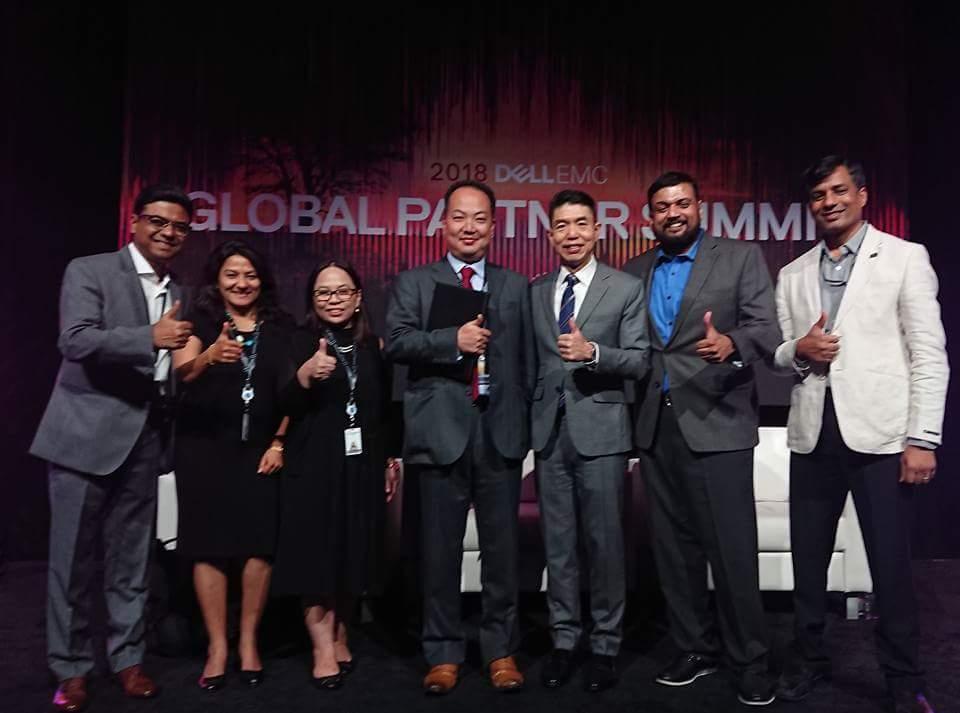
A photograph from Dell Technologies World in 2018 catches the regional team after its APJ Channels Breakout Session. More than 500 partners attended, described at the time as a record turnout. Rajagopalan stands second from the right, one thumb up, looking less like a brand theorist than a member of a crew that has just landed something heavy. It is a useful picture of his work because a channel is not an abstraction. It is a room full of people who must decide whether your plan deserves their next quarter.
“Career is not a sprint.”Advice to Dell marketing interns, 2024
The spreadsheet earns its seat
Rajagopalan's colleagues describe him as strategic, articulate, business-savvy and collaborative. One recommendation singles out his ability to form a point of view quickly because it rests on deep business context. Another emphasizes his habit of connecting marketing-effectiveness measures to tangible outcomes. The flattering adjectives are pleasant. The connecting mechanism is more revealing: he treats a key performance indicator as a claim about the business, not a decorative percentage.
Consider the dashboard implied by his results. Revenue contribution asks whether marketing helped create business. Buyer growth asks whether the company is enlarging its field of customers. Retention and NPS ask what happens after acquisition, when promises meet experience. Partner ROI asks whether the route to market is healthy. No single number gets to declare victory. Together they discourage the familiar trick of choosing whichever metric looks cheerful that month.
The four-window marketing dashboard
This approach suits infrastructure marketing, where exuberance ages quickly. Data storage, servers, private cloud, cyber resilience and AI infrastructure are bought because organisations need capacity, control and continuity. The promise has to survive a procurement process and, later, a difficult night in the data center. In that setting, restraint can be a commercial virtue. The message should be clear enough to begin a conversation and precise enough that the next expert does not have to apologize for it.
A mentor's seven small instruments
The internship advice returns us to the person operating the system. Since 2012, Rajagopalan has also volunteered as an adviser and consultant to the Dell Social Innovation Competition, helping social entrepreneurs think about how technology might support education and economic upliftment. The two mentoring settings share a theme: access to machinery is not the same as knowing what to do with it.
The advice is striking for what it omits. There is no promise of a neat ladder. Rajagopalan explicitly makes room for non-linear growth, which is convenient because his own career looks more like a lattice. Commercial marketing informed channel work. Channel work made merger integration concrete. Operations turned activity into a system. Customer intelligence sharpened the feedback. A global role now draws on all of them.
“Be your own chief storyteller,” he told the interns. It is the one instruction that sounds conventionally marketer-ish, until the next two words: make yourself interesting. The invitation is not merely to polish a personal brand. It is to acquire enough experience, relationships and perspective that there is something worth telling. Rajagopalan's LinkedIn profile lists Tamil, Hindi and English at native or bilingual proficiency, with elementary French and Russian. Even that modest detail fits the larger habit: learn another vocabulary; widen the room in which you can listen.
Now the product is the age of AI
His current mandate arrives as Dell's infrastructure business is being pulled into the AI buildout. The marketing problem is tempting to oversimplify. Three letters can make every product sound new, every forecast sound inevitable and every sentence acquire an unnecessary adjective. Rajagopalan's operating background offers a useful brake. Demand intelligence asks where intent is real. Product marketing asks what the infrastructure can actually do. Run-the-business discipline asks whether the organisation can repeat the result.
In a 2026 post celebrating Dell's fiscal-year results, he thanked customers and partners before adding “onwards and upwards.” The phrase is buoyant, but the order is instructive. Customers and partners first. Momentum second. The network remains visible even in celebration.
There is a certain elegance in spending 21 years inside a company whose public identity has expanded along with one's own job. Dell was once easy shorthand for a personal computer. Rajagopalan's career has followed the organisation into enterprise solutions, a vast merger, multi-cloud infrastructure and now AI systems. He has not simply marketed each new chapter. He has worked on the connective tissue that lets a chapter become a business: the message, the partner, the buyer, the measure and the weekly meeting where somebody asks what moved.
Perhaps that is why the short advice to interns feels more durable than a list of campaigns. Build competence. Collect relationships. Find your rituals. Ask. The market will change nouns on you. Cloud becomes multi-cloud; analytics becomes AI; a hardware company becomes a solutions company. An operator survives by keeping the verbs useful.