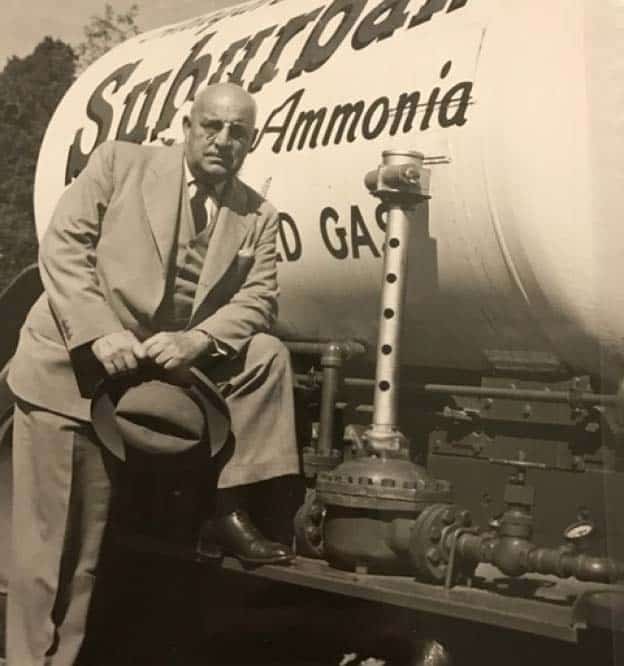
In 1928, Adele Anton had a problem with her new house in West Orange, New Jersey. There were no gas mains nearby. She preferred cooking with gas. Her husband, Mark, found an advertisement for Rock Gas, ordered propane equipment, and supplied the house himself. Then he began supplying the neighbors.
- Propane, tank installation and scheduled deliveries for homes and businesses.
- About one million customers, with service across 42 states.
- A $190 million biogas acquisition expands its role from fuel delivery into production.
That is the origin story Suburban Propane tells. Its appeal is its specificity. There was no need to invent an appetite for heat or cooking. The appetite existed. The infrastructure stopped short. Anton made the last stretch of the journey into a business. Today, that business serves about one million customers through roughly 750 locations in 42 states. The gap between a fuel source and a customer's appliance remains its territory.
The pipe has wheels
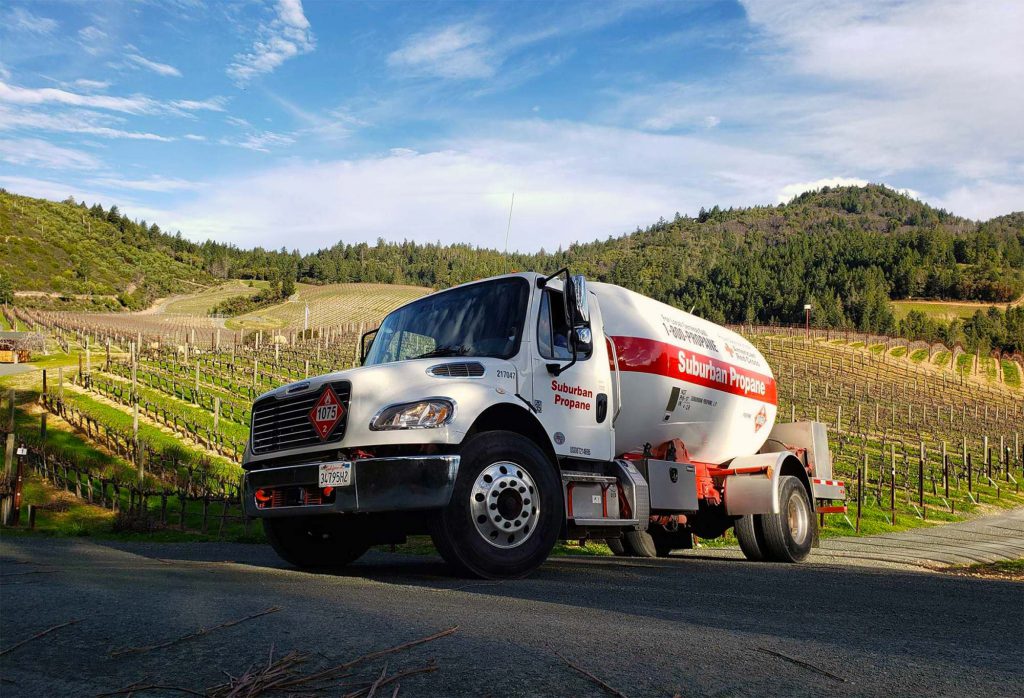
Suburban sells propane for homes, restaurants, warehouses, farms and industrial sites. Customers use it for heating, hot water, cooking, forklifts and crop drying. The company also distributes heating oil and refined fuels, markets natural gas and electricity in deregulated markets, and sells, installs and services heating equipment. It operates where a delivery truck and a storage tank can make energy available without a connection to a gas main.
The market is narrower than the word energy suggests. Suburban is not a pipeline utility with a connection to every house on a street. It must persuade customers to choose a delivered fuel and keep serving them economically.
The fuel itself is not exclusive. Independent dealers and other national propane distributors can sell the same molecule. Suburban's proposition is the machinery around it: purchasing, storage, transportation, trained drivers, tank installation and customer support. Its national accounts offering gives businesses with multiple sites another reason to consider a large network. Local execution still decides whether that network is useful. A distant purchasing advantage means little to a customer waiting for a refill.
The useful luxury of forgetting
Automatic delivery moves the scheduling job from the customer to the supplier, using estimated consumption to plan refills. Online account tools handle bills and delivery requests. A budget plan spreads estimated annual fuel spending over the year, with payments reviewed twice annually. These are practical answers to two different anxieties: remembering the tank and absorbing a winter bill.
For a prospective customer, the useful first step is a local quote. Location, consumption and service arrangements affect the economics. Ask about tank ownership, rental charges, delivery terms and the full delivered price. A budget plan changes when the money leaves your account; it does not establish a permanently cheap fuel price. Suburban advertises emergency service around the clock, but choosing a supplier still requires checking the arrangements for your property.
“Our Business is Customer Satisfaction.”Suburban Propane’s company motto
Winter is an unpaid sales director
Suburban is a publicly traded master limited partnership, listed as SPH. Its ordinary business earns money from selling fuel and related services, with the difference between procurement costs and selling prices supporting an expensive physical network. Fiscal 2025 revenue was $1.433 billion. Net income was $106.6 million. Those numbers describe a substantial operating business, rather than an early-stage energy experiment.
They also describe a business that cannot choose its weather. In the quarter ended June 27, 2026, propane sales slipped 1.8% to 70.6 million gallons. Suburban reported unusually warm spring conditions. Adjusted EBITDA, its non-GAAP operating measure, fell from $27 million to $18 million. Lower volumes arrived alongside higher payroll, vehicle and fuel costs. Fixed infrastructure does not become proportionally cheaper when customers need less heat.
Management's response includes pursuing uses less dependent on winter. In March 2026, Suburban said its NASCAR relationship covered 21 tracks, supplying operations including track drying, concessions and camping. Racing provides a conspicuous demonstration of a quieter business idea: find customers whose demand follows a different calendar. A propane truck can serve more than the household thermostat.
A $190 million second act
The more ambitious expansion begins with waste. In December 2022, Suburban bought two biogas facilities from Equilibrium Capital Group for $190 million. The transaction used borrowing and assumed green bonds. One site, in Stanfield, Arizona, processes dairy manure. The Columbus, Ohio facility takes food waste, with an upgrade project intended to turn its biogas into pipeline-quality renewable natural gas.
This changes Suburban's job. Delivering an established fuel requires reliable logistics. Producing renewable gas also requires feedstock, processing equipment, permits and markets for environmental credits. In its August 2026 results, the company reported that its upstate New York digester had entered service after quarter-end. Columbus was expected to follow during the fourth quarter. That expectation was a forecast, rather than confirmation that the upgrade was complete.
For the reader, the practical distinction is between a renewable version of a familiar fuel and a new production business. Renewable propane can use existing propane infrastructure. A digester needs its own operating system, and its gas must reach the required quality. Customers can benefit from compatibility while investors still carry the cost of building supply.
The distinction matters because the transition has already produced losses. Suburban wrote its Oberon Fuels investment down to zero as of December 28, 2024, recording a $10.2 million impairment. The filing pointed to Oberon's financial condition and uncertainty over fresh capital. It also recorded a $9.6 million impairment on Independence Hydrogen. These were investment write-downs, not the purchase price of the RNG facilities. The familiar delivery business did not make development-stage financing risk disappear.
- 01 Manure or food waste
- 02 Anaerobic digestion
- 03 Gas upgrading
- 04 Pipeline-quality RNG
What survives the trip
Suburban's declared motto is compact: “Our Business is Customer Satisfaction.” Its culture is expressed publicly through safety, employee development and SuburbanCares, including an American Red Cross relationship dating to 2012. These are company commitments; the operational test happens at individual customer locations, every day.
The lesson worth borrowing is Anton's original sequence: find an existing need, identify the missing connection, and make that connection dependable. Suburban's newer investments add a qualification. Distribution expertise can help introduce another fuel, but production technology and financing bring separate problems. Cheap accessible natural gas, competitive electric equipment, sparse delivery routes or unfavorable credit prices can weaken different parts of the model. The business still begins with a specific customer and a specific gap. A century of scale has made that gap more complicated to cross.