Consider the space between two batches of fuel. Gasoline travels through a pipeline. Diesel follows. Where they meet, the products mix, creating a liquid that no longer satisfies either specification. The industry calls it transmix. Sunoco buys it and processes it back into usable fuel. It is an unglamorous business, tucked inside a familiar name. It is also a useful place to begin understanding what Sunoco LP actually does.
- Sell stores; retain fuel contracts.
- Buy connecting infrastructure.
- Move, store, supply and process fuel.
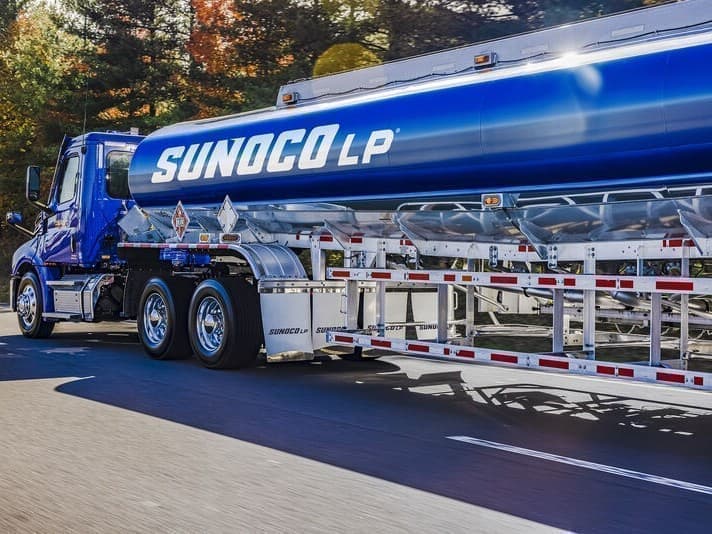
Most motorists encounter Sunoco as a sign above a pump. The company behind that sign operates farther back along the journey: buying fuel, arranging supply, moving products through pipelines, storing them in terminals and delivering them to customers. By October 2026, it described a network spanning 33 countries and territories. The pump is the visible endpoint of a much larger operation.
The name has a longer history than the partnership. Joseph Newton Pew and Edward O. Emerson started the legacy business in 1886. Today’s partnership was formed by Susser Holdings in 2012 and adopted the Sunoco LP name in 2014. Those dates describe different things: an old fuel brand and the newer legal vehicle assembling this network. Confusing them makes the modern acquisition story seem much older than it is.
01 / The store sale that kept the customer
In January 2018, Sunoco completed the sale of more than 1,000 convenience stores to 7-Eleven. The announced deal had carried a $3.3 billion price, plus inventories; Sunoco subsequently reported approximately $3.2 billion in gross proceeds at closing. The distinction matters. So does the other document attached to the transaction: a 15-year take-or-pay fuel supply agreement.
Sunoco’s subsequent annual report described approximately two billion gallons of annual supply, with up to another 500 million gallons of growth volumes added incrementally during the first four years. Ownership of the stores changed. Their need for fuel remained. Sunoco had arranged to keep serving that need.
The financial reset was substantial. The company reported reducing debt by more than $2 billion. Its historical account describes the divestiture as a move toward more stable income through distribution and logistics. That is the documented reason for the change in emphasis. Reading it as a confession that every store had failed would go beyond the evidence.
The stores changed hands.
Anatomy of the 2018 transaction
The gallons still had somewhere to go.
02 / Follow the route, buy the connections
The next big purchase made the logic easier to see. Sunoco completed its acquisition of NuStar in May 2024. Announced at approximately $7.3 billion including assumed debt, the transaction added roughly 9,500 miles of pipeline and 63 terminals. Calling that a $7.3 billion cash shopping trip would misdescribe an equity transaction whose headline value included debt.
Pipelines move large volumes between places. Terminals provide the storage and transfer points where products wait, change transport modes or receive handling services. A station operator needs dependable supply; a shipper needs a practical route and somewhere to put its product. Sunoco can serve both sides of that problem.
The business collects wholesale fuel margins alongside charges for transportation, storage and handling. Property rents, retail sales and refinery operations add other income streams. The mix matters because each activity carries its own costs and exposure to demand.
This is where its market position differs from that of a single local wholesaler or a company that only rents tank space. The pieces connect. Geography still decides whether those connections are useful: a terminal near the wrong customers is an expensive place to admire a storage tank. Sunoco competes on location, price, access and service.
03 / The customer buys fewer headaches
For an independent station owner, the offering extends beyond gasoline. Sunoco supplies branded and unbranded fuels, station branding, equipment and retail services. A fleet operator can seek diesel delivery. Construction, agricultural and government customers can inquire about bulk supply. Emergency fuel services address the particularly urgent problem of keeping operations running during a power outage.
The products are practical: gasoline, diesel, aviation fuel, lubricants and diesel exhaust fluid among them. Racing fuels occupy a more conspicuous corner of the portfolio. Sunoco became NASCAR’s official fuel in 2004. The racing connection attracts attention; routine delivery gives the commercial relationship something to live on.
A company-published testimonial from station owner Eric Schmitz reduces his choice to “economics, image, brand, and value.” It is an interested endorsement, but a revealing shopping list. A dealer is buying a package of operating advantages. The logo gets a place on the canopy only if the rest of the arrangement makes sense.
Then there is transmix. Terminals, pipeline operators, transport companies and retailers can sell Sunoco their mixed fuel. The first thing to fail here is the product specification: the mixture cannot be sold as either original fuel. Processing recovers value from that mismatch. This requires specialist facilities and fuel-quality expertise, rather than a clever label for waste.
04 / Parkland complicates the tidy version
An account of Sunoco simply abandoning retail would miss what happened next. In October 2025, it completed the Parkland acquisition, announced at approximately $9.1 billion including assumed debt. Parkland brought international distribution, convenience retail and British Columbia’s Burnaby refinery. Sunoco’s evolution includes taking on retail operations again, alongside more of the supply chain.
Q2 2026 segment adjusted EBITDA / US$ millions
By the second quarter of 2026, Sunoco sold approximately 4.1 billion gallons and reported net income of $283 million. Its June balance-sheet discussion put long-term debt at approximately $13.3 billion. Scale brings obligations. The quarter’s capital spending included $77 million for maintenance, including Sunoco’s proportionate share of joint-venture spending.
05 / Keep the demand in the deal
There is a lesson here for businesses without a pipeline budget: separate the asset you own from the recurring need you satisfy. Sunoco sold stores while retaining a contract to supply them. Another operator could examine which customer relationship should survive a divestiture before negotiating the price.
The conditions matter. Customers must keep buying, contracts must hold and the economics must cover delivery and maintenance. Fuel demand can fall; storms can interrupt operations; cheaper competing routes can take business. Owning more infrastructure does not suspend those constraints. It increases the number of places where execution matters.
Back at the pipeline, two products meet and create a problem. Sunoco has found a way to earn from fixing it. That small operation explains the wider company rather well: look along the route, find the work someone needs done, and make a business of doing it repeatedly.