Michael Hennigan’s career contains a return to the same address with a very different set of instructions. He started at Sunoco’s Marcus Hook refinery in 1981, working in engineering and operations. In 2013, as chief executive of Sunoco Logistics, he was leading the business that bought the former refinery for $60 million. The plan was to turn it into a hub for natural gas liquids. A workplace from his early career had become a question about what should happen next.
The distinction matters. A refinery processes crude oil. The proposed hub would help move products from the Marcellus and Utica shale regions toward customers. Marcus Hook’s industrial usefulness could survive a change in its principal activity. The location came with deep-water berths, rail access, pipeline connections and five underground storage caverns. These were substantial items to find lying around the old workplace.
That episode offers a way into Hennigan’s long passage through the energy business. His titles eventually included chief executive of Sunoco Logistics, chief executive of Marathon Petroleum and executive chairman of Marathon and MPLX. But the more interesting thread runs through the decisions: understanding an asset well enough to imagine another use for it, then arranging the commercial business around that use.
The same address, a different business
Marcus Hook gives the story a pleasing circularity, though the business itself was moving on. By May 2013, Sunoco Logistics was describing plans to repurpose the closed refinery as a natural-gas-liquids shipping hub. Propane was already arriving by truck and rail. The ambition connected an established industrial site on the Delaware River to the developing shale economy inland.
For Hennigan, this was familiar geography under a new business plan. His early career had included a return to Marcus Hook as business manager in 1996. He had also worked at the Philadelphia refinery and in Sunoco’s corporate planning organization. The same company had let him examine refining from several distances: the operating site, the planning desk and the financial office.
Later in 2013, Sunoco Logistics put its expansion capital forecast at approximately $900 million, excluding the Marcus Hook acquisition. Its projects included pipelines serving production regions and routes to refining markets. The opportunity was quite physical: production needed a way out, and customers needed a way to receive it. A pipeline business earns its place between those two needs.
Marcus Hook, Pennsylvania · Acquisition price: $60 million
The acquisition was effectively an internal transaction. Sunoco belonged to Energy Transfer Partners, which was also Sunoco Logistics’ general partner. That corporate relationship is useful context for the $60 million price. This was an existing industrial site being reassigned within a connected group of businesses. Hennigan’s task as logistics chief was to explain how the property would fit the new business, alongside the pipelines and terminals already serving its customers.
Learning what happens after the refinery gate
Hennigan holds a chemical engineering degree from Drexel University. His career then took him steadily into the questions that surround the equipment: what to buy, what to sell, how to move it and where a business should put its money. Technical knowledge was one part of a progressively wider assignment.
He moved into business planning in 1990 and corporate planning in 1993. Financial analysis and strategic planning followed in 1998. By 2000, his remit included wholesale fuels marketing and product supply for northeast refining. Trading, sales, supply and transportation appeared in subsequent titles. The list is long, but its direction is clear. He was moving across the business as well as up it.
When Sunoco Logistics recruited him as vice president of business development in 2009, he had already spent more than a quarter-century at Sunoco. Deborah Fretz, then the logistics company’s chief executive, welcomed the combination of commercial experience and technical knowledge. A year later he became president and chief operating officer. In 2012, he became president and CEO.
By then, he had spent years at the points where one department’s decisions become another department’s problem. Supply must meet operating requirements. Trading needs somewhere for the product to go. Financial plans have to accommodate physical constraints. Read this way, his résumé is an education in the arguments an energy company has with itself before it can make a decision.
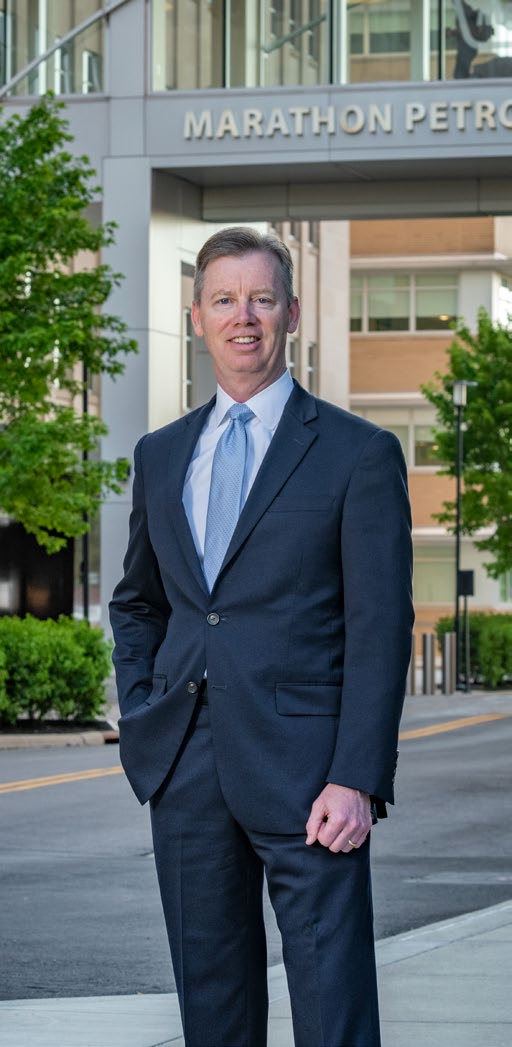
In June 2017, he joined MPLX’s general partner as president. The appointment brought the former Sunoco Logistics chief into Marathon Petroleum’s midstream business. Gary Heminger, then Marathon’s chief executive, emphasized Hennigan’s commercial experience in welcoming him. Hennigan became MPLX’s chief executive in November 2019. Four months later came the larger assignment at Marathon itself.
A $21 billion change of shape
Marathon appointed him president and CEO on March 18, 2020. The board had considered external and internal candidates. His background combined decades in refining with experience leading a midstream company. The new job asked him to bring those strands together across a larger energy business, with its own questions about corporate structure and performance.
On his first quarterly earnings call as Marathon CEO, in May, Hennigan described his background in unusually straightforward terms: “My personal background is more in the commercial area and the financial area.” It is a useful self-description from someone whose working life began in engineering. Over the intervening decades, his attention had expanded from how an operation worked to how the business around it earned its living.
“My personal background is more in the commercial area and the financial area.”
Michael J. Hennigan · May 2020 earnings call
In August 2020, Marathon agreed to sell Speedway to 7-Eleven for $21 billion in cash. The transaction closed in May 2021. For a reader trying to follow corporate strategy, that is a wonderfully legible number. A large retail business changed hands; Marathon received the money. Yet the arrangement also contained a quieter detail that fits Hennigan’s commercial background.
The agreement included a 15-year fuel supply contract for approximately 7.7 billion gallons a year associated with the Speedway business. Store ownership would change while an important supply relationship continued. Marathon was changing the shape of its company and preserving a market for its product at the same time. The shop signs were only the visible part of the transaction.
Transaction closed May 2021
The sale also posed a familiar management question: what should a company own, and what can it accomplish through a contract? Ownership brings control and responsibility. A supply agreement creates a different connection. In the Speedway deal, those choices sat side by side. Hennigan’s years in logistics, supply and trading made the episode particularly apt for his career story.
Another refinery, another assignment
The Marcus Hook episode also finds an echo in Marathon’s renewable fuels projects. During Hennigan’s tenure, the company converted facilities in Dickinson, North Dakota, and Martinez, California, to renewable diesel production. The practical idea was again to give existing industrial assets a different assignment. The feedstocks and finished products changed; the need for equipment, logistics and commercial arrangements remained.
Dickinson began producing renewable diesel in 2020. Martinez, co-owned through a joint venture with Neste, began in the first quarter of 2023. These projects belonged to a company still operating a substantial petroleum business. Their place in the story is specific: they show another instance of investment directed toward changing what an established site could produce.
In his 2023 climate report message, Hennigan connected environmental performance with operating economics. He described more than $100 million in energy-efficiency cost savings in 2022. The figure gives that discussion a practical grounding. Energy consumed inside an operation has a cost as well as an emissions consequence; using less of it can matter on both sides of the ledger.
That does not make every conversion the same story. Marcus Hook’s planned role was logistics and storage. Dickinson and Martinez became renewable fuel producers. But the episodes belong together in a profile of Hennigan because each asks a question about the future usefulness of an existing asset. A long industrial career includes knowing when the original assignment needs revisiting.
The handover, and the next assignment
In May 2024, Marathon announced that Maryann Mannen would succeed Hennigan as CEO on August 1. He would become executive chairman. She had joined as chief financial officer in 2021 and become president in January 2024. The transition gave the company a sequence of changes in responsibility rather than a single abrupt exchange of titles.
At the announcement, Marathon credited the period under Hennigan with approximately $37 billion returned to shareholders through dividends and repurchases. That figure describes a company’s capital returns during a defined period, involving an entire organization and the markets in which it operated. Hennigan’s own contribution also included preparing to pass responsibility to the executive who would follow him.
He retired as executive chairman of Marathon and MPLX in December 2025. By May 2026, another assignment had arrived: independent director of Kayne Anderson Energy Infrastructure Fund. He also served on the boards of Nutrien and The Cigna Group. The new fund role kept his work close to the infrastructure businesses he had spent years operating.
From Marcus Hook to those boardrooms, the continuity lies in the range of questions he learned to ask. What can this site do? Who needs its output? How will it reach them? Where should the capital go? His career took decades to bring those questions into the same office. At Marcus Hook, one of the answers was waiting at an address he already knew.