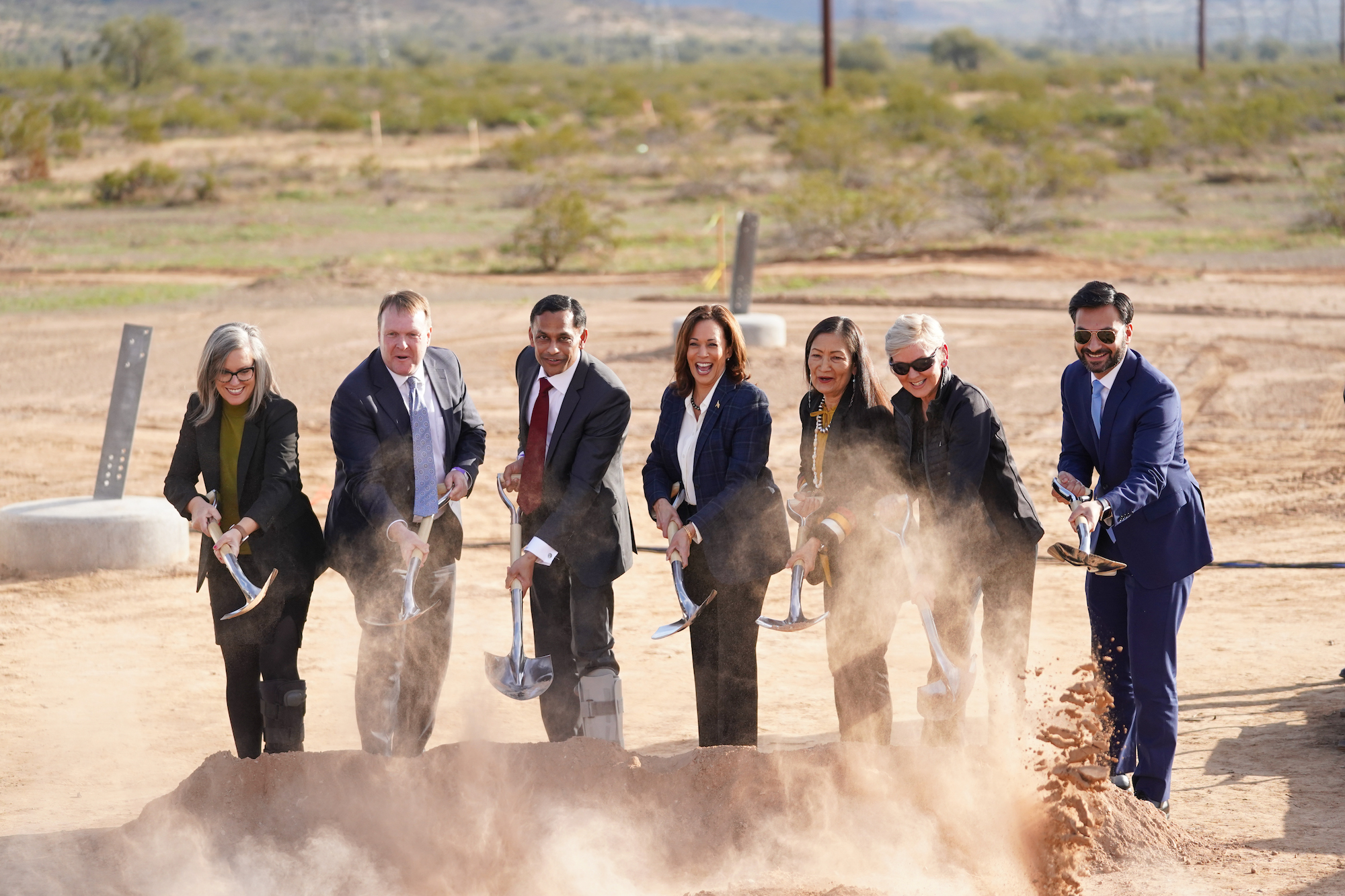
In January 2023, Himanshu Saxena stood in the Arizona desert with a collection of people whose calendars are generally difficult to reconcile. Vice President Kamala Harris was there. So were Energy Secretary Jennifer Granholm, Interior Secretary Deb Haaland and Arizona Governor Katie Hobbs. They had gathered near Tonopah to mark construction of Ten West Link, a transmission line connecting Arizona and California. The object of all this attention was 125 miles of electrical infrastructure. Wires rarely receive such distinguished company.
For Saxena, chairman and chief executive of Lotus Infrastructure Partners, the occasion made a long-running investment argument visible. Building renewable generation is one part of changing an energy system. Getting its output to the people who need it requires another set of assets, another set of approvals and considerable patience. A solar farm can look persuasive in a photograph. A connection to the grid has to work.
Ten West Link entered commercial operation on June 12, 2024. Behind that date lay a competitive selection in 2015 and years of coordination across jurisdictions. Saxena thanked the agencies and partners who had worked on the project over nine years. The distance was measured in miles; the effort was measured in calendars.
Before the balance sheet, the molecules
Saxena’s route into infrastructure finance began with chemical engineering. He earned a bachelor’s degree at the Indian Institute of Technology in Bombay, then a master’s at Cornell University. Cornell identifies him as MS ’00. An MBA at Duke followed; he was a Fuqua Scholar. The sequence put engineering and business on the same résumé before either became the defining label.
At industrial gases company Praxair, now part of Linde, he worked as a chemical engineer and filed for several patents. His later work at American Electric Power concerned financial risk in power trading and the optimization of a generation portfolio. He then joined JPMorgan’s global energy and utilities investment banking group. Across those jobs, the subject remained energy, while the questions changed: how a process works, how an asset earns money, how a transaction gets financed.
That progression offers a useful way to read his subsequent investments. Hydrogen infrastructure and ammonia production have a chemical vocabulary. Power trading has a financial vocabulary. Transmission has an engineering vocabulary and a regulatory one. Saxena had worked in several of those worlds before arriving at Starwood Energy in February 2008. His career crossed disciplines that an infrastructure project must eventually persuade to cooperate.
- PraxairChemical engineering
- American Electric PowerTrading risk & generation
- JPMorganEnergy & utilities banking
- 2008 → 2017 → 2023Starwood arrival → CEO → Lotus
The apprenticeship becomes the job
Starwood Energy made him co-head of the business in 2015, alongside Brad Nordholm. In November 2017, Saxena became chief executive, while Nordholm moved to vice chairman. By the time of that appointment, Saxena had led acquisitions and development involving approximately 4,500 megawatts of power generation and transmission projects, with an aggregate enterprise value of about $5 billion.
Barry Sternlicht, then chairman of Starwood Energy, credited him with helping build both the team and the investment platform. It was a promotion following years inside the organization. The CEO announcement placed responsibility for the investment program, strategy and management of the firm together. Such responsibilities sound tidy on paper. In infrastructure, they attach to assets with construction schedules, counterparties and operating obligations.
The figures in the appointment announcement describe a point in his career. His current Lotus biography puts the aggregate enterprise value of projects and assets he has led over his career above $13 billion. That includes power generation, transmission, and midstream and downstream assets in North America. Enterprise value describes transactions and businesses. It says nothing about the contents of his personal bank account.
A battery is also a business arrangement
By 2018, Saxena was discussing storage as a growing part of the power system. Starwood had moved into the field in 2016 with a $100 million investment in Stem. Its customer-site storage model involved developing, owning and operating systems in return for recurring lease payments. The battery arrived with an arrangement for who would pay for it.
In a February 2018 interview, Saxena separated two questions about storage: improving technical performance and reducing cost. He also distinguished systems behind a customer’s meter from utility-scale systems connected directly to the grid. Those distinctions matter to an investor because a useful technology can earn revenue in different ways, under different rules.
His attention extended to corporate power-purchase agreements and the willingness of utilities to enter long-term storage contracts. Those agreements help turn demand into something that can support development and financing. The recurring theme is the connection between an asset’s purpose and its commercial structure. A battery may store electricity; the investment still needs a customer, a workable price and permission to participate in its market.
The flower and the machinery
In January 2023, the business emerged under the name Lotus Infrastructure Partners. Saxena had a botanical explanation for the choice: “The lotus flower is a symbol of purity, prosperity and perseverance.” For a firm involved in long development cycles, perseverance was a particularly relevant item in the bouquet.
He described independence as a natural stage in the organization’s growth. Infrastructure and real estate, he argued, were different businesses, and the team had reached a scale at which it could stand on its own. The change of name continued an existing investment approach, with room for the range of opportunities created by decarbonization.
One part of that approach was reconsidering what an existing industrial site could become. Saxena discussed acquiring coal plants with the intention of closing them and reusing land and interconnection rights for renewable assets or battery storage. He also discussed ways to reduce emissions from gas generation. Those were investment intentions, dependent on economics and execution. A connection already in place could be valuable even when the equipment attached to it had reached the end of its purpose.
Nine years for a line on the map
Ten West Link puts the patience involved into scale. DCR Transmission, a joint venture led by Lotus affiliates, was selected through a competitive process in 2015. The line runs between the Delaney substation in Arizona and the Colorado River substation in California. Its conductor capability is 3,200 megawatts at 500 kilovolts. It connects regions that need to exchange electricity, including output from new renewable generation.
A schematic connection, not a geographic map. Capacity is a technical rating, not a measure of continuous renewable output.
At an April 2024 event recognizing completion, Saxena described a need for reliable, lower-cost power. He also offered a compact explanation of the project’s place in the transition: “There is not going to be an energy transition without new transmission.” It is a sentence with the practical advantage of fitting on a slide and the practical disadvantage of requiring years of work to fulfill.
“There is not going to be an energy transition without new transmission.”Himanshu Saxena, April 2024
The California Independent System Operator took operational control of the line in June 2024. At that point, Lotus reported more than 7,000 megawatts of renewable resources applying to connect through it. Applications are a pipeline of interest, rather than completed projects. Still, they show why the connection mattered: a line can create an opening for generation that has yet to be built.
His old industry returns in a new form
A month after the Lotus launch, the firm announced NeuVentus, a platform for hydrogen pipeline transportation and salt cavern storage. Initial projects were aimed at the Texas Gulf Coast. Saxena described the opportunity as bringing together renewable energy, midstream and downstream expertise. Sam Porter, NeuVentus’s chief executive, led the operating platform.
The project areas recall Saxena’s early work in industrial gases, though on a different commercial scale. Producing hydrogen and moving it to a customer are separate problems. Storage introduces another. NeuVentus was formed to develop infrastructure for those movements and pauses, with fee-for-service transportation and storage as its planned model. The launch announcement described a platform to be developed, rather than a network already operating.
Ammonia supplied another connection between chemistry and investment. In July 2026, Lotus announced that an affiliate, together with MB Energy, had agreed to sell Gulf Coast Ammonia’s Texas City facility to Yara North America. The announced consideration was $1.3 billion plus certain working-capital adjustments. Its nameplate capacity was approximately 1.3 million metric tons annually.
The facility was in commissioning when the agreement was announced, and completion of the sale remained subject to regulatory approvals and other conditions. Saxena emphasized demand for ammonia and the role of customers and strategic partners. The episode follows an industrial project through development, construction and a proposed transfer to an operator in the ammonia business. Each stage asks something different of capital.
A larger fund, the same physical questions
In August 2026, Lotus announced final closings representing about $1.8 billion across Fund IV investments, future co-investments and a single-asset continuation vehicle. That total covered several vehicles. The announced investment areas included generation, transmission, storage, biofuels, ammonia and methanol. Saxena pointed to artificial intelligence and industrial consumption as drivers of new infrastructure demand.
His work also continues through Cornell infrastructure, energy and engineering advisory bodies, and the American Council on Renewable Energy. In a Cornell video, he argues that decarbonization will require a combination of technologies and that developing economies face a different path as their energy consumption grows. The position fits the breadth of the investments: electricity, fuels, networks and the equipment that makes them usable.
For all the changes in names and fund sizes, Saxena’s story keeps returning to the same practical junction. Someone must understand the equipment. Someone must arrange the financing. Someone must secure the connection and find the customer. His career has moved through each of those conversations. In the Arizona desert, they briefly shared a stage. The more consequential moment came later, when the line entered service.
Continue the conversation
- Lotus Infrastructure Partners ↗
- Himanshu Saxena on LinkedIn ↗
- Decarbonization Challenges / Cornell video ↗
- Lotus on YouTube ↗
- Lotus on X ↗
- Lotus on Facebook ↗
- Lotus on LinkedIn ↗
- Ten West Link ↗
- April 2024 reporting / Inside Climate News ↗
- August 2026 capital announcement ↗
- July 2026 ammonia agreement ↗
- Career biography ↗