In February 2024, Saum Sutaria was discussing an acquisition pipeline when he placed a small obstacle in the path of a large ambition. There was a target. There were prospective deals. There was also the possibility of paying too much. He said the company would not pursue a number for its own sake. For an executive on an earnings call, it was a useful moment to apply the brakes.
Targets have social advantages. They fit on slides. They travel comfortably from a board meeting to an investor presentation. A condition is less glamorous: only at the right price, only with the right assets, only if the business can improve afterward. Sutaria supplied the conditions. The number would have to wait its turn.
That exchange offers an entry into his working life. He spent 18 years at McKinsey & Company advising other organizations. In January 2019, he crossed into Tenet’s management team. By September 2021, he was chief executive. In August 2023, he became chairman as well. The consultant had acquired a particularly demanding client: the company he now ran.
His story is best followed through those changes in responsibility. The early work was about understanding businesses and proposing decisions. The later work required making the decisions, appointing people to carry them out, and answering for the results. The vocabulary could remain familiar. The consequences now came back to his desk.
Two subjects, then eighteen years
At the University of California, Berkeley, Sutaria earned degrees in molecular and cellular biology and economics. The pairing puts two very different kinds of explanation on the same résumé. One investigates living systems. The other examines choices, incentives, and scarce resources. It would be too convenient to claim that an undergraduate course list predicted his career. It does, however, make the subsequent breadth less surprising.
His 18 years at McKinsey eventually brought him to senior partner. His advisory work covered strategy, operations, finance, and institutional investors. By December 2016, he was appearing at Stanford’s State of the West symposium in that capacity. Before he entered Tenet, explaining complicated organizations was already a public part of his professional life.
There was writing, too. In May 2018, he coauthored an article examining corporate scale and acquisition strategy. Its premise was that familiar reasons for combining businesses would persist while the ways of creating value would change. Size was a starting point for questions about the business. A bigger organization still had to justify the combination.
Read beside his later comments about purchase discipline, that earlier work gives his career some continuity. The questions did not disappear when he changed employers. What should be combined? What does ownership make possible? What work remains once the transaction has been announced? Eventually, the author would have an operating company with which to answer.
The consulting years also produced relationships that lasted beyond the firm. Peter Attia has described Sutaria as an important mentor and the person who recruited him to McKinsey in 2006. They reunited for a recorded conversation in December 2024. In the accompanying notes, Attia described him as a particularly structured thinker. It is a useful description from someone who knew him before the Tenet titles.
At McKinsey before joining Tenet in January 2019.
The chair was already being prepared
Tenet announced Sutaria’s appointment in November 2018, with a January 6, 2019 start date. His new role was chief operating officer. He would report to Ron Rittenmeyer, then executive chairman and CEO. The company also eliminated a management layer as part of the change. Even the organization chart was being asked to do less standing around.
Rittenmeyer had recruited someone with long experience examining other organizations. Now that experience would be tested from inside one. The distinction is practical. An adviser can point out that responsibilities overlap. An operating executive has to decide whose responsibilities change and then keep the work moving.
A photograph published in June 2019 catches the two executives in a less formal chapter of that transition. At an anniversary celebration in Palm Beach, Sutaria stands at the right of a group that includes Rittenmeyer. It is an ordinary corporate event photograph, which is part of its appeal. The future succession is still a working relationship between people appearing in the same room.
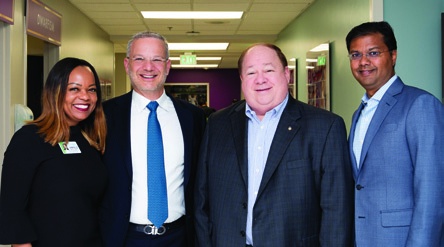
He added the presidency in November 2019 and joined the board in November 2020. When Tenet announced him as its next CEO in August 2021, he had already occupied several positions from which to understand the enterprise. The handover was presented as a succession plan developed by Rittenmeyer and the board. Sutaria took the top job on September 1.
Rittenmeyer described a colleague attentive to both immediate demands and longer horizons. He would remain executive chairman during the transition. That arrangement gave the change a period of overlap: a successor assuming executive responsibility while the predecessor retained a senior role. The dates matter because they show how much preparation sat behind the announcement.
President in November
in November
on September 1
on August 10
In August 2023, Sutaria succeeded Bob Kerrey as chairman. Kerrey moved to lead director. Sutaria now held the two positions most visible at the top of the organization, while the board retained a separate lead director. His arrival had become a sequence: operations, presidency, board membership, chief executive, chairman. Each appointment widened the responsibilities attached to his name.
The work after the deal
The February 2024 acquisition discussion becomes more interesting against that background. Sutaria was responding to a question about USPI’s development pipeline and an expansion target. His answer put asset quality, valuation, and subsequent earnings growth into the same explanation. A purchase needed to be attractive when signed and useful after the ink dried.
“So we’re not going to chase a number.”
Saum Sutaria · February 2024
That is a statement of intent, and it deserves to be read as one. It does not establish that every acquisition will work. It does establish the test he publicly offered: the terms and the capacity to improve an asset should govern the appetite to buy. An executive can be measured against such a statement later. The restraint becomes part of the promise.
His choice of colleagues supplies another piece of the picture. In 2023, Tenet appointed Sun Park to succeed Dan Cancelmi as chief financial officer. Sutaria welcomed Park’s experience and his approach to data and outcomes. The appointment placed a new finance leader beside a CEO whose own career had repeatedly joined strategy to financial analysis.
There is a less celebrated part of running an institution: telling people how they are expected to behave. In his introduction to Tenet’s code of conduct, Sutaria writes, “We must act with integrity in everything we do, every day”. The surrounding instructions ask employees to understand the rules and seek help when questions arise. A code is a commitment whose value depends on what follows it.
By February 2026, his public discussion of expenses included a broader deployment of technology and automation. He distinguished structural changes to how work is performed from the familiar annual search for savings. The discussion extended beyond the AI label. That is a useful operating distinction: a technology investment has to reach an actual task before it can change its cost.
Another board, a family connection
One of Sutaria’s other institutional commitments begins with two daughters and a sport. When he was introduced at a USA Water Polo board meeting in September 2024, he shared that both daughters played water polo. His appointment had been unanimously approved by the nominating and governance committee that May. The family detail brings the board biography down to a human scale.
USA Water Polo’s directors are volunteers charged with setting the organization’s strategic direction. Sutaria is listed as an independent director. Its 2025 committee lists place him on audit and finance, and on nominating and governance. The assignments are familiar territory for a corporate leader, even as the institution’s purpose and participants differ.
The minutes from the meeting at which he was introduced also record discussions of finances, costs, and possible ways to raise funds. Those are ordinary institutional questions, and they are consequential ones. Someone has to examine the numbers, consider alternatives, and help keep an organization capable of doing its work. Sporting ambition has a balance sheet, too.
The connection does not require a grand theory about his parenting or personality. Two daughters play a sport; their father joins its national governing board and takes on committee duties. It is a specific commitment with a documented family connection. Alongside the succession dates and corporate appointments, it adds a different reason for his name to appear on a meeting agenda.
The next report is still ahead
By July 2026, Tenet was reporting quarterly net operating revenue of $5.628 billion and adjusted EBITDA of $1.304 billion. The latter is a company-defined, non-GAAP earnings measure. Management raised its annual outlook, and the board increased its share repurchase authorization by $2 billion. Those are company results and decisions; they reflect work across an enterprise, beyond any single executive.
*Non-GAAP measure reported by the company. Historical quarterly figures, not personal earnings.
There are more decisions ahead. In September, Tenet announced pricing for a $2 billion note offering intended to refinance existing debt. On October 2, it set October 29 as the date for its next results announcement. As of this profile’s publication, that report is still in the future. The chronology remains open.
That seems an appropriate place to leave Sutaria: between decisions already made and numbers still to come. His public career offers an extended view of someone moving closer to the consequences of his advice. Eighteen years spent examining other businesses led to responsibility for one. The acquisition target can wait for the right terms. The next operating decision cannot.