Tomofumi Nakata once tried to predict what people would pay to watch. At Harvard, he wrote a paper applying statistical methods to movie box-office performance. Years later, the co-founder and CEO of Qlay is working on a rather different performance problem: how much of an online interview belongs to the person taking it?
There is an intriguing connection between those two projects. A film offers a carefully constructed appearance. A hiring interview offers a carefully constructed introduction. Both invite an audience to make a judgment with incomplete information. Nakata has moved from studying audiences to helping employers examine what happens on the other side of a screen. The camera has survived the career changes remarkably well.
The film student who kept the numbers
His childhood included Singapore, Tokyo and California. He went to Harvard with an interest in film production, then switched to statistics. Those interests met in his box-office paper, which used principal component analysis and clustering techniques. He graduated in 2019. There is something pleasingly practical about studying the movies through the money they make: an audience can applaud a premise, but eventually somebody must buy a ticket.
His college life also included men's rugby and Japan Society. On his professional profile, he lists English and Japanese at native or bilingual proficiency. These are useful particulars in a career that has crossed the Pacific repeatedly. They describe experience and language, without requiring a grand theory about what a childhood in several places must do to a person.
At McKinsey, he worked in Tokyo and Los Angeles, advising large companies. His assignments included investment allocation, consumer purchasing behavior and growth strategy. One electronics-company project reduced net working capital by more than $25 million. Another involved consumer surveys for a fast-food business across multiple markets. He also worked on a beverage company's portfolio growth framework. His work put statistical analysis beside decisions about what businesses should actually do.
Then he wanted responsibility for the business itself. His explanation was unusually plain: he wanted to get closer to “producing things that are needed, selling them, and earning money.” A consultant can recommend a decision; a founder must live with the invoice. Nakata's move into entrepreneurship gave him a different relationship with the consequences of his advice.
That change also makes the earlier career more interesting to read. The consulting assignments involved customers, markets and investment choices inside established organizations. With Qlay, Nakata had to choose a problem around which to build an organization. Each subsequent description of the product made that choice more specific: consumer sentiment, engineering recruitment, the integrity of an interview. A founder can carry experience from one setting into another, but the customer still gets to decide whether it helps. His résumé could begin a conversation. The product would have to continue it.
From advising a customer's business to finding customers for his own.
A first audience, then a different question
Nakata and Tokumasa Yamashita met through a co-founder matching program. Qlay's company history dates its establishment to October 2023. Yamashita became COO and CTO, bringing experience in software, finance and a previous AI startup. Their partnership paired Nakata's consumer-strategy background with a colleague who had already built and operated technology businesses. The matching program supplied the introduction; it supplied no guarantee that the work would be easy.
Early Qlay addressed consumer sentiment. It used generative AI to make sense of language collected from online material, including social media and reviews. The commercial question was familiar to a former marketing consultant: what are customers saying, and what should a business do with that information? Reading every comment by hand has a certain romantic thoroughness. It also makes a poor plan for getting home on time.
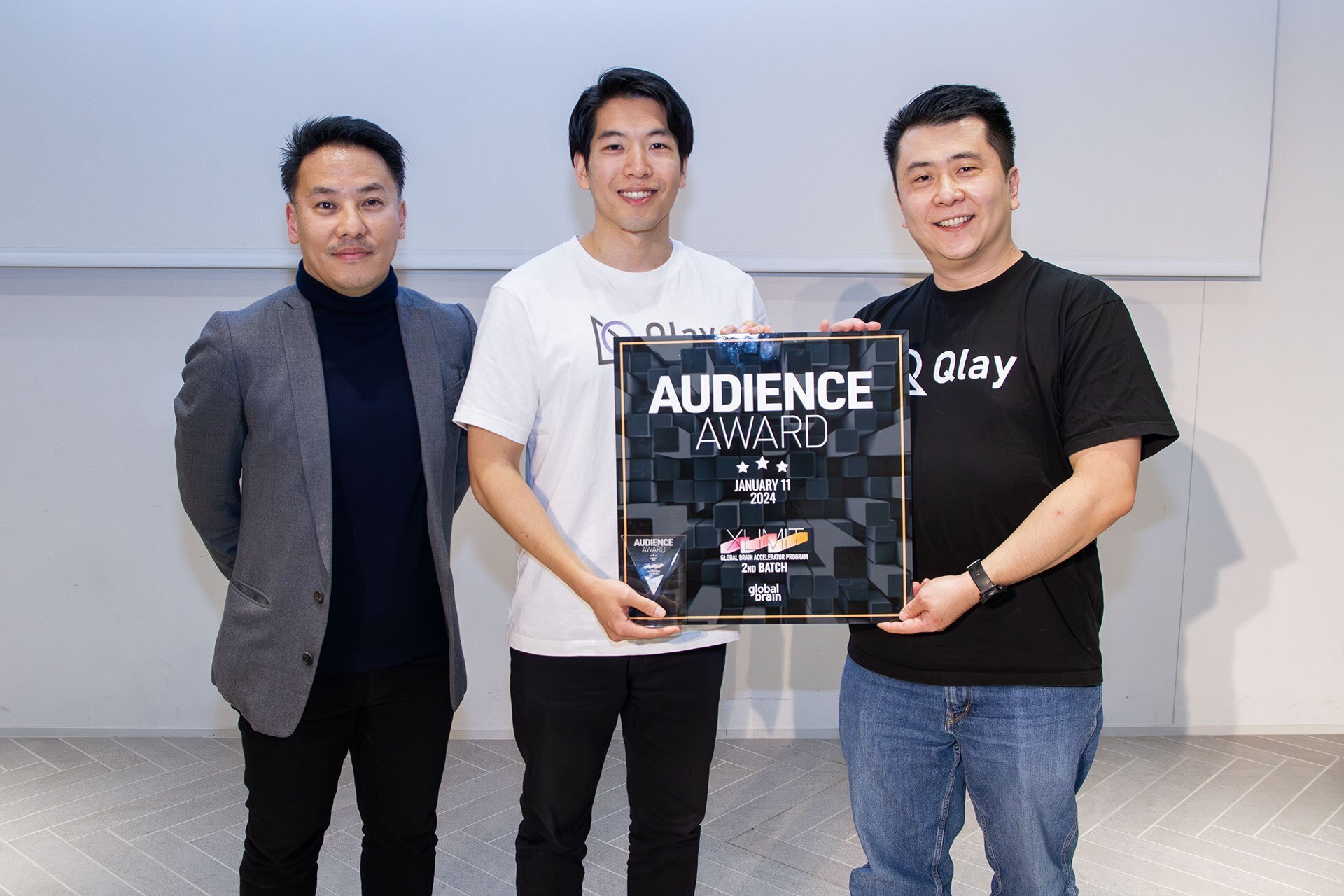
On January 11, 2024, Qlay won the audience award at the second XLIMIT Demo Day. The accelerator program had begun the previous October and brought its participating companies through mentoring and other support before their pitches. The audience prize was decided by attendee votes; the judges' award went to Flamers. The distinction matters. Qlay had persuaded the room, a modest but concrete test for a company selling a new idea.
By March 2024, Qlay had contracted with a Fortune 100 company for consumer-sentiment analysis connected to automotive marketing. That was an early commercial application of the research product. Later descriptions of Qlay moved toward engineering recruitment, automated screening and interview proctoring. The sequence shows a business changing its focus. It does not require a tidy retrospective claim that the founders knew the destination from the beginning.
The problem hiding outside the frame
In November 2024, Nakata presented Qlay at the Japan-Korea Startup Founder's Day in Palo Alto. The gathering brought together the two countries' consulates and startup communities. His own description placed Qlay in Berkeley SkyDeck's Batch 17 IPP. In another public appearance at 500 Global's Product Open House, he described a service that helped startups source, screen and shortlist engineering talent. Recruitment had become a public part of the proposition.
The next difficulty follows naturally from that work. An employer wants to know what a candidate can do. A remote interview provides answers, but those answers can arrive with assistance the interviewer cannot see. Software that helps people work can also help them present an ability they have not demonstrated independently. The useful distinction is between permitted assistance and assistance concealed from the person doing the evaluation.
Qlay now markets an AI Proctor for remote interviews and tests. Its published features include a smartphone used as a second camera, eye-gaze tracking, speech-cadence analysis, application and tab monitoring, alerts and a session report. The second camera gives a side view of the setting. Gaze and speech analysis look for patterns that might indicate outside help. These are the company's descriptions of its tools; a suspicious signal still calls for interpretation.
A phone camera sees more of the interview setting.
Eye movement and speech rhythm offer possible clues.
App monitoring, alerts and reports help an interviewer follow up.
At a January 2026 presentation around CES, Nakata demonstrated the idea with a video. An audience member failed to detect the interviewee's cheating until Nakata pointed it out. The episode is a revealing piece of salesmanship: the audience gets to experience its own difficulty before hearing about the proposed solution. A product demonstration has acquired the plot of a short detective story.
For Nakata, that problem links recruitment to the older work of assessing consumer evidence. In each case, a decision depends on understanding what the available material represents. The stakes and methods differ. Customer comments concern a market; an interview concerns an individual. The common commercial challenge is helping a customer decide what deserves attention before committing money and time.
The moat needs a front door
In a conversation with Amy Chen, Nakata described two requirements for a lasting AI business: something competitors would find difficult to reproduce, and an effective route to customers. For Qlay's recruitment business, he identified its talent database as the former. He also stressed connections with customers and the team's ability to execute sales. In his telling, easier access to AI models leaves plenty of difficult business work intact.
That argument is refreshingly earthbound. A useful tool must reach someone who needs it, earn that person's confidence and fit into a working routine. Having a clever demonstration helps. So does knowing who will approve the purchase. The distance between those two conversations can consume a founder's calendar. Nakata's emphasis on sales makes sense of the public events that accompany his product work.
He has appeared in Qlay's gatherings with Open Network Lab, including a fireside conversation with Translink Capital's Kelvin Mu in Palo Alto. A separate AI Keynotes event brought in speakers from Voyage AI and Google. These occasions place the company among founders, investors and technical practitioners. They offer a public view of how Nakata spends part of his time: convening conversations as well as presenting his own company's answers.
Planned priorities: product development, customer acquisition in Japan and the United States, and partnerships.
Qlay announced $1.4 million in pre-seed funding on August 5, 2025. Participants included Nissay Capital, ANOBAKA, East Ventures, Global Brain, Digital Garage, Headline Asia and Z Venture Capital. The announcement set out plans for product development and customer acquisition, particularly in Japan and the United States. Financing supplied resources for the next stage. The work of turning prospective customers into paying ones remained.
A shark with a sales calendar
Asked to describe his team in early 2024, Nakata chose “A shark that never stops.” He explained a preference for acting, collecting information and then thinking through the next decision. He also named authenticity and impact as personal tests for his work. The resulting picture has a useful tension: move quickly, but have a reason for moving. The shark, apparently, is expected to justify its itinerary.
Qlay's continued public presence included 4YFN in Barcelona in 2026, where its company posts discussed interview proctoring and fair evaluation. That gives the career another setting beyond the Tokyo-Los Angeles consulting years and the San Francisco startup base. The business question travels with him: how can an employer make a sound judgment about someone encountered through software?
The student studying box-office results and the founder demonstrating interview assistance share an interest in what lies behind a convincing performance. Nakata has changed the setting, the customer and the product. He has also accepted the founder's obligation to make the argument commercially useful. His next audience will have its own questions. Somewhere among them will be the least cinematic question in business, and perhaps the most decisive: will we pay for this?