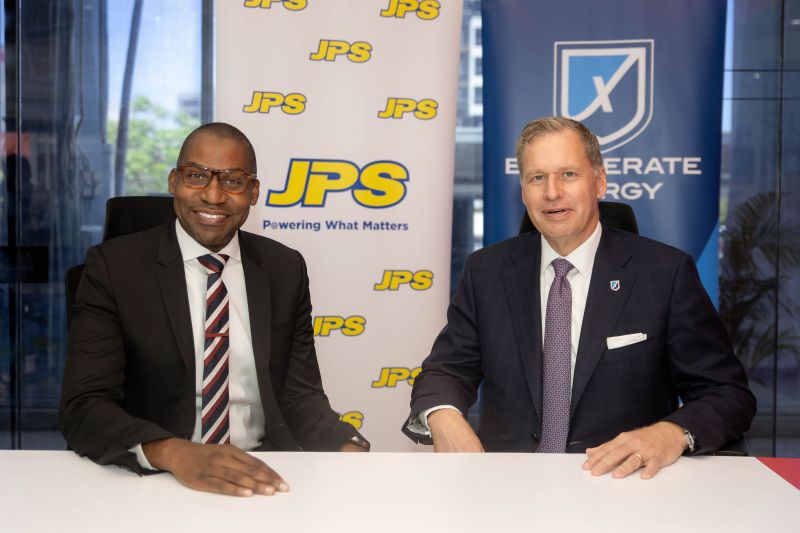
In May 2025, Steven Kobos sat down with Hugh Grant, the president and chief executive of Jamaica Public Service. Behind them stood the banners of their two companies. In front of them was an otherwise unremarkable white table. Excelerate Energy had just bought a business in Jamaica for roughly $1.1 billion. Now came the conversation with the electricity provider that was its largest customer on the island.
The photograph has none of the drama usually assigned to the energy business. No flare stack. No champagne. Two executives, a table and the practical matter of keeping a country supplied. It is a useful place to begin with Kobos, whose career has followed the less photogenic portions of the journey from an agreement to an operating asset.
He became Excelerate’s president and chief executive in 2018, after years of legal work for the company. By the Jamaica meeting, he was leading a publicly traded business whose responsibilities extended from floating terminals into fuel supply and power generation. The lawyer who once helped put the arrangements together was now responsible for making the whole arrangement work.
An Oklahoma education, an international brief
Kobos earned a bachelor’s degree at the University of Oklahoma in 1986 and a law degree there in 1990. His J.D. came with highest honors. His professional vocabulary would eventually include charter parties, international oil and gas transactions, shipping and liquefied natural gas. These are subjects in which a misplaced word can become an expensive travelling companion.
While employed by Frederic Dorwart, Lawyers, he served as managing counsel with primary legal responsibility for Excelerate’s global projects. He worked as the company’s counsel for approximately eleven years before taking the top job. He joined the partnership’s board in 2017. The distinction matters: he arrived in management with a long acquaintance with the business, rather than discovering its contracts after accepting the keys.
In June 2026, his conversation on C.O.B. Tuesday returned to helping launch LNG imports into Kuwait and opening markets in South Asia. His working geography has also encompassed Argentina, Brazil, Finland and Germany. The recurring task is unusually concrete: find a way for a country to receive fuel it cannot yet receive, then connect that fuel to the people and businesses waiting for it.
A floating terminal still needs a shore
Excelerate’s signature equipment carries a cumbersome name: floating storage and regasification unit, usually shortened to FSRU. The vessel stores liquefied natural gas, turns it back into gas and sends it into a receiving network. A ship can move between markets. A country’s pipelines, port structures and electricity system have considerably less freedom to pack up and leave.
That meeting point between mobility and fixed infrastructure is the territory Kobos has made his business. An available ship solves part of the problem. Berthing arrangements, connections, fuel procurement and customers still have to fit together. His move from legal adviser to operator places him on both sides of that familiar divide between a project that can be signed and one that can run.
In November 2020, Excelerate announced that its fleet had completed the transition to its own ship-management subsidiary, Excelerate Technical Management. Ten ships had changed management in ten months. Kobos congratulated the management team and more than 600 seafarers who supported the work. It was an operational milestone with a distinctly unglamorous virtue: the company was taking more direct responsibility for the service it sold.
“Transitioning 10 ships in 10 months,” he said. The symmetry makes a tidy line. The work behind it involved crews, compliance and a sequence of individual vessels. For a chief executive whose earlier responsibilities lay in legal agreements, bringing fleet management inside the company was a consequential expansion of what answering for a project meant.
Finland puts the proposition on a clock
In 2022, the European energy emergency gave floating terminals a newly urgent audience. Finland needed an alternative to Russian pipeline gas. In May, Gasgrid Finland signed a ten-year agreement with Excelerate for a terminal vessel. By August, construction was under way at Inkoo. The timetable left little room for the leisurely habits associated with large infrastructure.
The Exemplar arrived on December 28. It was connected to the gas network the following day; commercial operations began on January 16, 2023. Those dates tell the story better than an adjective. Within months, a charter agreement had become a functioning route for imported gas. The vessel was essential, as were the port works and connecting pipeline that gave it somewhere useful to send its cargo.
Kobos’s company had equipment that could travel to the problem. Gasgrid and its partners supplied the local work that made arrival meaningful. For him, Finland offered a particularly visible demonstration of the business he was running: an international asset becoming part of a national energy system, with public policy and commercial execution tied to the same calendar.
The terminal’s early use also supplied a useful qualification. Demand and available capacity are different things. A mild early winter helped limit initial utilisation; Gasgrid recorded 18 LNG cargoes during 2023. Building an alternative route gives buyers an option. It does not require them to use every available unit of capacity immediately.
- MAY 2022Ten-year charter signed
- 28 DEC 2022Exemplar arrives
- 16 JAN 2023Commercial operations begin
Wall Street, then further downstream
Another calendar was running in parallel. Excelerate priced its initial public offering in April 2022 at $24 a share. The completed offering, including the underwriters’ option, comprised 18.4 million shares. Kobos had taken the chief executive role four years earlier; now the company’s plans would be assessed in the recurring public rhythm of earnings, guidance and capital allocation.
Excelerate had been founded in 2003 by George B. Kaiser. Kobos’s place in this history is the long-serving adviser who became its operating leader and guided it through a listing. Keeping those roles distinct makes his story more interesting. His experience came from knowing the machinery of the company before he became responsible for its direction.
Jamaica made that direction tangible. The acquisition closed on May 14, 2025, bringing the Montego Bay LNG terminal, the Old Harbour LNG terminal and the Clarendon combined heat and power plant into Excelerate. The purchase joined import infrastructure to an asset that generates energy. It widened the company’s involvement in what happens after LNG reaches the coast.
Financing was part of the undertaking: an equity offering produced $212 million in gross proceeds, and an $800 million notes offering helped fund the transaction. The numbers explain the scale. The follow-through explains the job. Owning linked assets means integrating people and operations as well as arranging the purchase price.
The people on the other side of the deal
After the Jamaica closing, Kobos travelled with colleagues to meet nearly 100 employees joining Excelerate. Chief operating officer David Liner and human resources leader Amy Thompson were part of the visit. Kobos also met Prime Minister Andrew Holness. A transaction that appears as a single line in an acquisition table became a series of introductions, facility visits and commitments.
His meeting with Grant brought the customer into that picture. Jamaica Public Service was both the island’s primary electricity provider and Excelerate’s largest local customer. A fuel supplier and an electricity provider have different businesses, but their operating days are connected. Their relationship gives the acquisition a human scale that the billion-dollar figure obscures.
Bangladesh is another place where Kobos’s commercial work meets public institutions. He chairs the U.S. Chamber of Commerce’s U.S.-Bangladesh Business Council. In 2024, the council’s executive delegation named him as a visit leader alongside retired ambassador Atul Keshap. The role puts him in discussions about the conditions under which international businesses can invest and operate.
His public message to employees is rather shorter than the typical international agreement. In Excelerate’s 2022 code of conduct, he wrote: “Simply stated, do the right thing.” The accompanying message calls for reporting suspected misconduct and accountability for decisions. It is a stated standard for the organisation, expressed by someone who spent much of his career dealing with the consequences of written commitments.
Simply stated,
do the right thing.STEVEN KOBOS · 2022 CODE OF CONDUCT
The next shore comes with a timetable
By 2026, Kobos was continuing to pursue the integrated approach in the Middle East. Excelerate’s agreement for a terminal at Iraq’s Khor Al Zubair combined regasification services and LNG supply. It was a larger bundle of responsibilities than simply chartering out a vessel: the company would help develop the receiving infrastructure and provide the fuel passing through it.
The timetable changed. In May 2026, Excelerate revised its outlook to reflect a delayed Iraq start amid conflict in the region. It also announced an interim nine-month charter for the Excelerate Acadia in Jordan. The mobility of the fleet gave management another deployment while the shore-side project waited. Flexibility had a specific address and a contract length.
In August, Kobos said the company was aiming for Iraq operations in the second quarter of 2027. That remained a target, rather than an accomplished result. The same month’s results described a seven-year agreement to redeploy Express to Colombia and the purchase agreement for a carrier intended for conversion into an FSRU, with commercial deployment expected in early 2028.
These projects leave Kobos with a familiar set of dependencies: customers, vessels, construction and the clock. The grand vocabulary of energy security eventually reaches a berth, a pipeline connection and a person responsible for the next decision. He began by helping write those responsibilities down. His work now is to carry them across the water and make them hold at the shore.