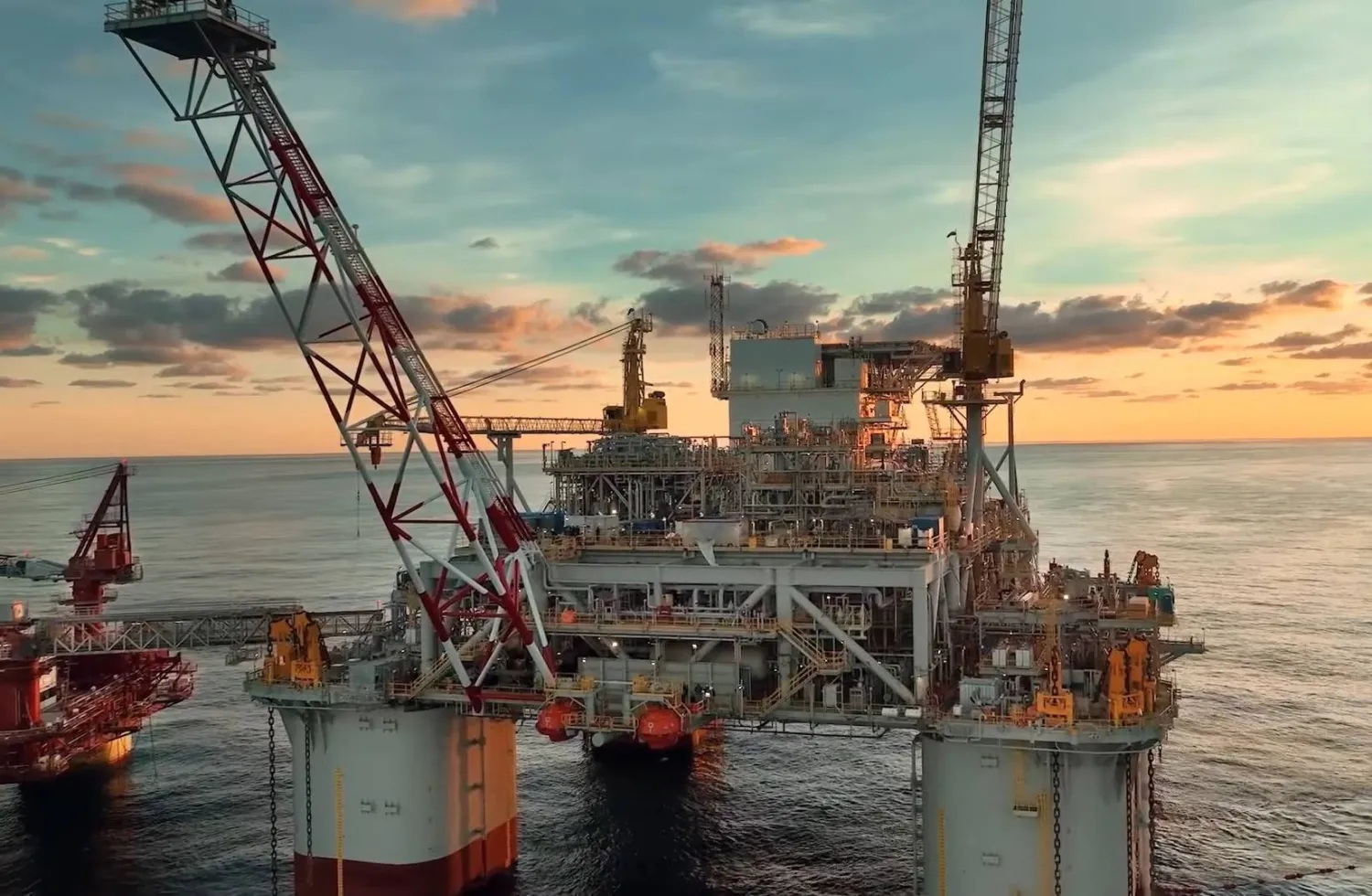
Consider the number 20,000. At Chevron’s Anchor development, in the Gulf of Mexico, that is the pressure, in pounds per square inch, that its subsea equipment is rated to handle. Production began in August 2024. The project’s announced price tag: approximately $5.7 billion.
- The pump is the endpoint: Chevron also finds, produces, refines and transports energy.
- The Hess deal put Chevron inside an oilfield operated by rival ExxonMobil.
- Anchor and Gorgon reveal the same business test: can the whole system work under pressure?
For a motorist, Chevron is a canopy, a pump, perhaps a bottle of Techron. For an engineer, it is a sequence of stubborn physical problems. Rock must surrender hydrocarbons. Equipment must survive pressure. Ships must arrive. Refineries must keep running. The company earns its place by making these separate events behave like one continuous service.
That is what an integrated energy company does. Chevron explores for and produces crude oil and natural gas, processes them, and sells fuels, lubricants and chemicals. Its expertise spans geology, drilling, reservoir management, refining and logistics.
A barrel needs a way out
The pattern predates the modern logo. Chevron traces its origins to Pacific Coast Oil Company, incorporated in San Francisco in 1879. Its founders included Charles Felton, Lloyd Tevis and George Loomis. The predecessor business had oil from California’s Pico Canyon. It needed capital and routes to customers. Within the following year, Pacific Coast built a refinery and a pipeline connection to the railroad.
In 1895 came the George Loomis, a steel-hulled tanker capable of carrying 6,500 barrels. Distribution turned something underground into something somebody could buy.
Today, the customers stretch from drivers to airlines, freight fleets, industrial operators and utilities. Chevron supplies gasoline, diesel and jet fuel; its lubricants help machinery run; Oronite makes additives for fuels and oils. Chevron Phillips Chemical, its joint venture with Phillips 66, makes petrochemicals and polymers that enter other manufacturers’ products. Natural gas and LNG connect the company to power generation and international energy buyers.
Buy the field. Share the table.
Chevron’s size gives it options that a small explorer lacks. It can develop a discovery, buy another producer or share a project’s costs and risks. Its alternatives include ExxonMobil, Shell, BP and TotalEnergies. Chevron’s particular competitive position comes from its mix of assets, operating experience and ability to finance projects whose returns take years.
The Hess acquisition makes that position wonderfully awkward. Announced in October 2023 at an equity value of $53 billion, the transaction closed in July 2025 after a favorable arbitration outcome. ExxonMobil had challenged the deal over rights associated with Hess’s Guyana interest.
Chevron gained a 30 percent interest in Guyana’s Stabroek Block, alongside Bakken acreage and other operations. ExxonMobil operates Stabroek. A competitor became a partner at the same table. By July 2026, Chevron reported $1.5 billion in annual run-rate Hess synergies, ahead of its original schedule. That is a company-reported cost-saving rate, not an extra $1.5 billion of guaranteed annual profit.
“We were willing to strive for something that had yet to be achieved.”Kevin Aberdeen · Anchor startup manager
The invoice arrives before the oil
Anchor illustrates the cost of doing something physically difficult. Its equipment opened access to high-pressure reservoirs; its floating production unit was designed for 75,000 barrels of oil a day. Those are gross design figures, not Chevron’s net production or a promise that the facility runs at full capacity every day.
At Tengiz in Kazakhstan, Chevron’s 50 percent-owned affiliate started its Future Growth Project in January 2025. The expansion was designed to add 260,000 barrels a day of crude capacity. These projects explain why energy companies talk obsessively about capital discipline: an expensive plant needs enough reliable production, at acceptable prices, to justify its construction.
The business model joins upstream sales of oil and gas with downstream margins from refining, manufacturing and marketing. Commodity prices still matter enormously. Chevron reported $184.4 billion in sales and other operating revenues for 2025, alongside $12.3 billion in net income. Revenue measures the goods sold; it does not measure the cash left after the machinery, people and obligations have been paid.
The island with a pressure problem
Gorgon, the Chevron-operated LNG project in Western Australia, turns the pressure story upside down. Here the task includes putting carbon dioxide underground. The system separates naturally occurring CO₂ from the gas stream and stores it beneath Barrow Island. It does not capture every emission associated with producing, transporting and ultimately burning the gas.
The storage system began operating in 2019, but pressure management constrained injection. Government-released project documents describe high sand production in water wells and work to improve sand management. Removing reservoir water helps make room for stored CO₂; trouble handling that water can limit the whole operation.
Chevron’s 2024 management plan said the partners had invested more than A$3 billion in the injection system. Its October 2025 consultation material proposed upgrades to pressure-management infrastructure. The engineering response changed as operating evidence arrived. That is a concrete lesson for any business selling a technical solution: test the supporting system as rigorously as the headline technology.
Chevron has also bought capabilities closer to its existing fuel network. Its $3.15 billion acquisition of Renewable Energy Group in 2022 added renewable-fuel production and feedstock expertise. The fit is practical: customers still need usable fuel, dependable supply and distribution. The economics depend on feedstock costs, customer demand and policy incentives; a familiar delivery network cannot settle all three.
Copy the connections
There is a transferable habit here. Find the bottleneck between a useful resource and a paying customer. Invest in the connection. Share risks when another operator has something you need. Then distinguish rated capacity, actual output and economic return. They are three different numbers, however tempting it is to put only the largest on a slide.
The conditions matter. Long project lives become liabilities when prices fall, approvals change or equipment underperforms. Owning several stages of the chain gives Chevron more ways to earn, while leaving it exposed to energy markets and environmental obligations. Its published culture emphasizes safety, integrity and partnerships. Gorgon shows why those commitments must be judged against operating results.
The next customer may look less familiar than a driver. In July 2026, Chevron announced a 20-year agreement to supply Microsoft with 2.67 gigawatts of power for a West Texas data center. Different customer, recognizable problem: connect an energy resource to a place that needs it, continuously. Even the digital economy eventually asks somebody to build the physical connection.