An unmarked envelope helped change the future of a Houston school. Inside was an anonymous gift of $8 million, accompanied by a brief blessing and an instruction to keep going with a capital project. The Yellowstone. Forever. fundraising campaign had been struggling to reach its goal. Brad Childers, one of its co-chairs, had spent years dealing with corporate capital. Here was capital arriving without a donor’s name attached.
The gift helped the school proceed with a project to double its campus and invest in academics. Childers and Janet Childers shared campaign leadership with Anne and Les Csorba. His response was unusually compact for an executive accustomed to quarterly explanations: “Our gratitude is immense.” In a career full of mergers, reorganizations and expensive machinery, this was a different kind of expansion.
Childers runs Archrock, the Houston company that supplies natural gas compression services across the United States. His business sits in the space between producing gas and getting it where customers need it. It is a practical occupation, concerned with pressure, maintenance and equipment that must keep working. His path into it began with a law degree.
The lawyer acquires an operating job
His formal name is D. Bradley Childers. He earned a bachelor’s degree at Claremont McKenna College and a juris doctor at the University of Southern California. From 1989 to 1994, he worked in Sullivan & Cromwell’s Los Angeles office as a corporate and securities lawyer. Then he joined Occidental, initially as corporate counsel, before moving into business development in 1999.
That transition matters. Lawyers examine the obligations a business is prepared to accept. Business development asks which obligations might be worth accepting in the first place. Childers’s subsequent career would bring both questions together, then add a third: could the people and machinery actually deliver what the agreement promised?
Universal Compression announced his appointment as senior vice president and general counsel in August 2002. By July 2006, he was president of its international division, relinquishing his legal and corporate development titles while helping with the transition. The progression was concrete: he had moved from advising an operating business to running part of one.
Universal merged with Hanover Compressor in 2007 to form Exterran Holdings. Childers became a senior vice president, then president of North America operations in 2008. By the time he became interim chief executive in November 2011, he had experience on both sides of the international-domestic divide. The permanent appointment followed that December.
Corporate and securities law at Sullivan & Cromwell.
Joins Universal Compression as general counsel.
Takes charge of Universal’s international division.
Becomes Exterran Holdings president and CEO.
Continues leading the business as it becomes Archrock.
An awkward inheritance, plainly described
The promotion came with problems. Looking back in 2014, Childers described an enterprise suffering from falling performance and elevated debt. He had taken responsibility for a business that needed repair. There is a certain professional honesty in saying that aloud when the easier executive vocabulary would have involved opportunities, headwinds and a strategic journey.
His response involved simplifying the company, reinvesting in its core compression and oilfield services businesses, and developing products. By 2014, Exterran had introduced regular quarterly dividend payments. Childers credited employees and the leadership team for the turnaround. The details offer an early view of a pattern that would recur: narrow the focus, put money behind the operating business, then explain what shareholders receive.
A year later came a more visible act of simplification. In November 2015, Exterran Holdings separated its international services and global fabrication businesses into Exterran Corporation. The remaining company became Archrock. For anyone trying to follow the career through a stack of old business cards, the nomenclature requires patience.
The distinction is useful, though. Childers’s chief executive tenure began in 2011 at the predecessor business; Archrock’s name arrived in 2015. He remained with the domestic compression and aftermarket services company. Its customers included businesses needing compression supplied under contract and owners needing parts, maintenance and repair for equipment they already had.
The corporate structure changed again in April 2018, when Archrock Partners merged into a wholly owned Archrock subsidiary. Childers had also served as president, chief executive and chairman of the partnership’s managing general partner. His responsibilities had therefore extended across both the operating company and its affiliated partnership. Alongside his executive duties, he has been a director of Archrock since April 2013, giving his tenure a place in the boardroom as well as management.
What a compressor has to do with the future
Compression helps natural gas move through the infrastructure connecting production with its uses. In Childers’s world, the commodity story becomes an equipment story: available horsepower, working machines, technicians and customer commitments. A promising demand forecast still needs a compressor in the right place. The machinery is admirably resistant to PowerPoint.
In July 2024, Archrock agreed to buy Total Operations and Production Services, known as TOPS, in a cash-and-stock transaction announced at $983 million. The attraction included a young compression fleet in the Permian Basin and substantial electric motor drive capability. Archrock completed the purchase on August 30.
The acquired portfolio covered about 580,000 horsepower, including roughly 500,000 operating horsepower and contracted new-equipment backlog. Alongside the assets came electrical expertise and the people who knew how to operate them. Childers presented the transaction as a way to deepen Archrock’s Permian operations and expand its ability to serve customers pursuing emissions reductions.
Announced cash-and-stock value. Completed August 30, 2024.
This is a specific version of the energy transition: changing the equipment used within an existing energy system. Electric motor drive compression became a larger part of the company’s capabilities through an acquisition. Its appeal rested on customers, contracts, engineering knowledge and a fleet that could earn its keep. Childers had put a considerable sum behind that combination.
The other expansion, closer to home
Yellowstone Schools brings the story back to Houston. Childers serves on its board, with his Yellowstone Academy directorship documented from February 2014. The school operates in the Third Ward, combining a Christian private elementary school with a public charter upper school. Its work reaches families across financial backgrounds.
The capital campaign attached a tangible project to that commitment. More room and stronger academic resources require people willing to raise money, sustain attention and persuade others to participate. The anonymous $8 million contribution helped unlock the project, but it arrived in the middle of a collective effort. Childers’s involvement was as a campaign co-chair, alongside three others.
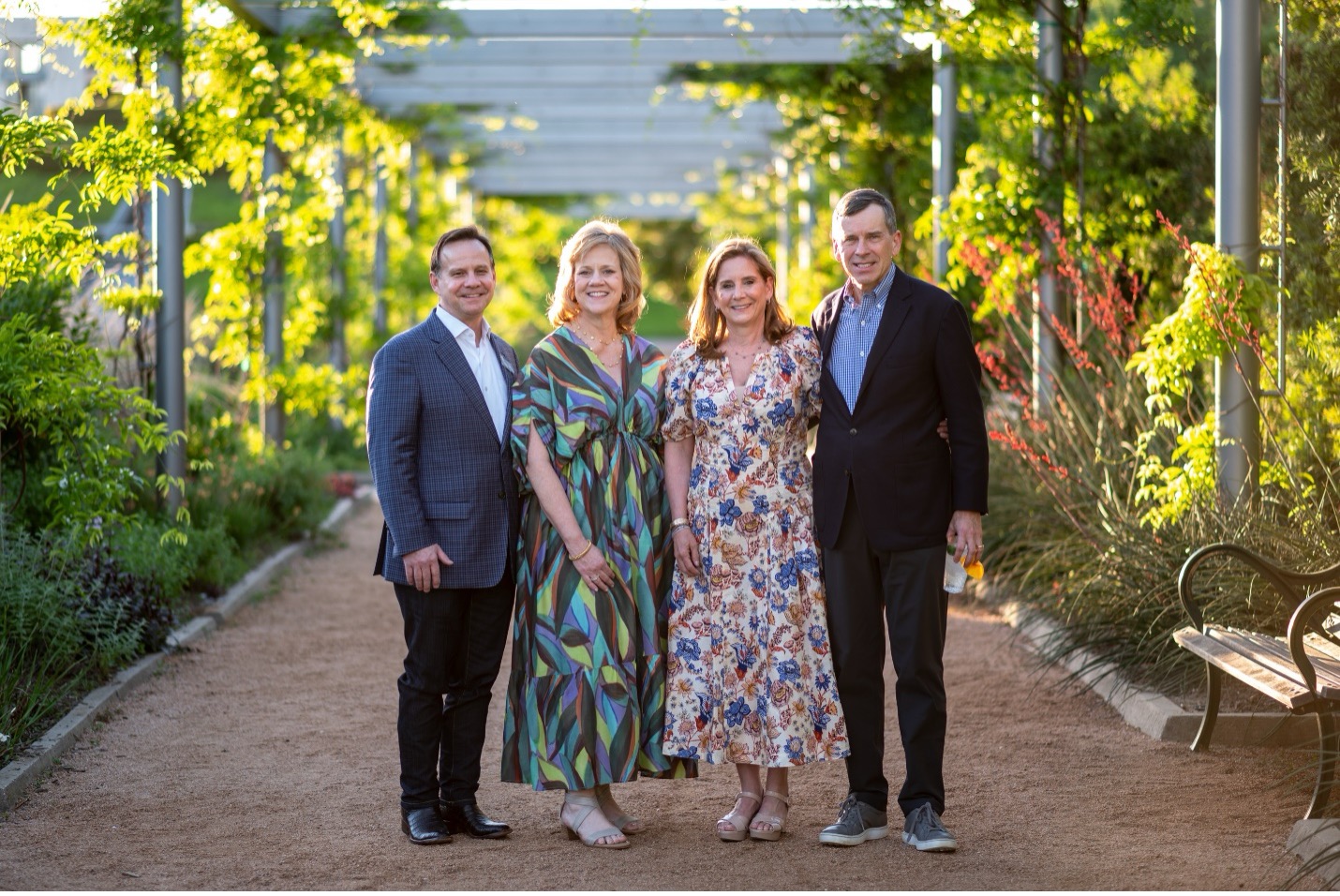
In April 2024, Yellowstone’s Party in the Park honored the Childerses and the Csorbas. The gathering at McGovern Centennial Gardens raised more than $778,000. The four honorees were recognized for their support and stewardship of the campus campaign. The photograph captures a side of Childers’s public life that a compression fleet chart cannot accommodate.
There is no need to turn the school into an allegory for a company. Students have purposes of their own. What the two commitments do share is time: Childers’s involvement with Yellowstone extends across years, just as his operating career has continued through successive corporate structures. Both are more revealing than a single ceremonial appearance.
“Our gratitude is immense.”
Brad Childers, on support for Yellowstone’s campus campaign, 2023
A chief executive picks up a microphone
In May 2025, Childers appeared on Ben Fanning’s Lead the Team podcast. Sharing the interview on LinkedIn, he said it included stories he had not previously shared. It was an invitation to hear the executive at a different pace from an earnings call, discussing leadership rather than walking listeners through a financial table.
By 2026, he was hosting Power Leaders, a podcast about the people behind energy and its supporting industries. An opening conversation featured Caterpillar senior vice president John Shanahan. Archrock’s podcast page also features a conversation with Ariel chief executive Alex Wright. For a compression executive, these are conversations close to the machinery and people that make his own business possible.
The program’s emphasis is on career decisions, difficult problems and the experiences that shape leadership. That choice gives Childers a public role beyond explaining Archrock. He can ask the questions. A sitting chief executive interviewing other industry leaders also offers a useful change in seating arrangements: for once, somebody else has to supply the answer.
Eight years is a useful unit of ambition
Archrock’s August 2026 results supplied a particularly clear measure of the horizon Childers is working toward. The company had signed an agreement covering approximately 665,000 horsepower with an existing strategic customer. Its base term was eight years, with a two-year extension option. That is a substantial commitment to keeping equipment useful well beyond the next quarterly call.
There were constraints alongside the ambition. Second-quarter revenue fell to $371.2 million from $383.2 million a year earlier, while net income rose to $66.7 million from $63.4 million. Archrock narrowed its full-year adjusted EBITDA guidance, citing near-term costs and timing effects. A long-term demand thesis still has to coexist with the price of lube oil.
Childers’s stated priorities included customer service, operational reliability and disciplined investment. His argument for future demand centered on liquefied natural gas exports and power consumption. The company outlined a cumulative growth capital investment opportunity of $1.4 billion to $1.6 billion for 2027 through 2030. Those were forward plans, with the execution still ahead.
His career has moved from legal agreements to operating divisions, from a troubled predecessor company to a more focused compression business, and from answering interview questions to asking them. The school campaign offers another scale on which to consider the same person. In each setting, the interesting question comes after the announcement: what will the commitment make possible, and who will keep it working?
Further reading & listening
- Brad Childers on LinkedIn
- Archrock leadership
- Power Leaders on Apple Podcasts
- Watch: Childers on Lead the Team
- Watch: Power Leaders with John Shanahan
- Yellowstone Schools leadership
- Yellowstone’s campus campaign
- The 2024 Party in the Park
- Archrock’s TOPS acquisition
- Archrock’s August 2026 results
- Archrock news and media