In Dubai, six cranes lifted a single piece of an offshore electricity platform. The load weighed 1,962 metric tonnes. This was part of McDermott’s work on BorWin6, a North Sea grid connection project. Picture the coordination: six lifting machines, one shared movement, and very little room for improvisation. Now consider the less photogenic problem. Who pays if the job takes longer than expected?
- McDermott sells the engineering and execution behind energy megaprojects.
- Its vessels and fabrication network help connect design to installation.
- Its financial history shows why winning work and making money are different skills.
That question runs through McDermott’s story. The company can coordinate steel, ships and people across oceans. It has also needed bankruptcy protection, asset sales and repeated financial repairs. The useful puzzle is how those two things coexist. Start with the cranes. Then follow the cash.
Somebody has to own the handoffs
An energy company discovers a resource or approves a facility. Between that decision and a working asset lies an awkward procession: engineering drawings, equipment orders, fabrication, transportation, installation and commissioning. Every stage hands something to the next. An error in the drawing can become a problem in the yard; a late component can disrupt work offshore.
McDermott offers to manage much of that procession. Its customers include national oil companies, international energy groups and infrastructure developers. They buy engineering judgment and execution capacity. For a project owner, the attraction is practical: fewer interfaces to manage personally, and a contractor that understands how a design will eventually be built and installed.

The equipment matters. McDermott’s Amazon vessel has a J-lay system rated for water depths of 3,500 metres. Fabrication facilities turn designs into large structures before those structures travel offshore. Engineering, yard work and installation sit within the same delivery network. That breadth is a competitive argument, although peers such as Saipem offer overlapping capabilities. Integration has to earn its keep on each job.
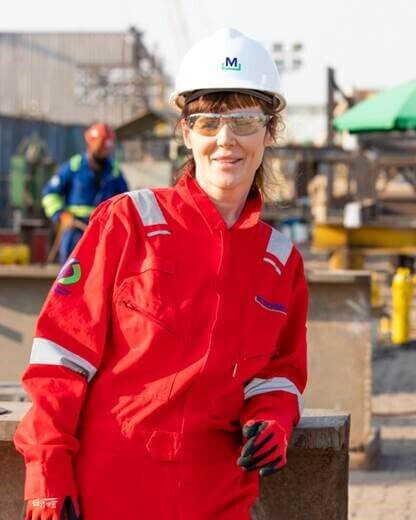
McDermott’s stated values include commitment, integrity and well-being. Its description of teamwork is revealing: “One team executing courageous and creative solutions.” In this business, collaboration has a physical consequence. A drawing passes through many hands before it becomes steel in the water.
The order book was full. The cash was not.
McDermott’s 2018 combination with CB&I expanded its business. It also brought projects whose losses exceeded estimates. In its 2019 annual filing, McDermott identified Cameron LNG and Freeport LNG as major cash consumers. At the end of that year, backlog stood at $18.6 billion. The company had abundant work and strained liquidity at the same time.
The mechanism is easy to miss. New contracts can require procurement spending and letters of credit before their cash benefits arrive. Meanwhile, overruns on existing jobs consume money already expected to fund something else. McDermott’s filing described precisely that collision. The immediate failure was financial capacity: the company could not comfortably fund the work it had won.
A full order book is a promise of work. The bills arrive on their own schedule.
In June 2020, McDermott emerged from restructuring after equitizing nearly all of $4.6 billion in funded debt. It also sold Lummus Technology; the court-approved transaction had a base price of $2.725 billion. Those numbers describe financing and a business sale, rather than the construction cost of one facility. The remedy changed ownership economics and the asset portfolio.
- 01 / WINCommit to delivery
- 02 / FUNDBuy equipment; arrange guarantees
- 03 / ABSORBCarry delays and extra costs
- 04 / COLLECTReceive later project payments
Changing the bargain
The repairs continued. A March 2024 cross-border restructuring extended approximately $2.6 billion of credit and term-loan facilities and discharged or released roughly $2 billion in unsecured litigation claims. Later that year, McDermott sold its CB&I storage business. Its accounts record approximately $450 million in sale proceeds, alongside a separate pre-sale working-capital transfer of about $25 million.
The operating response matters as much as the financing. McDermott’s 2025 business plan called for more hybrid contracting. Its first-quarter 2026 report recorded $833 million of hybrid-contract revenue, compared with $622 million a year earlier. That is observable movement in the contract mix. It does not establish that every new project will be profitable.
A hybrid contract combines pricing approaches rather than placing every uncertainty inside one fixed sum. The lesson readers can borrow is to specify responsibility before committing: define the scope, decide how changes get paid for, and match spending commitments to available funding. Even a small services company can make those questions part of its sales process.
Operating income was about 2.3% of revenue. Financing and other items still matter.
The same steel, a different energy job
McDermott’s capabilities travel across markets. BorWin6 involves an offshore electricity platform. LNG work involves liquefaction facilities and terminals. Its July 2026 cooperation agreement with ULC-Energy concerns integrating planned small modular reactors with industrial energy systems. The agreement supports development; it is not evidence of a completed reactor. The common thread is engineering complex physical systems.
Customers continue to commission that expertise. In August 2026, ADNOC awarded McDermott an offshore contract classified as exceeding $1 billion. September brought an Eni subsea award offshore Cyprus, disclosed in a $500 million to $750 million band. These are useful indications of project scale. Neither disclosure supplies an exact price or a guaranteed margin.
The next lift is financial
On September 21, 2026, McDermott completed refinancing that included $500 million of equity and $550 million of secured Nordic bonds. The bonds mature in 2031. New guarantee and credit facilities accompany them. The transaction gives the company a revised financing structure for work that still has to be delivered.
Integration is most useful when the project is large enough for coordination to justify the machinery around it. It cannot rescue an unrealistic estimate, settle every disputed change or make uncertain demand disappear. McDermott’s story offers a specific test for anyone buying or selling complex work: identify who carries each uncertainty, and check whether that party can afford it. The six cranes need a shared plan. So does the balance sheet.