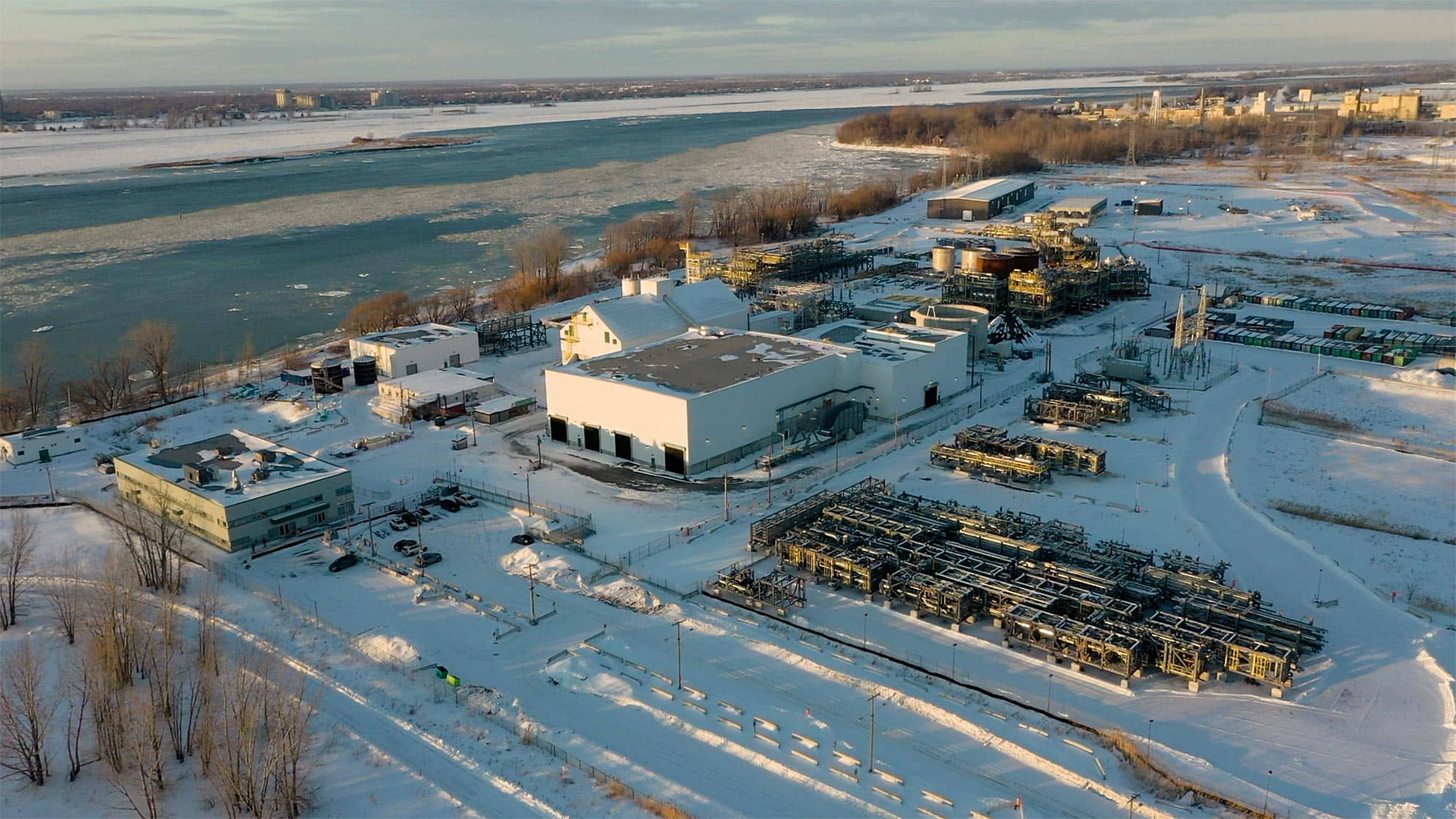
StormFisher's most interesting product is not e-methanol. It is the second chance. On the bank of the St. Lawrence River in Varennes, Quebec, sits a fuel complex that was supposed to turn woody biomass into methanol. The original project was budgeted around C$1.5 billion, ran into repeated overruns, stopped before commissioning and entered creditor protection. In October 2025, a court approved the sale of its assets to StormFisher for C$17.5 million. That is the sort of discount that makes a spreadsheet look clever before anybody asks what happens next.
What happens next is another C$600 million to C$700 million, if current engineering estimates hold. StormFisher plans to keep the valuable bones - roughly 80 acres, an energized 230-kilovolt connection, substations, access to Hydro-Quebec power and useful equipment - while changing the chemistry. Biomass gasification is out. A 100-megawatt electrolyzer, renewable electricity and captured biogenic carbon dioxide are in. The target is roughly 72,000 tonnes of low-carbon methanol a year, with commercial operation now aimed at early 2029.
A molecule with somewhere to go
The company, founded in 2006 by Brandon Moffatt, Chris Guillon and Pearce Fallis, spent its first act in biogas and organics. It helped turn an underused London, Ontario digestion plant into a large food-waste-to-renewable-natural-gas operation, then sold the organics business and operating teams to Generate Capital in 2022. StormFisher's founding group shifted toward hydrogen-derived fuels because it saw a market that could scale beyond the radius of a waste facility.
Its current pitch begins with a useful restraint: make molecules that already have buyers. Methanol is a widely traded chemical used in fuels and industrial production. E-methanol has the same chemical composition, but its hydrogen comes from renewable-powered electrolysis and its carbon can come from captured biogenic CO2. It can move through much of the storage and transport system already built for methanol. Shipping lines can burn it in methanol-capable engines; chemical producers can use it as feedstock; methanol-to-jet plants can turn it into an input for synthetic aviation fuel.
How the product moves
Then: ship fuel, chemical feedstock, fuel blending or conversion into e-SAF. The chemistry is proven. Coordinating the inputs is the business.
That distinction explains StormFisher's position in the market. It is not a reactor vendor and does not claim a proprietary catalyst. It is a developer, prospective owner and operator that chooses equipment, secures sites and power, contracts carbon, arranges financing, signs fuel buyers and expects to live with the plant after the ribbon cutting. Competitors include other power-to-liquids developers such as European Energy, Liquid Wind, HIF Global and C2X. Customers can also choose biomethanol, biodiesel, ammonia, sequestration or electrification. StormFisher's answer is operational discipline plus a molecule that fits existing trade routes.
“We're not looking to develop and flip; we think long term.”Judson Whiteside, CEO
What failed first - and what changed
At the old RCV project, the first visible failure was cost control. The biomass scheme accumulated hundreds of millions of dollars in overruns, halted with parts of the complex unfinished and never entered service. The deeper problem was a complicated process and execution plan. StormFisher did not decide that methanol itself was the mistake. It decided the route to methanol was. Its redesign replaces biomass gasification with a process management describes as simpler and more reliable: split water using clean electricity, combine the hydrogen with captured carbon and synthesize methanol using established equipment.
The price comparison needs care. StormFisher did not buy a finished C$1.5 billion plant for pennies and pocket the difference. It bought distressed physical assets from a project whose sunk public funding and original budget do not equal present value. The site was reported as roughly three-quarters complete in aggregate, with the electrolyzer portion much less advanced, but the new design means not everything built for the old process remains useful. Reuse can save permitting time and replacement cost. It cannot make incompatible equipment compatible.
The strategic change was also geographic. In early 2025, StormFisher described North Texas as its most advanced project. By early 2026, the company said it had stalled work in Kansas and Texas as US incentive timelines tightened and competition for low-cost power and water intensified, including from data centers. Quebec offered comparatively stable policy, clean baseload hydroelectricity, an existing interconnection and a short Atlantic route to European ports. A global clean-fuel thesis became a local infrastructure choice.
Who pays for the green premium?
StormFisher's customers are not casual consumers. They are maritime carriers, cargo owners, fuel distributors, refiners, chemical producers and sustainable-aviation-fuel developers. Many need lower-carbon molecules because batteries cannot practically serve an ocean crossing, high-temperature industrial process or long-distance aircraft. European rules matter because they turn decarbonization from a brand preference into a compliance bill. FuelEU Maritime, aviation mandates and the RFNBO framework create demand for fuels with traceable renewable inputs.
The business model is project finance wearing work boots. Corporate investors ARC Financial and Hy24 have committed C$30 million and US$50 million respectively; StormFisher said it had raised more than C$100 million by January 2026. Varennes is a separate order of magnitude. The company was preparing to seek roughly US$200 million in project equity, alongside debt, while negotiating long-term offtake. Revenue ultimately comes from selling fuel; bankability comes from proving that buyers, power, carbon supply and policy support will survive for years.
The four-party e-methanol bargain
Designs, finances and operates the plant, then delivers certified fuel.
Turn a by-product and renewable electrons into contracted inputs.
Use e-methanol on selected voyages where compatible engines exist.
Help fund the premium and claim verified Scope 3 reductions.
A 2026 partnership with CarbonLeap makes that last point concrete. StormFisher supplies e-methanol, carriers use it on selected voyages and CarbonLeap aggregates demand from cargo owners through book-and-claim. A company can support cleaner fuel and claim an allocated emissions benefit without insisting that its own container sat on the exact vessel that burned it. The partners say StormFisher's product can reduce lifecycle carbon intensity by more than 85 percent. The model spreads the premium across the supply chain, but it only works if certification remains credible and corporate buyers accept the accounting.
The useful parts to steal
StormFisher's playbook is copyable in a way its plant is not. First, begin with an existing commodity and customer pain, not a laboratory novelty. Second, hunt for stranded infrastructure where grid access, land and permits are worth more than the distressed purchase price. Third, stay technology agnostic enough to remove a process that no longer earns its complexity. Fourth, develop with an operator's eye: maintenance access and reliability matter because the owner expects to run the asset for two decades. Finally, follow regulated demand. A buyer facing a rising penalty signs a firmer contract than one collecting sustainability talking points.
Copy this - but only after five yeses
- Is there abundant, contractable low-carbon power?
- Is concentrated biogenic CO2 available at predictable cost?
- Does inherited infrastructure truly fit the redesigned process?
- Will customers sign long-term, financeable offtake agreements?
- Can the project survive weaker subsidies, delays and cost inflation?
Under which conditions would it not work? Start with dirty or expensive electricity: electrolytic hydrogen can lose both its carbon logic and its economics. Add unreliable carbon supply, scarce water, a weak grid connection or a remote port and the delivered fuel price climbs. If regulations soften, customers may refuse the premium. If methanol-capable shipping grows more slowly than expected, offtake gets harder. If lenders treat book-and-claim demand as optional rather than contractual, the demand story will not finance steel and concrete. And if the old site hides more incompatibility than value, reuse becomes an expensive form of nostalgia.
StormFisher itself has become more sober about the category. Whiteside has said early tonnage forecasts were too high and the market developed more slowly than the 2022 hydrogen rush implied. That candor is useful. This is a 35-to-40-person team attempting one industrial project well, not a software company launching six markets in a quarter. Varennes still needs final engineering, vendors, equity, debt, contracted buyers and construction. The acquisition was the opening move, not the victory.
If StormFisher succeeds, its difference will look almost disappointingly practical: it bought the right leftovers, rejected the wrong process, matched clean Canadian power to mandated European demand and operated the result without drama. If it fails, the site will offer a second lesson in how cheap assets can be overwhelmed by expensive completion. Either outcome makes Varennes worth watching. The storm is already here. The fish is financing.