Most green-hydrogen pitches begin with the elegance of splitting water. Ecolectro begins with the shopping list. A conventional proton exchange membrane electrolyzer can be compact, responsive and productive, but its stack often depends on iridium catalysts, platinum-group metals and machined titanium. Those are awkward ingredients for a technology expected to expand across refineries, fertilizer plants, trucking depots and power systems. Ecolectro's proposition is to keep the useful geometry of membrane electrolysis while replacing much of that costly material cabinet with hydrocarbon polymers, nickel and stainless steel.
The Ithaca company calls the result an alkaline exchange membrane, or AEM, electrolyzer. Water and electricity go in. Hydrogen and oxygen come out. The thin membrane between the electrodes carries hydroxide ions, allowing the machine to operate in alkaline conditions where abundant catalysts can work. Ecolectro designs the membrane, ionomer, electrodes, membrane electrode assembly and stack as a matched set. It is less a miracle material than a coordinated chemistry project with pumps attached.
reported peak rate
at high production
closed in 2024
The company started with a sheet, not a machine
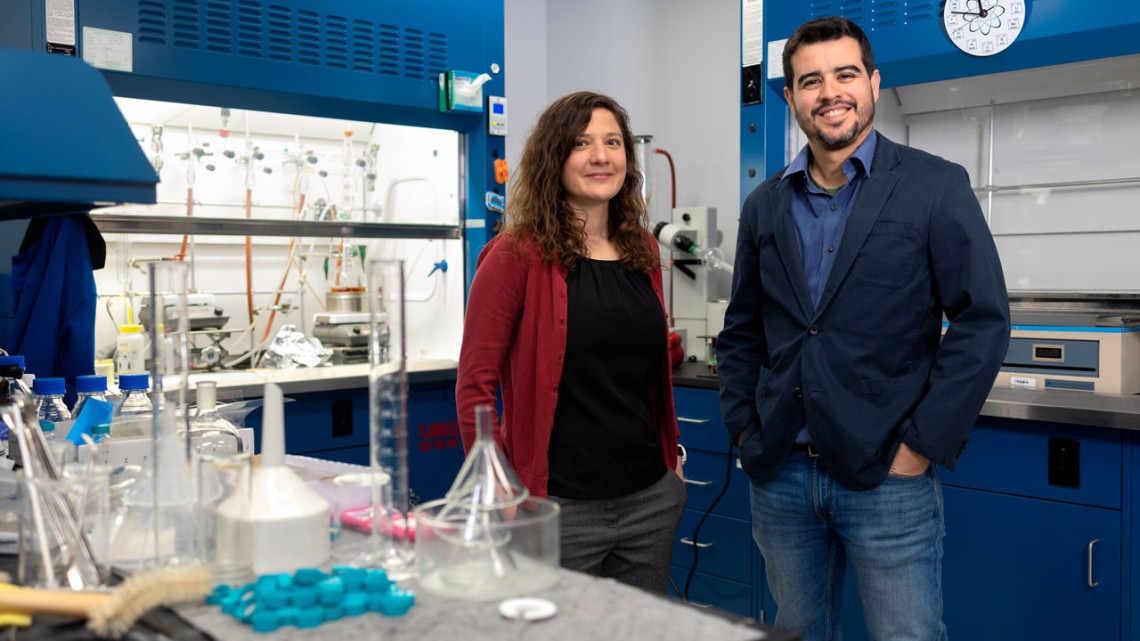
Ecolectro was founded in June 2015 by two Cornell-trained chemists. Gabriel Rodríguez-Calero had studied nanoparticle electrodeposits with electrochemist Héctor Abruña. Kristina Hugar was developing polymer electrolyte scaffolds in Geoffrey Coates's lab. Rodríguez-Calero wanted to form a company and surveyed Cornell inventions worth commercializing. Hugar's alkaline membrane work won. They licensed the technology, entered Cornell's McGovern incubator and opened a lab in January 2016.
The first public version of Ecolectro looked like a specialty-materials business. A $150,000 National Science Foundation award helped attack membrane synthesis. The science team later reported a 15-fold increase in production while halving process time, achieved by streamlining synthesis and reducing purification steps. That is the unglamorous work behind climate hardware: the breakthrough is sometimes fewer washes in a recipe.
Fuel cells were an early target. But a membrane sample is not what an industrial customer ultimately buys. Customers buy kilograms of hydrogen, delivery schedules, service, uptime and a piece of equipment someone will insure. Ecolectro moved down the stack, integrating its materials into membrane electrode assemblies and then full electrolyzer systems. The shift did not abandon the chemistry. It gave the chemistry a job.
“We humbly approach our work with the attitude of rapidly discovering all the things that we don't know yet.”Kristina Hugar, co-founder and CTO
What failed first: durability, then scale
There is no public tale of one dramatic explosion or fatal prototype. The disclosed failure points are more ordinary and more important. Early reinforced AEM work explicitly targeted chemical stability, swelling, mechanical strength and 1,000-hour operation. A polymer that conducts ions beautifully can still soften, crack, swell or chemically degrade in hot alkaline service. Even if it survives, its synthesis may be too slow or impure to manufacture economically. Ecolectro's grant history reads like a systematic campaign against those failure modes.
What changed the founders' operating view was contact with the complete system and its buyers. Hugar has described an approach centered on finding failure points quickly and making technical choices that improve customer deliverables. The company went from proposing better materials for other people's devices to building stacks that use those materials together. In 2024, it reported current density above 4 A/cm² at less than 2.1 volts and cell efficiency above 74 percent at high production rates, without iridium catalysts or titanium components in key stack hardware. These are company-reported cell results, not a guarantee of lifetime system cost.
The cost claim has two layers
Ecolectro says its materials can reduce stack cost by 78 percent compared with traditional PEM stacks and lower overall hydrogen production cost by 33 percent. Its manufacturing announcement with Re:Build said on-site production could fall below $2.50 per kilogram in many regions, depending on electricity prices. Those are modeled ambitions. The cost of the company's own climb is easier to count: an early $150,000 NSF grant, a $1.7 million ARPA-E award, a reported $4.5 million seed round in 2022 and a $10.5 million Series A led by Toyota Ventures in 2024. A secondary database later recorded a $2.31 million convertible note in 2025.
Where Ecolectro says the savings land
The distinction matters because the stack is only one line in a hydrogen project. Electricity usually dominates operating cost. Compressors, water treatment, power electronics, installation, financing and utilization all join the invoice. A cheap stack sitting idle beside expensive electricity does not produce cheap hydrogen. Ecolectro can shrink part of the equation; it cannot repeal the rest.
The customer is the test bench
Liberty New York Gas supplied Ecolectro's most concrete field lesson. At the utility's Massena office, a 10 kW electrolyzer makes hydrogen on-site. Blending equipment sends that hydrogen into a dedicated section of the building's natural-gas supply for heat. Liberty announced the system as operational in June 2024 and planned an 18-month initial pilot, with later phases discussed toward a 1 MW deployment.
Heating one office will not decarbonize New York. It will expose a machine to weather, operators, maintenance windows, real controls and the mild indignity of an ordinary utility property. That is precisely its value. The likely customers beyond utilities are hydrogen users in refining, chemical production, transportation, heavy equipment, power generation and energy storage. On-site generation also avoids part of the costly business of moving and storing a very light gas.
Ecolectro's business now spans materials and equipment. It keeps its proprietary chemistry, membranes and membrane electrode assemblies in Ithaca. In May 2025, it hired industrial scale rather than building all of it: Re:Build Manufacturing agreed to integrate and assemble early systems in Rochester, New York, with planned high-volume work in New Kensington, Pennsylvania. Ecolectro protects the recipe; Re:Build bends steel, connects subsystems and prepares repeatable machines.
The part worth stealing
Founders cannot copy Ecolectro's patents, but they can copy the sequence. Start with defensible university research. Use grants to answer scientific questions that venture capital dislikes funding. Improve the production recipe before ordering a factory. Put a small unit with a serious customer where failure is informative but contained. Then choose a manufacturing partner whose existing tools and labor turn capital expense into a variable cost.
There is another lesson in the product boundary. Ecolectro did not remain a membrane vendor simply because the membrane was the clever part. It integrated far enough to control whether the clever part worked for a buyer. But it stopped before owning every factory operation. That boundary - proprietary chemistry inside, industrial assembly outside - is the company's most portable idea.
Conditions that help
- Cheap, genuinely low-carbon electricity
- Steady on-site hydrogen demand
- High equipment utilization
- A buyer willing to run a field demonstration
Conditions that break it
- Expensive or carbon-heavy grid power
- Intermittent, tiny hydrogen demand
- Cheap delivered gray hydrogen
- A project requiring long operating records today
The approach will not win everywhere. Traditional alkaline equipment has decades of operating evidence and can be attractive at large, steady sites. PEM remains proven where compactness and rapid response justify its materials bill. Solid-oxide systems can offer high efficiency where abundant heat is available. AEM must establish durability, serviceability and manufacturing yield while competitors improve too. Ecolectro's public 2024 plan anticipated 250-500 kW and 1-5 MW commercial-class systems. Public evidence of broad commercial deployment remains thinner than evidence of pilot progress.
A chemistry company learns to ship
Ecolectro fits an unusually awkward market position. It is too hardware-heavy to scale like software and too young to sell only on decades of operating data. Its advantage is a materials platform that attacks three buyer anxieties at once: stack cost, constrained supply chains and PFAS exposure. Its disadvantage is that every claimed advantage must survive thousands of hours inside a wet, pressurized electrochemical machine.
The company has spent roughly a decade converting elegant chemistry into fewer purification steps, stronger membranes, integrated electrodes, pilot stacks and a manufacturing relationship. That timeline can feel slow until one remembers the product is expected to sit at an industrial site splitting water reliably while money passes through it every hour.
Ecolectro's wager is not that hydrogen becomes cheap through optimism. It is that a list of specific deletions - iridium, platinum-group metals, titanium-heavy components, PFAS and unnecessary transport - can compound into a project an industrial buyer will sign. The Massena pilot and Re:Build partnership move that wager from a Cornell lab toward a purchase order. The next proof will not be another current-density record. It will be a machine that keeps making economical hydrogen after the novelty wears off.