A blast furnace is an industrial declaration of war against room temperature. Ore enters. Coal burns. The interior approaches 1,600°C. Oxygen leaves iron by hitching itself to carbon, and carbon dioxide leaves everyone else with the bill. For centuries, the furnace has been less a machine than a fact of life.
Sandeep Nijhawan looked at this cathedral of heat and asked an engineer's impolite question: what if we did not melt the ore at all? At Electra, the Boulder company he co-founded in 2020, ironmaking happens in an aqueous system at roughly 60°C. A good cup of coffee has encountered sterner conditions.
The temperature makes a memorable party trick, but it is not the whole trick. Low heat allows the process to ramp with wind and solar instead of demanding constant power. Chemistry dissolves ore and separates impurities and useful mineral co-products. Electrowinning plates out high-purity iron. That iron can then travel into the electric-arc furnaces steelmakers already use. The ambition is radical; the route to market is deliberately familiar.
A career made of useful detours
Nijhawan did not grow up announcing that he would one day redesign iron. His education moved from a BTech at IIT Kanpur to aerospace and mechanical engineering at the University of Minnesota, then to an MBA at IMD in Lausanne. His working life took an equally angular route: semiconductor equipment at Applied Materials, an LED startup, advanced-materials R&D at Intermolecular, distributed energy storage at Staq Energy, hydrogen electrolysis at AquaHydrex, and an operating-partner seat at True North Venture Partners.
He has recalled an early choice that explains the rest. After mechanical-engineering training, he had an offer to design equipment. He declined and became a process technician so he could learn chemistry and materials science closer to the work. The move traded prestige for proximity. It also put him in the trenches of semiconductor fabrication, where physics has to behave repeatedly, customers are exacting, and a laboratory idea earns nothing until a production line can trust it.
Later, he would joke that the MBA arrived with the familiar atmosphere of a midcareer reckoning. The year gave him language for a pattern already visible: large corporations could teach him scale, but small teams gave him energy. He liked people willing to challenge an inherited assumption, find the fatal flaw early, and build only after the evidence said build.
“Not being afraid of failure is very key.”Sandeep Nijhawan, on building hard technology
That philosophy is easier to print on a wall than to practice in a plant. Software can fail in a sandbox. Industrial hardware fails with pipes, permits, procurement schedules, safety reviews, and invoices. Nijhawan's useful refinement is to separate the size of the problem from the size of the first experiment. Think big. Attack the assumption that can kill the venture. Try small. Scale only when the result gives permission.
Designing for the weather
Electra began with a constraint disguised as an annoyance. Wind and solar are cheap and clean, but intermittent. A blast furnace prefers steady appetite and continuous operation. One conventional response is to make renewable power behave more like fossil power through storage and firming. Nijhawan's response was to make the industrial process behave more like renewable power.
Once intermittency became non-negotiable, high-temperature ironmaking stopped fitting inside the box. The team searched for a lower-temperature approach that could pause and resume. It also wanted feedstock flexibility. Traditional routes favor high-grade ore; Electra says its process can use lower-grade material, including already-mined ore that conventional economics leave behind. Separate the iron, recover valuable co-minerals, and the waste pile starts to resemble inventory.
There is elegance here, but Nijhawan does not sell elegance. He sells the possibility of a commodity that can stand on its own economics. His stated target is cost parity at scale without leaning on a permanent green premium. High purity matters because customers otherwise pay to remove unwanted gangue later. Modularity matters because repeatable units can be built and financed differently from a single monumental furnace. Renewable compatibility matters because an industrial customer wants energy flexibility, not a lecture.
This is the quiet commercial lesson inside the climate story: virtue is rarely enough to rearrange a global supply chain. A cleaner input becomes interesting when it is also purer, flexible, financeable, and available. Environmental benefit opens the conversation. Ordinary advantages close the contract.
Build the ecosystem before the factory
A new social app can begin with users. A new iron process needs a small civilization. Miners control feedstock. Steelmakers qualify the product. Equipment partners help turn vessels and cells into reliable systems. Buyers send demand signals. Governments shape incentives and permitting. Long-duration investors tolerate the years between chemistry and cash flow. Banks appear when the risk starts to look less exotic.
Electra has assembled that ecosystem with conspicuous intention. Its backers span BHP, Rio Tinto, Nucor, Temasek, Breakthrough Energy, Toyota Tsusho and other financial and industrial investors. In 2025, a $186 million Series B helped move the company from pilot toward demonstration. A $50 million Breakthrough Energy Catalyst award and Colorado clean-industry tax support followed. Electra announced advanced purchase orders with Nucor, Toyota Tsusho and Interfer, while Meta agreed to buy the company's first environmental attribute credits.
In March 2026, J.P. Morgan added a $30 million venture-debt facility. Debt is a revealing milestone for a hardware company. Equity can fund possibility. Credit begins asking whether a schedule, an asset and a route to revenue can withstand arithmetic.
“We have so much demand for this material.”Sandeep Nijhawan, as Electra moved beyond pilot scale
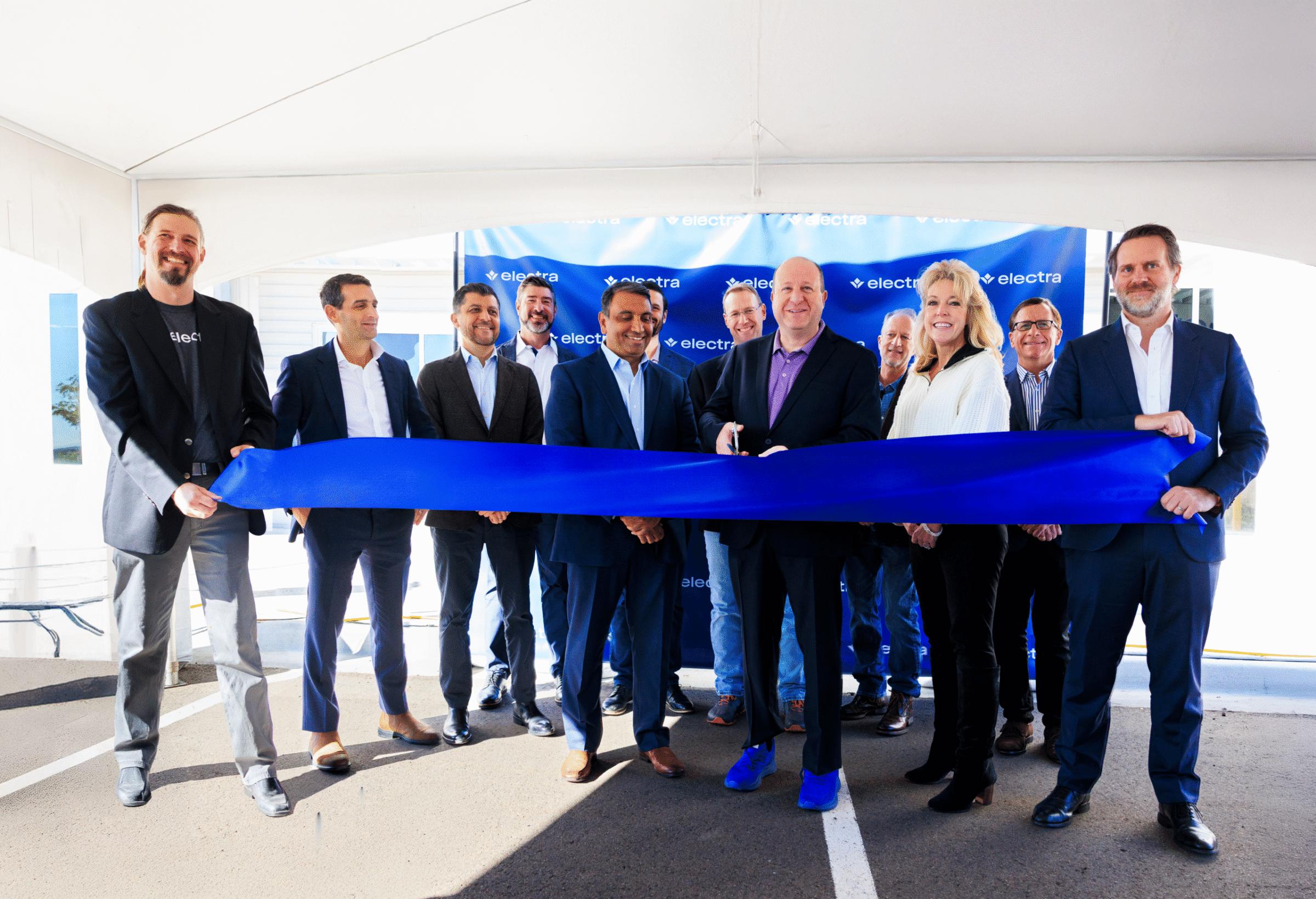
The demonstration facility unveiled in Colorado in October 2025 is intended to produce 500 tonnes of iron a year. That number is tiny beside the roughly two billion tonnes of steel made globally, and enormous beside a beaker. It sits at the awkward, valuable scale where valves misbehave, maintenance routines become real, material arrives with variation, and customers can finally hold the output.
Nijhawan often speaks about the company in the plural. It is fitting. Electra emerged from his partnership with co-founder and CTO Quoc Pham, and its progress depends on operators, electrochemists, mechanical engineers, project developers, customers and capital providers agreeing to move in sequence. He calls talent a central constraint on the climate transition. The machinery is modular; the coalition is not.
His preferred culture follows the same logic as the process. Electra describes itself as no-nonsense and first-principles, two phrases that can sound austere until Nijhawan explains the social machinery underneath them. People have to question assumptions without turning disagreement into theatre. Investors have to understand that first-of-a-kind plants mature on industrial clocks. Strategic partners need enough access to help, but not so much control that the young company becomes a committee. Nijhawan's years on both sides of the venture table show here. He did not simply collect capital; he selected a mix of patient financial backers and operating companies whose ore, furnaces, markets and balance sheets could help the technology leave Boulder.
The mountain moves by the tonne
Recognition has arrived along the way. Nijhawan appeared on the 2024 TIME100 Climate list. The Denver Business Journal named him among its Most Admired CEOs in 2025. He also joined the board of iron-flow-battery company ESS Tech in 2023, carrying his electrochemical and commercialization experience into another corner of the energy transition.
Awards make an awkward fit with his favored metaphor. He has described changing a process with five centuries of momentum as moving a mountain day by day. Mountains do not respond to plaques. They respond to repetition, money, policy, teams, and machines that work on Tuesday exactly as they did on Monday.
Policy still matters. Nijhawan has called for a global carbon price to accelerate industrial decarbonization, pointing to Europe's carbon-border mechanism as the kind of market signal that can reward cleaner materials. He pairs that argument with a broader concern for circularity. Removing carbon while creating a different resource problem would be a poor bargain.
His personal aspiration is similarly plain: leave the world in better condition for the next generation. The corporate version has a deadline. Electra says it is working toward commercial-scale production by the end of the decade. Between here and there lie the unphotogenic chapters of industrial innovation: commissioning, qualification, yield, uptime, financing and repeat construction.
The useful thing about Nijhawan's story is that he does not confuse a grand mission with a grand gesture. The garage mattered. The process technician job mattered. The pilot mattered. The first customer sample matters. An industry measured in billions of tonnes will not change because someone found a nicer adjective for steel. It changes when a new route becomes dependable, economical and ordinary.
For now, Electra's iron begins in a warm chemical bath rather than a roaring furnace. If the method scales, one of civilization's hottest habits may cool down without asking civilization to use less steel. There is something pleasingly Nijhawan about the wager: question the premise, respect the physics, recruit the ecosystem, and let the product make the argument.