Hydrogen has an excellent publicist. It is the first element on the periodic table, the fuel of stars and a recurring guest in speeches about the energy future. It is also, in practice, an industrial ingredient purchased by the kilogram, moved at irritating expense and usually made from fossil gas. Gabriel Rodríguez-Calero built his career in the distance between those two versions: hydrogen the celestial idea and hydrogen the line item.
He was born and raised in Puerto Rico, then studied chemistry at the University of Puerto Rico, Río Piedras. At Cornell, where he completed master's and doctoral degrees in chemistry, his world narrowed productively. Conducting polymers. Electrode materials. Energy storage. The sort of work where a tiny change in a molecule can be the difference between an elegant paper and a useful device.
Rodríguez-Calero worked with electrochemist Héctor Abruña and later held postdoctoral positions with Abruña and polymer chemist Geoffrey Coates. His publication trail runs through carbon nano-onions, organic battery cathodes, flexible substrates and electrochemical films. It is a career that makes the word material feel literal again: matter chosen, measured and persuaded to behave.
Act I / The invention needs an exit
A laboratory with a door
What bothered him was not a lack of invention. It was the number of inventions that never acquired a route into ordinary use. University laboratories could produce answers to hard problems, yet the institutions needed to package, finance and sell those answers often failed to appear. For a scientist, this was an organizational bug. For a future founder, it was an invitation.
In 2015, a year after finishing his doctorate, Rodríguez-Calero surveyed Cornell projects that had generated intellectual property. One belonged to fellow chemist Kristina Hugar. Her doctoral work improved alkaline exchange membrane materials, a crucial component in electrochemical systems. He asked her to commercialize it with him. They founded Ecolectro that June.
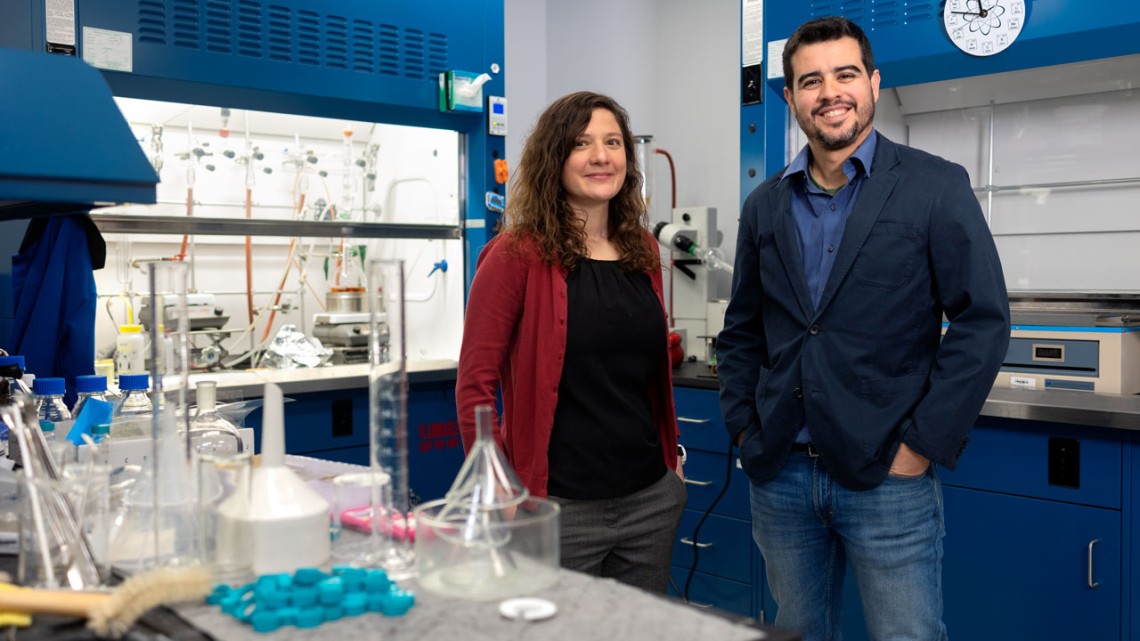
The division of labor was complementary from the beginning. Hugar brought the membrane breakthrough. Rodríguez-Calero brought his background in materials and electrochemical systems, plus an appetite for the less romantic duties of company formation: business development, fundraising and the patient explanation of why a polymer might rearrange the economics of a very large market.
Peanut butter is the line that sticks. Hydrogen is already embedded in modern industry, from refining and ammonia production to food processing. The climate question is not whether the molecule has uses. It is whether those users can obtain it without the carbon emissions attached to conventional production, and without paying a green premium large enough to frighten the procurement department.
Act II / Remove the expensive parts
The membrane in the middle
An electrolyzer uses electricity to split water into hydrogen and oxygen. Proton exchange membrane systems can be compact and responsive, helpful qualities when the power supply is variable wind or solar. But they traditionally rely on iridium, a scarce and costly metal, and PFAS-based materials. Conventional alkaline systems use more abundant materials but come with different performance and form-factor tradeoffs.
Ecolectro's wager is an anion exchange membrane, or AEM, approach intended to combine attractive features from both camps. Its membrane chemistry lets the stack use non-precious-metal electrodes, avoids PFAS and is designed to fit existing PEM-style systems. In founder language, it is a drop-in replacement. In buyer language, it is novelty with fewer renovations.
+ water
electrolyzer
at the customer site
The company first made polymers, then integrated those materials into stacks, then built complete electrolyzers. Each step exchanged one kind of uncertainty for another. A membrane can work beautifully on a bench and become temperamental when enlarged. A stack can hit a production target and still be awkward to manufacture. A machine can perform and still lose to transport costs, maintenance requirements or a customer's capital budget.
Rodríguez-Calero's favorite company memory sits at the first of those crossings: the successful demonstration of Ecolectro's initial electrolyzer prototype. He has described it as the moment years of research, teamwork and resilience became visible. The machine worked. Then, as hardware insists, success created a longer to-do list.
By 2024, Ecolectro reported production rates above four amps per square centimetre and cell efficiencies above 74 percent without iridium or titanium components. Those are company-reported technical milestones, not decorative numerology. Production rate affects how much equipment is required. Efficiency affects the electricity bill. Materials affect both the capital cost and the supply chain.
Efficiency is an operating expense wearing a lab coat.
Ecolectro's reported cell efficiency at high hydrogen production rates. Real project economics also depend on electricity price, utilization, financing, storage and delivery.Act III / Proof leaves the building
A pilot in a northern town
Ecolectro's first commercial deployment put a 10-kilowatt electrolyzer with Liberty New York Gas in Massena, near the Canadian border. The pilot produced hydrogen on site and blended it with natural gas used for commercial heating. The company reported that every kilogram of hydrogen avoided at least 5.5 kilograms of carbon dioxide compared with using natural gas alone.
More revealing was the location of the machine. Hydrogen is expensive to compress, store and truck. Putting production beside consumption eliminates some of that nuisance. Using the utility's actual water and electricity costs alongside Ecolectro's at-scale manufacturing assumptions, the project put production below $2.50 per kilogram. The assumptions matter, but so does the direction: chemistry becomes commercially interesting when it removes logistics as well as atoms from the bill.
The capital story followed the technical one. Ecolectro used grants and programs from the National Science Foundation, the Department of Energy and New York State to retire early scientific risk. Private investors then funded the next scale. A $4.5 million round was announced in 2022. In November 2024, the company announced a $10.5 million Series A led by Toyota Ventures, bringing its stated total from private investment and public programs to $27.7 million.
This blend of public and private money is not incidental to Rodríguez-Calero's operating style. Climate hardware spends heavily before it earns predictably. Grants can fund technical chances that venture capital dislikes; investors can finance manufacturing and market expansion that a research program was never designed to carry. His job has been to assemble enough institutional patience for the chemistry to mature.
Act IV / The ordinary future
When the miracle becomes equipment
In a 2025 interview, Rodríguez-Calero described plans for 250-to-500-kilowatt customer demonstrations and one-to-five-megawatt systems. He also outlined a hydrogen-as-a-service model in which Ecolectro could own and operate equipment, giving customers a fixed payment rather than a new engineering department. The idea is straightforward: if capital cost and specialist knowledge slow adoption, sell the result rather than the machine.
By 2026, his public talks had acquired the sober vocabulary of commercialization: proof-of-concept validation, customer pilots, scale-up, technical proof points, funding environments. He presented Ecolectro's path at Pittcon as three phases, moving from initial research through pilot implementation to commercial systems. The grand promise of decarbonization had become a sequence of gates. That is progress in a hard hat.
His personal arc contains a similar conversion. The doctoral researcher became the colleague who went looking for intellectual property. The colleague became the founder who could explain a market. The founder became the executive matching grants, investors, manufacturing and customers to a material discovered at Cornell. He stayed close enough to research to understand its limits and far enough outside it to insist on a product.
The work is collaborative by design. Hugar's membrane research is the company's scientific origin; engineers and chemists turned it into stacks; utilities and industrial partners supplied the inconvenience of reality. Rodríguez-Calero's contribution has been to keep the chain connected. His public comments return repeatedly to teams, partners and systems rather than lone-genius mythology.
Hydrogen remains a difficult business. Electricity prices swing. Projects require infrastructure. Competing electrolyzer technologies continue improving. Cost claims made at pilot scale must survive procurement, construction and years of operation. Rodríguez-Calero's bet does not erase those facts. It chooses a precise place to begin: the membrane and the materials surrounding it.
There is something pleasingly chemical about that strategy. Change the component in the middle and the larger system may behave differently. Remove iridium exposure. Remove PFAS. Produce beside demand. Fit the equipment customers already know. Let a series of modest substitutions accumulate into an industrial argument.
The aspiration is not to keep hydrogen miraculous. It is to make green hydrogen dull in the best possible way: available, specified, financed and delivered without ceremony. Rodríguez-Calero began with the frustration that good technology so often remains inaccessible. Ecolectro is his decade-long reply, written first in polymer chains and now, increasingly, in purchase orders.