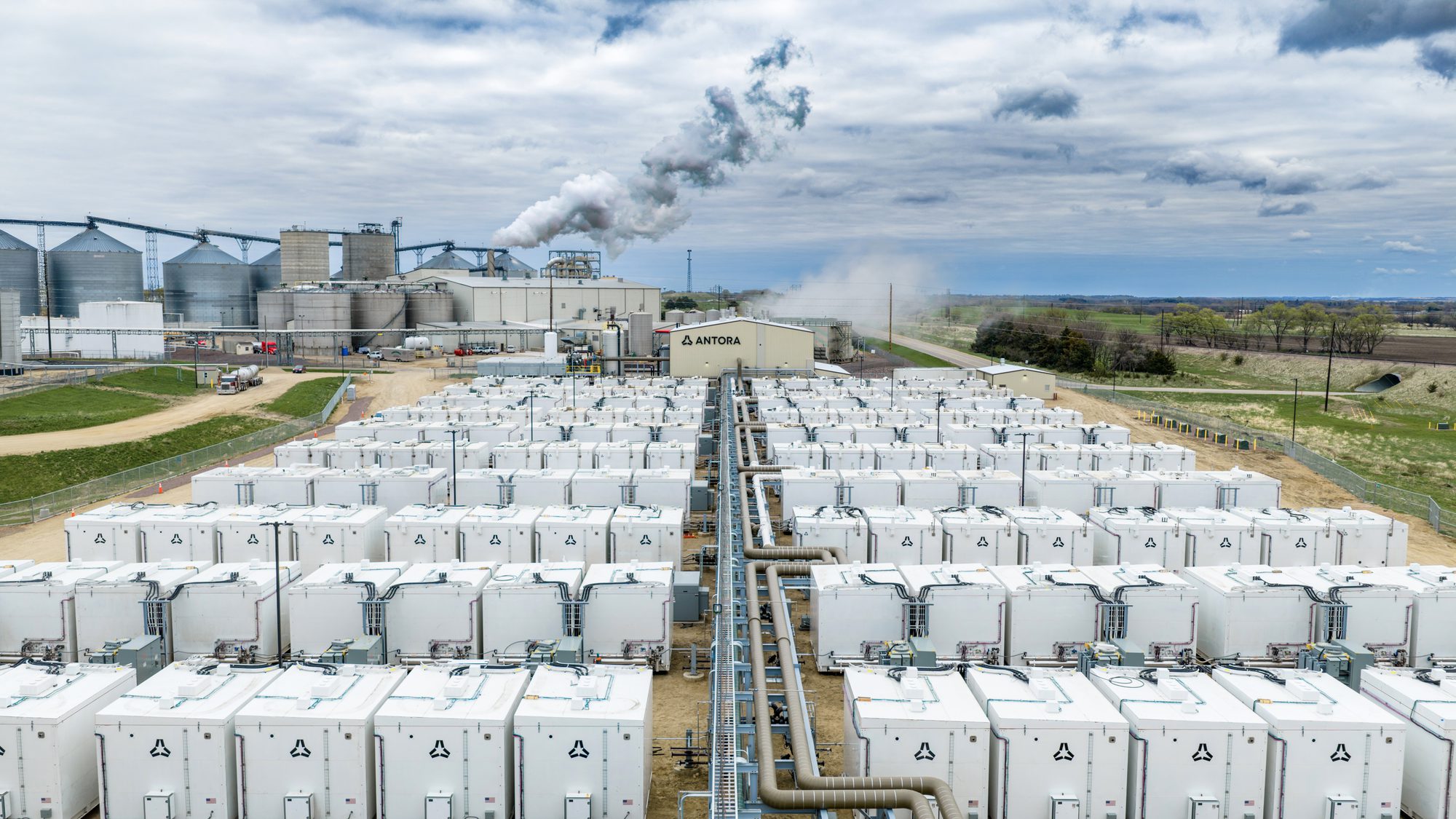
In Big Stone City, South Dakota, the most arresting thing about a battery is what comes out of it. The site beside POET’s bioprocessing plant holds 5 gigawatt-hours of energy in more than 200 factory-built modules. The electricity goes in when supply is plentiful. Industrial heat comes out when the plant needs it, including hours when the wind has other plans. Antora Energy brought the project from an empty lot to energy delivery in less than a year.
- Antora stores cheap electricity as heat in solid carbon, then sells dependable heat or power.
- Its first giga-scale project serves POET through a long-term heat agreement; POET’s upfront capital investment is listed as zero.
- The cleverest component may be the utility tariff that lets the batteries charge during local surplus.
- The test now is whether the same economics travel beyond South Dakota.
There is a temptation to call this a 5 GWh science experiment. POET would probably call it an energy supplier. The agreement is for delivered heat, and Antora says it arranged the power supply, project financing, installation and operation. That is a more useful description of the company than “battery maker.” A factory does not buy a chemistry lesson. It buys an energy bill it can predict and steam that arrives on time.
Why carbon, of all things?
Antora’s founders - Andrew Ponec, David Bierman and Justin Briggs - began with a broad question: how could variable clean electricity serve the world’s biggest energy users around the clock? They compared storage approaches and settled on heat. The obstacle was not how to warm something. Earlier thermal storage approaches had been held back by material limits and the difficulty of recovering useful heat. Antora needed a material cheap enough to buy by the truckload, sturdy enough to cycle through extreme temperatures, and able to give its heat back in a form a customer could use.
Their answer was solid carbon. Electric resistance heaters charge insulated blocks when power is inexpensive. The blocks hold heat for days. Light and heat radiate from the hot carbon to a heat-transfer system that can make process steam or hot air. Antora says its blocks can reach temperatures up to 2,400°C; its currently listed HeatCore product serves plant heat loads from 100°C to 375°C. The hotter storage medium gives the machine room to deliver useful heat at the temperature a particular process requires.
The material choice sets Antora apart from familiar lithium-ion batteries, which are built to return electricity rather than feed a steam header. It also differs from gas boilers, which make heat on demand by burning fuel. Other companies, including Rondo Energy, are pursuing thermal storage for industrial heat; Antora’s distinctive package is the carbon module, its high-temperature engineering, and an operation that spans manufacturing through energy sales. None of those choices erases the need for cheap electricity. They make cheap hours worth capturing.
The tariff is part of the machine
An industrial plant wants a continuous flow of heat. A power grid does not always have a continuous supply of cheap electricity. At Big Stone, Antora worked with Otter Tail Power on an electric rate that lets the battery charge selectively when local generation is in surplus. South Dakota regulators approved the arrangement in 2025. Antora says it allows the project to supply 24-hour energy without increasing costs for other utility customers.
That rate is not a footnote. It is one of the moving parts. A thermal battery charged at expensive hours can be a beautiful way to lose money. The useful trick is to put a large, flexible load where power can be bought cheaply, store those hours as heat, then deliver it against a customer’s steady demand. POET gets a long-term heat agreement; Antora’s project page lists the energy offtaker’s capital investment as zero. The total construction cost and contract price are not published, so there is no honest dollars-per-ton-of-steam figure to quote.
“Electrifying process heating requires not only hardware innovation but innovation in business models, controls, and utility rate structures.”Antora, explaining its 2022 Medley Thermal acquisition
Antora learned that lesson early enough to buy it. In 2022 it acquired Medley Thermal, a developer of renewable power-to-heat projects with control software and a project pipeline. The purchase added people who knew how to connect low-value electricity to thermal demand. The hardware could be manufactured; someone still had to make a power market, a utility and a factory agree on when it should run. Big Stone is the clearest public demonstration of those disciplines working together.
The first thing that had to work
The path to South Dakota was not a single leap from laboratory to 5 GWh. Antora opened a dedicated thermophotovoltaic, or TPV, cell line in 2023 and reported more than 40% conversion efficiency for turning hot light into electricity. That same year it operated a commercial-scale thermal battery at Wellhead Electric’s site near Fresno, California. In 2024 it opened a San Jose thermal battery factory. It then expanded the site to a three-building campus in April 2026.
The ordering matters. TPV is intriguing: photovoltaic cells watch the glow of hot carbon instead of the sun. Yet Antora’s own current product materials say direct TPV conversion is for future battery products. Its listed power block today pairs thermal storage and a steam generator with an ordinary steam turbine. Heat was the more immediate commercial route. That is a sensible sequence for a company selling to customers whose definition of “pilot” still includes production targets and a maintenance schedule.
A factory for a factory problem
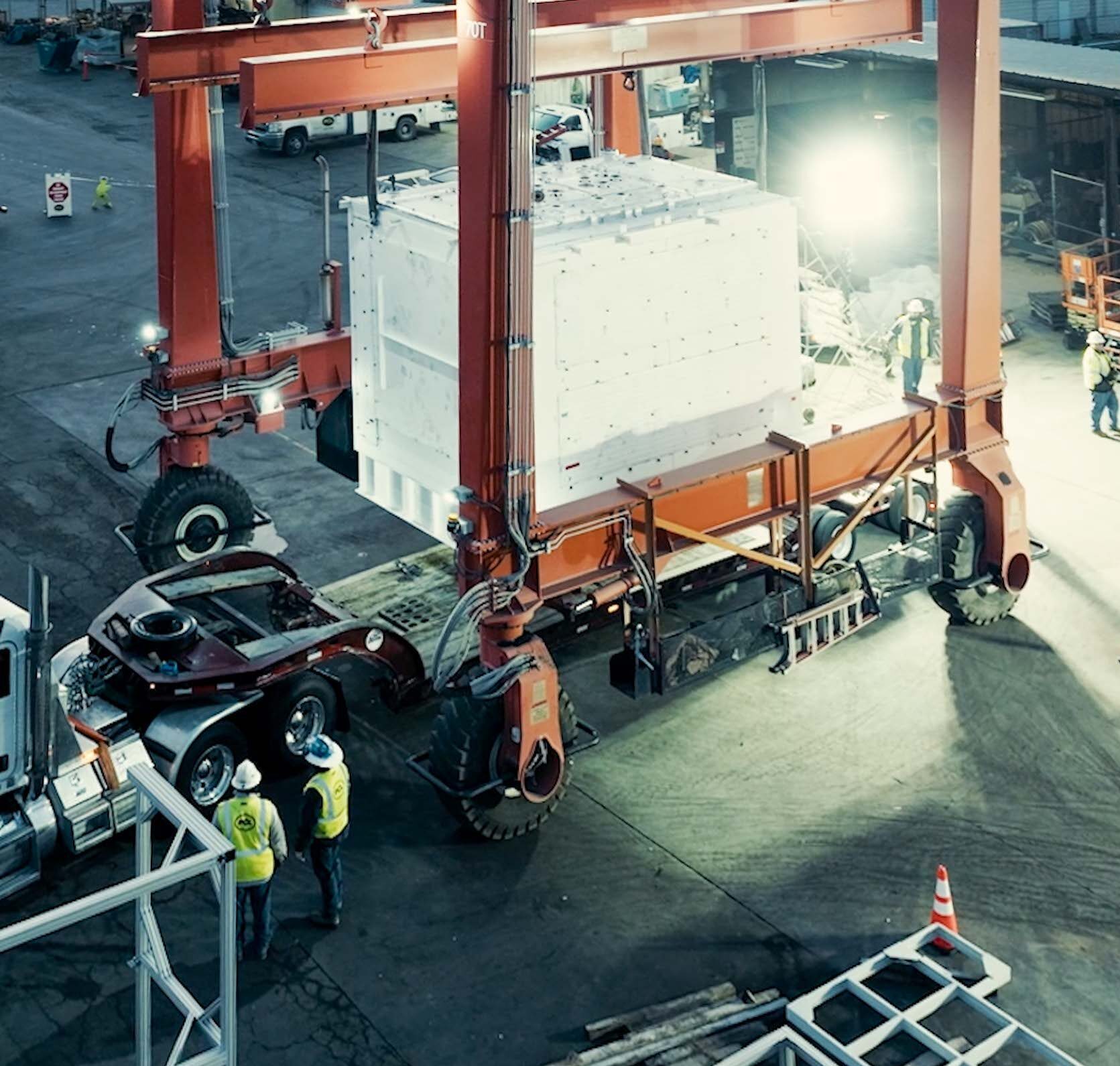
Antora says Project Big Stone supported more than 300 manufacturing and construction jobs between South Dakota and California. Its San Jose site now makes the modules in a three-building campus. That scale is expensive to build before demand is certain. The company raised $150 million in a 2024 Series B and $550 million in a July 2026 Series C led by G2 Venture Partners and Eclipse. The latest money is earmarked for more projects, a second U.S. manufacturing hub and a stronger domestic supply chain.
The supply chain has a literal carbon story. In September 2026, Antora and GrafTech announced a partnership to develop carbon-based battery materials at GrafTech’s St. Marys, Pennsylvania plant. GrafTech restarted eight bake furnaces there. An energy technology that depends on vast quantities of a humble industrial material must be able to buy that material repeatedly, at tolerable cost, from suppliers who can scale.
POET is the named customer with the largest public deployment. Antora also markets the same modular platform to chemical plants, food producers, steelmakers, data centers and the grid. Those are markets, not a roll call of completed projects. Antora says it has signed agreements with hyperscalers and industrial leaders, but it has not named those counterparties. The difference between an addressable market and a commissioned plant is the difference between a blueprint and a steam pipe.
There is a playbook here for other energy builders: start with a specific, steady load; find a power tariff that rewards flexible charging; package the equipment so it can be made repeatedly; and sell the customer useful energy rather than a pile of hardware. The circumstances matter. If local off-peak power is costly, interconnection is slow, or the customer has little continuous heat demand, the arithmetic will be less obliging. Big Stone shows what happens when those pieces fit. Antora’s next assignment is to prove they fit somewhere else.