A solar panel has an excellent work ethic and a rather firm view about office hours. It follows the sun. A factory, inconveniently, follows its orders. Between those two schedules lies the business that Manan Thakkar is now trying to build: renewable electricity that industrial customers can depend on when their own working day continues beyond daylight.
Based in Ahmedabad, Thakkar is a co-founder and managing director of Prozeal Green Energy. He and fellow co-founder Shobit Rai have taken the business from its early sustainability work into solar engineering, procurement and construction, then towards a broader combination of generation, storage and project development. The sequence matters. Each expansion brings the company closer to the customer's actual problem: keeping an industrial operation supplied with usable power.
The public milestones include an investment round, a Nepal joint venture and agreements with industrial customers. Yet his recent arguments dwell on less photogenic subjects: storage, manufacturing, grids and policy certainty. A row of panels makes a handsome photograph. A dependable electricity supply requires a good deal of work outside the frame.
Before the panels, the paperwork
Prozeal's early business was carbon consulting. Thakkar and Rai started with Clean Development Mechanism consulting before moving into solar EPC as the client response encouraged them to expand. The company's incorporation date is 4 July 2013. It is a useful starting point for understanding the founders: they entered through the business of sustainability, then moved towards the machinery that could deliver it.
That shift changes the nature of a promise. Consulting can help an organisation understand an opportunity; construction makes a company responsible for turning the opportunity into a working asset. EPC spells out three substantial obligations in three tidy letters: engineering, procurement and construction. The acronym is shorter than almost everything it describes.
Thakkar brought an education spanning technical and commercial disciplines. He holds an engineering bachelor's degree in electronics and telecommunications from the University of Pune and an MBA from Rochester Institute of Technology in the United States. His LinkedIn profile places his RIT studies in 2008-2010 and records tutoring finance and operations management courses.
There is a modest but revealing detail in that student chapter. A supervisor's recommendation praises how well he related to the undergraduates he tutored and the flexibility of his knowledge. It is a glimpse of work before the corporate titles: explaining something clearly enough that another person can use it. In a business involving engineers, financiers and industrial buyers, that ability has plenty of places to go.
An investment in the next obligation
The company's own chronology marks rooftop solar EPC in 2015, a commissioned ground-mounted project in 2021 and its first EV charging infrastructure development in 2022. These are different settings for the same underlying task: bringing an energy project from intention into service. They also show why describing Thakkar simply as a solar entrepreneur leaves part of the story out.
In April 2023, Prozeal announced a $4 million funding round led by Alchemie Ventures, the family office investment arm associated with Chandrakant Gogri. The stated uses were to scale operations and execute developer-model projects for energy and utility companies. An outside investment was therefore linked to a concrete change in how the business wanted to work.
For a founder, taking on development adds another layer of responsibility. Building a project for a customer and participating in a project as a power developer require different conversations about capital, contracts and time. The appeal of renewable power may bring a customer to the table. The arrangement that keeps the project viable has to keep that customer there.
- 2013Prozeal incorporated
- 2015Rooftop solar EPC
- 2021Ground-mounted project
- 2023$4m funding announced
- 2024Nepal venture announced
Selected company milestones. Dates describe the named event.
A border crossed, a job divided
In September 2024, Prozeal announced a joint venture with Nepal's Golyan Power. The proposed venture, Prozeal Green Energy Nepal, gave Prozeal a 60 per cent stake and Golyan Group 40 per cent. Its announced ambition was more than 500 MW of solar projects across multiple locations over the following 18 months.
The division of labour is more telling than the ambition alone. Prozeal would lead EPC development; Golyan would concentrate on business development, land acquisition and financing. The agreement was signed by Rai and Golyan Power director Akshay Golyan. For Thakkar's company, expansion involved bringing its execution work together with a partner's local responsibilities.
The proposed projects included rooftops and ground-mounted plants, with electricity intended for the Nepal Electricity Authority and commercial and industrial consumers. This was an announced development programme. Its significance in Thakkar's story lies in the business structure: international growth organised around a specific partner and specific tasks, rather than a pin added to a map.
Seventy megawatts, two states, one customer
A November 2025 announcement made the hybrid strategy tangible. Prozeal had signed a power purchase agreement with Grasim Industries for a 70 MW wind-solar hybrid project. The announced split was 49.5 MW in Gujarat and 20.5 MW in Andhra Pradesh, with an estimated project value of $100 million.
Thakkar described the partnership as reinforcing the company's commitment to India's energy transition. The practical interest is in the configuration. One industrial customer, two states and two generating technologies bring several decisions into a single agreement. A buyer's need for power becomes a project that has to be planned across locations and resources.
The photograph accompanying the announcement is suitably ordinary: people around a meeting table, documents held for the camera, laptops and bottles still in place. Renewable infrastructure has these moments too. Before a turbine turns or a panel produces, someone has to settle the agreement. The stationery gets its brief appearance before the engineering takes over.
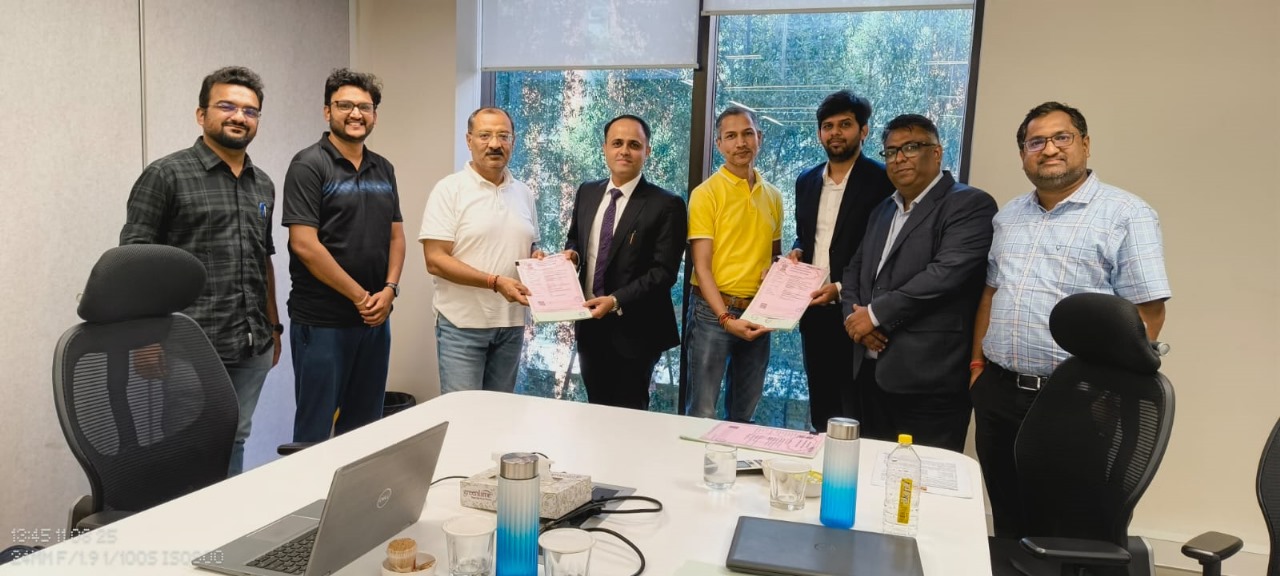
Wind-solar hybrid capacity announced under a power purchase agreement.
“This partnership with Grasim Industries reinforces our commitment to accelerate India’s transition toward sustainable energy solutions.”
Manan Thakkar · Grasim agreement announcement, 2025
The customer buys the hour, too
Thakkar's public thinking increasingly returns to reliability. In his July 2026 article on wind-solar hybrids, he argues for combining the two resources with battery storage to address the supply gaps that arise when generation and industrial demand follow different schedules. His focus is on what that combination can do for the customer: fewer interruptions, steadier operations and less dependence on backup generation.
There is an important distinction inside that argument. A generating plant's capacity describes what it can produce under specified conditions. An industrial operation needs electricity at particular times. A system designed around that operation has to account for the timing as well as the total. Thakkar's hybrid argument puts the customer's working hours into the design brief.
His pre-Budget comments in January 2026 take the same concern into public policy. He identifies inadequate grid-scale storage as a gap and argues that congestion, curtailment and variable supply can erode the advantages of inexpensive renewable tariffs. He calls for support for batteries, pumped hydro and green hydrogen, along with incentives and certainty for domestic manufacturing.
Those comments make his ambition more demanding than adding another installation. Imported battery cells, electrolysers and power electronics enter his discussion because equipment supply affects what can be built and at what cost. The founder is thinking about the chain of dependencies around the project. Even a sunny forecast leaves a fair amount undecided.
Conceptual diagram of the strategy; no generation forecast or performance guarantee is implied.
Two founders, a longer operating life
Rai's own May 2026 discussion of storage gives another view of the company the two founders are building. He stresses control systems, realistic battery degradation assumptions and disciplined operation. A battery's purchase price, in that account, is only one part of the economics; performance over time determines whether the asset can keep meeting its obligations.
The relationship between these arguments is useful. Thakkar discusses the industrial need and the policy conditions for meeting it. Rai describes the operating details that can decide whether a storage system performs as intended. Their public contributions approach the same business from different angles, with reliability as a shared concern.
Prozeal added operational leadership in April 2026 when it appointed Abhay K. Vishwakarma as chief operating officer. His remit covers project development and execution in India and overseas. For a founder-led company moving further into EPC and independent power production, that appointment puts a named executive in charge of a growing set of delivery responsibilities.
The server room joins the factory floor
Thakkar has also applied the energy argument to data centres. In a 2026 opinion article, he advocates policies that would accelerate their adoption of solar power and battery storage. Data centres put a particularly sharp edge on the reliability question: the digital services they support depend on continuous operation.
The connection broadens his commercial field without changing the central question. A manufacturing customer and a data centre have different activities, but both need the electricity arrangement to fit the way they work. Thakkar's interest in this market follows the same logic as his hybrid proposals: renewable generation becomes more useful when its delivery is designed around demand.
In June 2026, Prozeal announced a 60 MWp captive solar project in Uttar Pradesh, planned with a steel and mining company. Later that month’s public milestone was larger still: a notification of award from ONGC for 250 MW of captive wind projects connected to the inter-state transmission system, with a value of about ₹2,000 crore. The company dated that announcement 11 June.
The ONGC award is a commitment to future delivery. It is also a visible step beyond Prozeal's early solar work. On LinkedIn, Thakkar credited colleagues for meeting the tender and technical requirements. The detail brings the large contract back to the people who did the work necessary to secure it.
About ₹2,000 crore in announced contract value. Delivery and commissioning lie ahead.
What stays when construction leaves
There is another timescale in Thakkar's account of renewable development: the life of the community around a project. In his October 2024 interview, he describes hiring local workers during construction, training them and providing maintenance employment after the construction phase. He also describes engineers returning from urban centres to work nearer their families.
That is a more personal measure of what an infrastructure business leaves behind. Construction has a deadline; maintenance continues. A project can alter where someone earns a living as well as where a factory gets its electricity. Thakkar also points to support for schools near solar parks, including software and infrastructure improvements.
His career now sits between those human consequences and the contractual ones. A customer wants power on schedule. A team has to deliver the project. A local worker wants a role that survives the departure of the construction crew. The panels are the visible part; the continuing relationships are much of the business.
The hours after sunset are a useful test for all of it. They expose the difference between a capacity figure and a customer's day, between an announcement and an operating obligation. Thakkar's next chapter will be judged in those hours, when the solar panels have finished and the customer still has work to do.