Long before his current hydrogen assignment, Ajay Das arrived in Ahmedabad after midnight with a delayed flight behind him and a small grievance ahead. His cab driver asked him to put his own luggage in the boot. Das, who was paying for the ride, briefly wondered why the driver did not do it. Then he put the bag away and got in.
In the account he published in December 2016, conversation changed the evening. The driver, Mehul, owned three cars and was covering for an absent employee. He also taught mechanical engineering and ran a travel business. Das recorded his initial irritation, then his admiration for someone willing to take the wheel to keep the business moving.
The memorable part is Das leaving his own mistaken first impression in the story. A tidy executive anecdote might have edited that out. His version allows the passenger to learn something. Years later, as he leads Prozeal Green Energy’s Green Hydrogen & Derivatives business, the questions around work, value and responsibility have grown considerably larger.
An engineer with a finance degree
Das is based in Surat, Gujarat. His education combines electrical engineering at the National Institute of Technology Rourkela with an MBA in finance from the Xavier Institute of Management, Bhubaneswar. Those disciplines run through a career involving engineering, commercial development and corporate strategy.
His employers have included the Steel Authority of India, National Aluminium Company, Jindal Stainless and Adani Group. At Adani, he was a founding member of the corporate strategy team and contributed to the group’s energy strategy document. He also led business development across oil and gas and coal-to-chemicals activities.
Before Prozeal, he was Director of Business Development at Air Products, developing Indian projects involving hydrogen and coal gasification. His working history therefore includes the established industrial energy economy as well as the newer hydrogen business. The companies and technologies change; the recurring work involves making an industrial project commercially possible.
There is an earlier, smaller leadership entry too: he served as president of the Rotaract Club of Rourkela in 1996-97. His professional profile also records an oil-and-gas company IPO valuation project spanning December 2009 to September 2010. Engineering, finance and organized activity appear together well before the current assignment.
When the pricing formula becomes the question
In July 2014, Das published an article asking whether liquefied natural gas should remain priced in relation to crude oil. He examined US shale supply, potential pipeline imports into Asia and the uncertainty facing LNG developers. He was writing about the terms on which energy could be bought, rather than simply its availability.
He returned to the subject in January 2015, after the oil-price backdrop had changed. A formula attractive to a buyer under one set of prices could look different under another. His argument favored allowing LNG’s own supply and demand to determine its price.
The two pieces make an interesting pair because they preserve a commercial debate across changing conditions. They also show him addressing the difficulty of committing money while the assumptions beneath a project move. A contract may be written neatly enough; the market has no obligation to remain equally neat.
His writing later widened beyond prices. In November 2020, he argued that income inequality could obstruct climate action. He used coal-dependent communities in eastern and central India to ask how people would support a transition without alternative livelihoods. In his argument, redistribution and economic security belonged inside the climate discussion.
Who builds it, who owns it, who runs it?
At Air Products, Das publicly discussed Build, Own & Operate at an energy-transition symposium organized by Damodar Valley Corporation in Kolkata. The discussion concerned coal gasification and the conversion of coal into synthesis gas and chemicals. It put the operating model beside the technology.
Build, Own & Operate, usually shortened to BOO, also appears in his current Prozeal brief. The developer takes responsibility for creating and operating the asset. Customers can obtain the output without taking on the same plant investment and operating responsibilities themselves.
That recurring model supplies a concrete connection between two stages of his career. A change in the molecule being produced does not remove the question of who will pay for the plant, manage it and supply the customer. His work has addressed that allocation of responsibility in both settings.
Prozeal’s hydrogen-business recruitment adds the customer side of the picture. A business-development role reporting to Das in Surat called for identifying retail and bulk hydrogen consumers, understanding their requirements and building relationships. The vocabulary is ordinary commercial language. Even an emerging energy business needs someone prepared to buy what it makes.
The proposal that stayed on paper
In a later public post, Das recalled a proposal he had advanced at Air Products during 2023-24. It involved converting domestic coal into dimethyl ether, then starting with a 10 percent blend into LPG. He said he had presented the idea to government authorities and coal and oil public-sector companies.
By his account, the proposal did not proceed. Its immediate economics were less attractive than LPG. He used that experience to argue that financial comparisons should give greater weight to import dependence, supply interruptions, currency exposure and domestic industrial capability.
“Not everything that matters can be captured in an Excel sheet,”
Ajay Das, on energy investment
He extended that argument to green hydrogen and green ammonia. This is his stated position, rather than proof that an uneconomic project would eventually become profitable. The distinction matters. His argument asks decision-makers to consider a longer horizon and a broader set of benefits when judging an energy investment.
There is something revealing in choosing a proposal that failed to advance as the example. It gives the argument a specific point of friction: a project can promise strategic benefits while struggling against the price of the existing product. That is a practical problem for the business he now leads.
A hydrogen talk with the obstacles left in
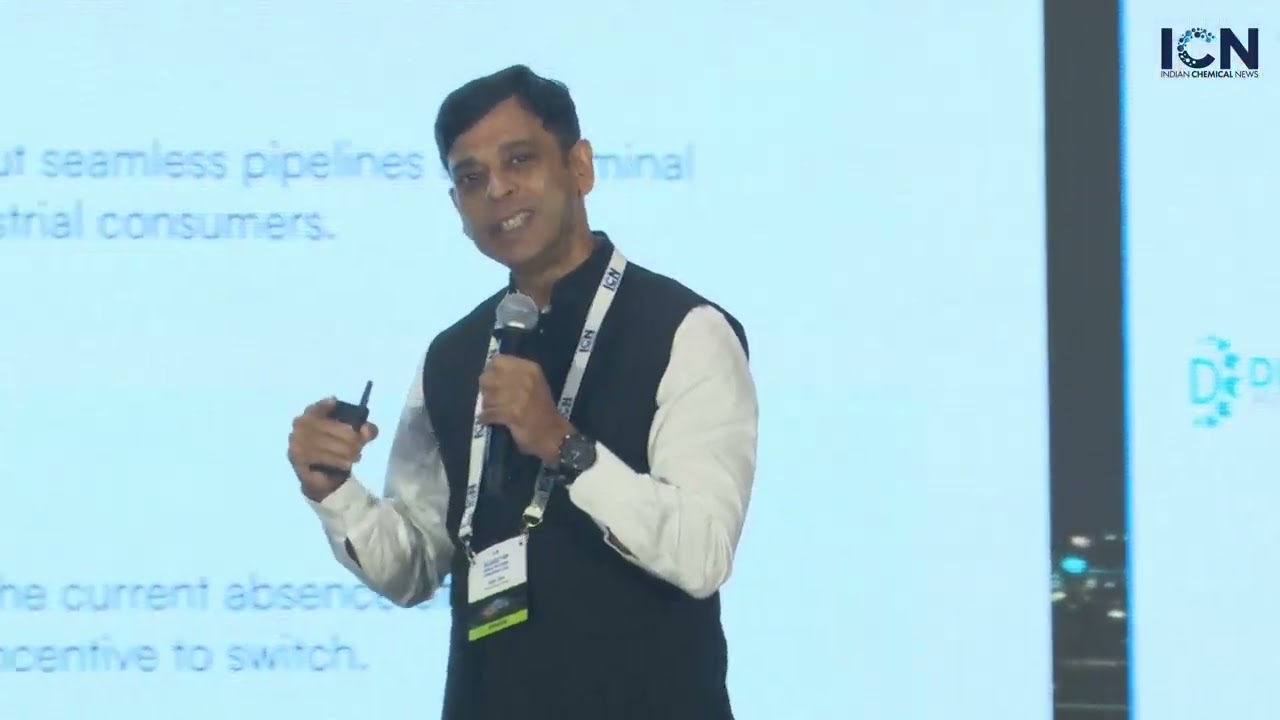
Das’s presentation on green hydrogen and derivatives, published by Indian Chemical News, sets out opportunities alongside constraints. Steel, refining, fertilizers and chemicals appear as prospective uses. Capital costs, the cost of renewable electricity and gaps in storage and distribution appear on the other side of the ledger.
The presentation also makes a geographically specific case for Gujarat. It points to industrial demand around Dahej, Saykha, Ankleshwar and Jhagadia, renewable resources and access to ports. The proposed approach concentrates on customers and infrastructure within industrial clusters.
Its recommendations include increasing incentives for hydrogen end-users to ₹100 per kilogram and using Gujarat Power Corporation as an aggregator of industrial demand. These are proposals in the presentation, not statements that those measures have been adopted. They put a number and an institutional role on the question of how to encourage purchases.
His conference appearances have covered related territory. At the Eastern India Clean Energy Summit 2025 in Odisha, he joined a panel and a CEO roundtable concerning policies, infrastructure and investment. At the South Gujarat edition of the Vibrant Gujarat Regional Conference, his session addressed the region’s hydrogen ecosystem. In each case, the subject extended beyond plant equipment to the conditions around a project.
From energy projects to the semiconductor supply chain
By July 2026, Prozeal had begun construction of an ultra-high-purity green ammonia facility in Gujarat’s Dahej industrial region. In a July 30 interview, Das discussed collaboration with Japanese semiconductor-material companies, gas businesses and trading houses. He sought strategic investment and purchasing partners for the first phase, with equipment partnerships envisaged for later stages.
The first phase was planned around seven tonnes of ultra-high-purity ammonia a day and a five-megawatt alkaline electrolyser. Commercial operation was scheduled for July-September 2027. Those are project plans, not a record of production already delivered.
The semiconductor connection gives his current assignment a precise market. The company is pursuing gases for manufacturing processes where purity matters, alongside the wider industrial opportunities for hydrogen. Selling into that market requires conversations about the customer’s process and requirements as well as the renewable origin of the gas.
In September 2026, Das represented Prozeal at a semiconductor networking event organized by Japan External Trade Organization and Japan Bank for International Cooperation in Ahmedabad. The company also reported engagement with prospective buyers at SEMICON India 2026. The partnership discussions he outlined in July were followed by these public industry meetings.
Later phases envisage larger ammonia production, specialty gases, green methanol and sustainable aviation fuel. For now, his public activity is concentrated on bringing investors, equipment companies and prospective buyers into the developing hydrogen-and-derivatives business.
ultra-high-purity ammonia
alkaline electrolyser
A future with someone at the other end of the contract
The career holds together through a set of documented commercial questions. Das has written about how energy is priced, argued that communities need alternatives when industries change, discussed who should own industrial plants and pursued customers for new products. His hydrogen assignment gathers those questions into one business.
His stated aim at Prozeal is to help enable India’s energy transition through green hydrogen and its derivatives. The current work gives that aspiration a place, a product and a proposed operating model. Surat is his base; Gujarat’s industrial clusters are part of the market; partnerships extend the conversation beyond India.
The late-night cab story offers a modest ending for a profile full of industrial plans. Das admired a business owner who covered an absent driver’s shift. Today his public agenda concerns plants, purchasing agreements and international partners. In both accounts, the work becomes concrete when someone takes responsibility for delivering it.