The sun keeps rather better office hours than an electricity customer. It supplies a solar panel during the day, then leaves the evening to somebody else. For Juan Camilo López, cofounder and CEO of Erco Energía, that simple scheduling problem now sits inside a much larger job: building a business that can generate power, store it, and sell it to people who need it at hours of their own choosing.
His career began with mechanical engineering at EAFIT in Medellín and a partnership with fellow student Juan Esteban Hincapié. Erco was founded in 2012. The company they started has since widened its responsibilities along the energy chain. The progression gives López’s biography its shape: an engineer learns how to make an installation possible, then helps assemble an organization that can live with its obligations for years.
An engineering partnership, before the financing
The original proposition was tangible. Customers could generate their own energy, with the possibility of storing it and selling a surplus back to the local network. López and Hincapié used their savings to start the venture. It emerged from a university graduation project, bringing a subject they had studied into a market where they hoped it could become useful. An idea for a degree became a business requiring customers.
Early entrepreneurship also made competing demands on the same small team. Hincapié later recalled the problem of having to sell panels and install them: the work of fulfilling an order took time away from finding the next one. The founders had a product to deliver and a company to keep alive. A panel on a roof might be doing its job perfectly while the people beneath it still had several jobs to do.
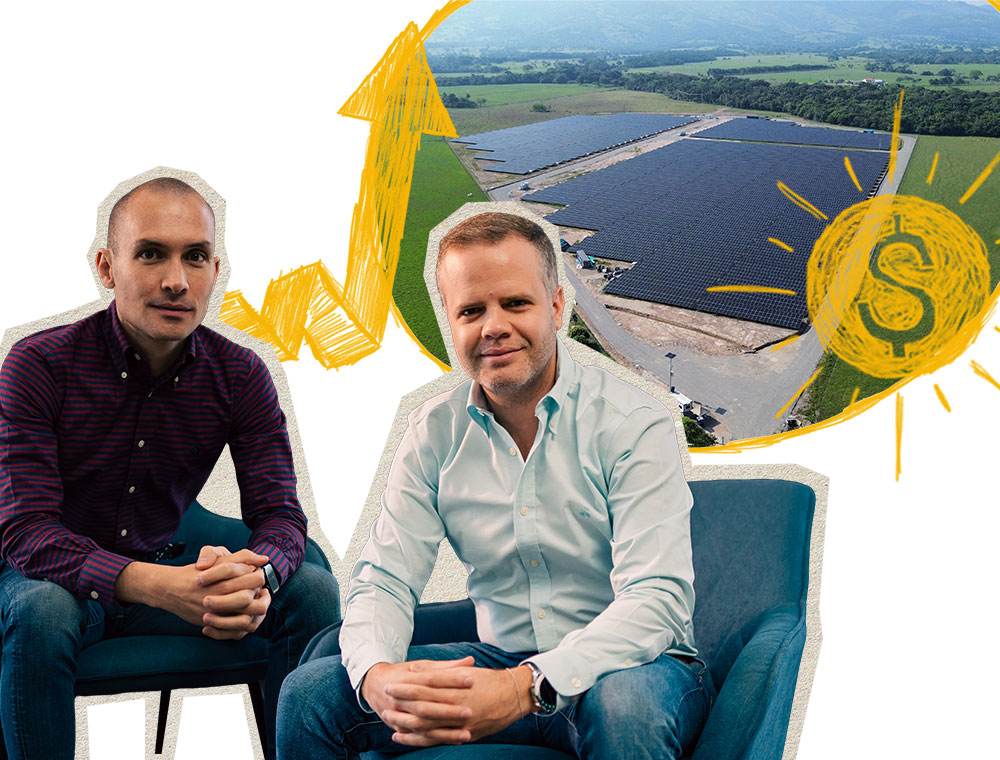
The cast was larger than a convenient two-founder photograph suggests. Erco’s tenth-anniversary account names Esteban López and Carlos Méndez alongside Juan Camilo and Juan Esteban as founders. An April 2015 account also placed the four together. These are useful names to retain. The company’s beginnings involved an engineering team, and its later success cannot sensibly be reduced to a chief executive having an idea in splendid isolation.
The contract enters the story
López’s education continued after the venture began. Alongside mechanical engineering, he completed a specialization and a master’s in project management at EAFIT. His 2017 thesis, coauthored with Manuela López Llano, investigated the feasibility of power-purchase agreements for photovoltaic projects smaller than 20 kWp in Antioquia. The title is wonderfully specific. It offers neither a promise to save the world nor an invitation to ignore the bill.
It also supplies a revealing continuity in his career. A power-purchase agreement puts a commercial relationship around generation. The thesis concerned small projects in a particular place, rather than solar energy as an abstract enthusiasm. Read as part of his biography, its subject shows that the arrangements surrounding an installation were already receiving his attention. He was studying how a solar proposition could work as a project.
Project management belongs naturally beside that question. Equipment, expenditure, and responsibilities have to meet in the same undertaking. The degree title is less picturesque than a field of panels, but it fits the work López would go on to describe. His career offers an argument for keeping the second education in the frame: the technical idea remains central while the number of things that must happen around it increases.
The company becomes responsible for the electricity
Erco’s business expanded into developing, owning, operating, and maintaining generation, as well as selling energy to users through digital commercialization. That development changes the meaning of a founder’s job. Finishing an installation provides one kind of achievement. Continuing to operate generation creates an ongoing responsibility. The customer relationship extends beyond the construction work, and the company has to remain able to carry it.
López and Hincapié also cofounded Neu Energy. EAFIT recorded both Neu and Erco in the Forbes Colombia startup selections for 2021 and 2022. Their entrepreneurial work stretched into an investment fund as well. The related businesses make the partnership worth following across more than one announcement: engineering, electricity commerce, and investment each gave the founders another part of the energy business to understand.
In 2021, López received EAFIT’s graduate recognition for Sustainability and Environmental Impact. His remarks connected doing work he enjoyed with responsibility toward society and his country. There was room for a small joke: he had put all his energy into the enterprise. The pun was practically waiting for him at the lectern. More revealing was his emphasis on aligning the work with what mattered to him.
“Trabajo con energía y por la energía de mi país.”
Juan Camilo López, EAFIT recognition, 2021“I work with energy and for my country’s energy.”
His public tenth-anniversary message made room for the people who had helped Erco grow. He thanked them for their contributions. For a company that began among university colleagues, the acknowledgment kept the collective effort visible even as the enterprise became larger.
A longer table in Miami
The partnership entered another setting in December 2024, when López and Hincapié were selected as Endeavor Entrepreneurs at the international panel in Miami. The selection placed them among founders working across countries and industries. For a business with practical operating problems, the value of such a gathering can be quite concrete: somebody across the table may have encountered a version of the same difficulty.
One encounter is documented. Andrés Friedman, the founder of Solfium, met Erco’s founders at the panel. They exchanged experiences, strategies, and views of the future of their businesses. Their companies differed, but they faced related markets and challenges. It is a modest scene to preserve in a biography: people who build things talking to other people who build things, with enough common ground to make the conversation useful.
The international story also contains a retreat. In May 2026, López said Erco had closed its Texas operation the previous year and brought lessons back to Colombia. He described continuing operations in Panama and digital energy commercialization in Brazil. Expansion therefore belongs in the account with its edits intact. A map of offices can record where a company went; the decision to leave one records another part of the work.
An announcement with a long runway
In August 2026, Erco closed a Series C equity round of $129 million. A consortium managed by Augment Infrastructure invested $50 million as part of it, joining the founders and existing shareholders Next Utility Ventures and Norfund. The consortium included Allianz Global Investors, Proparco, and Finnfund. The transaction brought several institutions into the company’s next chapter, each with an interest in how its plans would become operating work.
Another financing step had preceded it. In March 2025, Norfund announced an additional $20 million subordinated loan to Erco, taking its total investment to $50 million at that time. It described financing that helped attract senior debt from a national financial institution. Different sources of capital occupied different places in the undertaking. The sequence matters because building generation requires more than one successful conversation about money.
López later described the equity fundraising as taking more than a year and a half. He emphasized the contribution of social, environmental, and governance work to investor confidence. His explanation gave those practices a commercial role: they helped make the company ready for the transaction. The accompanying lesson was about the organization around the projects, including the rigor necessary for investors to commit capital.
The story has an employment dimension, too. Norfund reported in March 2025 that Erco had added 613 permanent positions since 2023 and provided more than 2,000 temporary jobs. It also described specialized construction and maintenance training for local workers near the facilities. Those figures belong to the company and that reporting period. They remind us that an expanding energy business carries people along with its equipment and agreements.
The evening test
The next ambition involves storage. López has described Erco’s 2030 targets as 1.3 GWp of installed solar capacity and 550 MWh of batteries. They are goals, with work still ahead of them. Capacity to generate and capacity to store answer different questions. Keeping the units distinct helps keep the promise distinct as well: building more solar generation and making stored electricity available are related undertakings.
Installed solar capacity
Battery storage
At the September 2026 Energy Summit in Medellín, López discussed batteries in relation to Colombia’s evening demand, including the hours between six and ten. He also identified financing speed, permits, and grid connections as obstacles to faster renewable development. The list takes the story back to project management. The hardware has a schedule; so do the people and institutions whose decisions determine when it can begin serving customers.
His stated view of solar leaves room for other generation. He has argued for a diversified system that includes hydroelectric, thermal, and wind power alongside it. For somebody who built a company around solar, the position is a practical acknowledgment of the larger system his business serves. An electricity customer asks for a working supply. The chief executive’s task includes understanding how his company’s contribution fits with the rest.
That is where López’s career becomes most interesting. The subject has grown from an engineering opportunity into a series of obligations: to partners, customers, workers, and investors, and to the projects meant to fulfill the company’s plans. The sunlight remains available on its own terms. López’s work is increasingly concerned with everything that must happen around it, including how to make its contribution useful after the working day has ended.