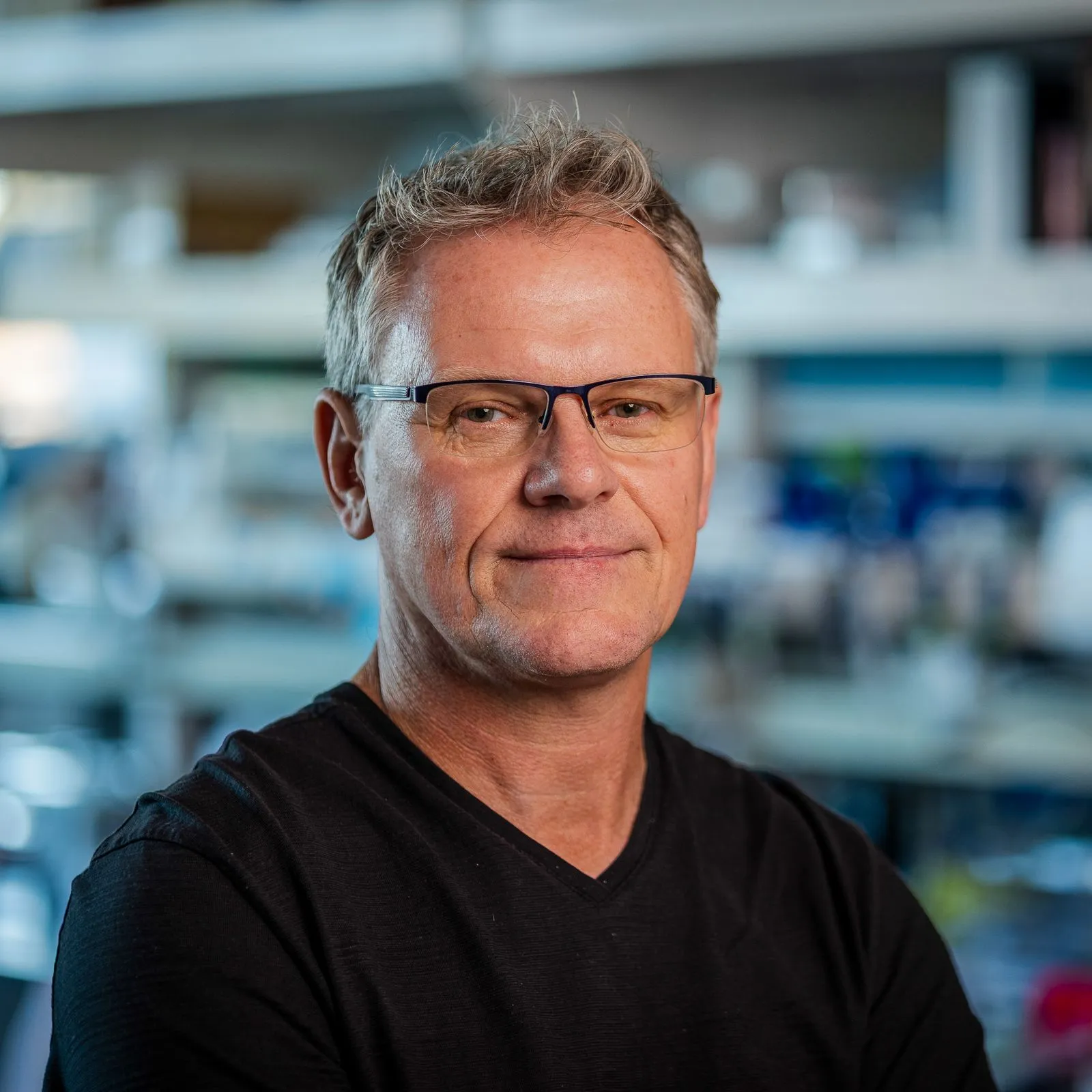
Forty years of failure - and one man who wouldn't accept it
For four decades, KRAS was the white whale of cancer biology. A mutation found in roughly 25% of all human cancers - lung, pancreatic, colorectal - and considered completely undruggable. Too smooth, too slippery, too featureless. Generations of drug hunters tried and failed. The gene got a nickname in the field: the undruggable oncogene.
Stig Hansen didn't believe in undruggable. Working at Sunesis Pharmaceuticals in the early 2000s, he invented something called Chemotype Evolution - a way of finding and growing molecular fragments that bind to proteins at unusual, cryptic sites that traditional chemistry missed entirely. He wasn't hunting KRAS specifically. He was building a better map.
In 2008, he took that map and founded Carmot Therapeutics with a small team in Berkeley. Over 15 years - through every biotech cycle, every funding squeeze, every moment when rational people would have stopped - he kept refining the approach. Three clinical-stage drug candidates for metabolic diseases. A growing pipeline. And then, quietly, a collaboration with Amgen that used his Chemotype Evolution technology to find a way into KRAS G12C.
In 2021, LUMAKRAS became the world's first FDA-approved KRAS inhibitor. The undruggable gene, drugged at last.
- Stig Hansen's 15-year bet, paid outRoche noticed. In January 2024, they acquired Carmot Therapeutics for up to $3.1 billion - one of the larger biotech exits of recent years. Hansen stayed on as advisor and board member. But he had already moved on. Kimia Therapeutics had been quietly forming since 2023.
Starting Over, Better
Kimia - from the Arabic and Persian word for alchemy, for chemistry itself - is what happens when a platform builder gets a second chance at a blank page. Hansen co-founded it with two Carmot veterans: Jack Sadowsky, who spent 14 years before Carmot leading bioconjugation chemistry at Genentech, and Ray Fucini, who had built Carmot's discovery technology infrastructure. They knew what they were doing, and they knew what they'd do differently.
The centerpiece is ATLAS: AcTive Learning with Automated Synthesis and Screening. Where earlier drug discovery platforms might screen thousands or tens of thousands of compounds, ATLAS can access and evaluate billions of drug-like molecules. It integrates nanoliter-scale high-throughput chemistry, machine learning models that improve with every experiment, genome editing for target discovery, and a proprietary HT-ADME platform that filters compounds for metabolic stability and drug-likeness before they ever reach a biologist.
ATLAS isn't just faster drug discovery. It's a continuously learning system that gets smarter with every molecule it makes and tests - an active feedback loop between chemistry, biology, and computation.
The framing matters: Hansen isn't running a drug company that uses AI. He's building a chemistry-first platform where AI is the substrate. The target areas - oncology, immunology, inflammation - were deliberately chosen to be outside Carmot's metabolic disease turf, a clean slate rather than a sequel.
The Platform Thinker
To understand what makes Hansen unusual in biotech, start with his academic background. He earned his MS and PhD in Molecular and Cell Biology at the University of Copenhagen before heading to UC Berkeley for not one but two postdoctoral fellowships. The first, in Nobel laureate Robert Tjian's lab, studied transcriptional regulation - how genes get turned on. The second, as a Novartis Fellow of the Life Sciences Research Foundation, was in Tito Serafini's lab, studying mammalian brain development.
A neuroscience postdoc turned cancer drug hunter. Two completely different systems, both requiring deep pattern recognition. When you study how a brain wires itself and how transcription factors read DNA, you develop intuitions about molecular interaction that don't come from conventional medicinal chemistry training. Hansen didn't enter industry with a drug target. He entered it with a philosophy.
That philosophy - that the key constraint in drug discovery isn't biology or computation but chemistry itself, specifically the ability to explore chemical space at scale - drove everything at Carmot and now drives everything at Kimia. He is, at heart, a map-maker. The drug is just the destination.
The ATLAS Platform in Detail
Automated Synthesis
Nanoliter-scale chemistry enabling rapid access to billions of drug-like compounds beyond traditional libraries
Active Learning
ML models that improve continuously with each synthesis-screen cycle, guiding chemistry toward optimal candidates
Genome Editing
Identifies druggable sites at key disease nodes; validates targets before chemistry begins
HT-ADME
Proprietary high-throughput filters for metabolic stability and solubility - drug-likeness at scale
The ATLAS acronym is deliberate. Hansen is building an atlas of the druggable universe - a map of chemical space at single-atom resolution, cross-referenced with proteomic data and biological assays. Every molecule the platform makes teaches the system something. The map gets more detailed with every experiment.
In March 2025, Kimia appointed Imran S. Haque, Ph.D., as Chief Technology Officer - a hire that signals where the platform is going. Haque spent years as Senior VP of AI and Digital Sciences at Recursion Pharmaceuticals, building machine learning systems for chemistry and biology. His appointment bridges the chemistry-first origin of the company with increasingly sophisticated computational infrastructure.
Imran brings a unique combination of expertise in building machine learning teams and technologies for chemistry, biology and genome editing, with applications in new target- and drug-discovery.
- Stig Hansen, on appointing Kimia's CTO Imran HaqueThe $55M Vote of Confidence
When Kimia closed its Series A in December 2023 - $55 million, led by The Column Group and Dimension, with Horizons Ventures and individual investors participating - it was a signal about who believes in what Hansen is building. The Column Group is one of biotech's most scientifically rigorous investors, known for long-term conviction bets. Dimension focuses specifically on companies applying machine learning to drug discovery. These aren't hedge funds chasing narrative. They're betting on the platform itself.
What the Map Reveals
The question Hansen keeps returning to isn't "which target should we pick?" It's "how much of druggable space have we actually explored?" The answer, by most estimates, is a tiny fraction. Traditional drug discovery is like mapping a continent one square mile at a time by hand. ATLAS is, in Hansen's conception, the satellite that makes the whole map at once and then zooms in wherever biology says to look.
His publication record gestures at this breadth. He has authored or co-authored research on chromatin loops and CTCF, on fragment-based lead discovery using Tethering with extenders, on GLP-1 receptor modulators, on USP28 inhibitors. The common thread isn't a single disease area - it's a method. Find the cryptic binding site. Grow the molecule. Apply the filter. Repeat, faster.
At 37 employees and growing, Kimia remains small enough to move fast. Hansen has been through the alternative. Carmot, over 15 years, grew into the kind of company Roche wanted to own. The job now is to build the platform that produces the next generation of medicines - and, if history is any guide, to do it patiently, methodically, and with more confidence in the chemistry than in any individual target.
The KRAS story is instructive not because it was a triumph of a single drug, but because it demonstrated that no protein is truly undruggable if you build a good enough map. Hansen is betting that the same logic applies to most of the proteins currently considered unreachable - and that ATLAS will find the routes.
Milestones that define a career
Invented Chemotype Evolution
A novel fragment-based drug discovery approach that finds cryptic binding sites traditional chemistry misses. Developed at Sunesis Pharmaceuticals starting in 2000.
LUMAKRAS - First KRAS Drug
Co-discovered the chemistry behind sotorasib (Amgen) via Carmot collaboration. The world's first FDA-approved KRAS G12C inhibitor, approved 2021.
$3.1B Carmot Exit
Built Carmot Therapeutics from a Berkeley startup to a $3.1 billion Roche acquisition over 15 years as co-founder and CEO.
Kimia $55M Series A
Raised $55 million in December 2023 from The Column Group, Dimension, and Horizons Ventures to scale the ATLAS platform.
20+ Patents & Publications
Author across GLP-1 modulators, USP28 inhibitors, CTCF chromatin research, and fragment-based lead discovery methods.
Novartis Fellow, UC Berkeley
Awarded a Life Sciences Research Foundation Fellowship at UC Berkeley, studying mammalian brain development under Tito Serafini.