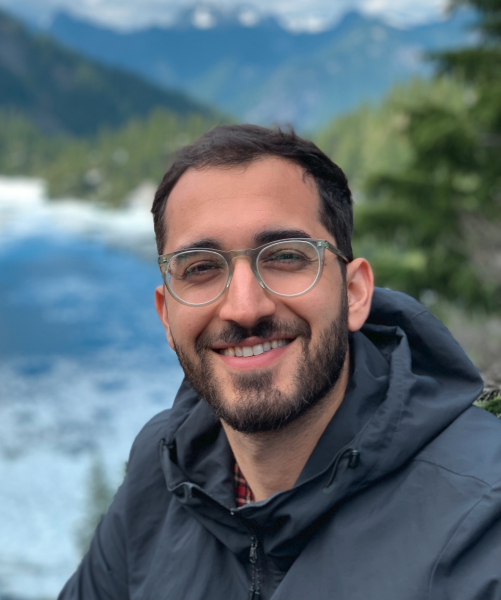
He Came for Proteins. He Stayed for Everything.
In 2017, Ali Madani was staring at ultrasound images of beating hearts at the UCSF Cardiovascular Research Institute, teaching convolutional neural networks to classify echocardiograms faster than any cardiologist could. That paper - Fast and accurate view classification of echocardiograms using deep learning - now carries over 700 citations. It was not, however, what he had in mind for a career.
Madani earned his PhD in Applied Science and Technology from UC Berkeley between 2014 and 2019, won the UC Dissertation Award, and picked up an AHA National Innovative Research Grant along the way. He interned at IBM Research, building multimodal cognitive assistants for radiology and cardiology. He co-founded an EHR startup. But the thing that wouldn't let him go was a question nobody had seriously asked: What if you treated protein sequences like language?
At Salesforce AI Research, he got to ask it out loud. As the architect of ProGen - trained on 280 million amino acid sequences from over 19,000 protein families - Madani demonstrated that a large language model could generate functional proteins from scratch. Not approximate them. Not retrieve similar ones. Generate brand-new sequences with catalytic efficiency comparable to proteins that evolution spent billions of years refining. The 2023 Nature Biotechnology paper that came out of that work has 1,300+ citations. It's the kind of result that makes other scientists do a double-take and re-read the methods section.
The future of biology will be written by our AI. A future where we are no longer constrained by what can be discovered in nature but where we can design breakthrough solutions tailored to humanity's needs.
- Ali Madani, CEO, Profluent
He left Salesforce to build the company those results demanded. Profluent landed in Emeryville, California, with co-founder Alexander Meeske. The first investor conversation was not a formal pitch meeting. It was a Twitter DM - Madani reaching out to Nathan Benaich at Air Street Capital in 2021. That DM turned into Profluent's earliest backing and, eventually, the largest single position in Air Street's second fund.
🧬
OpenCRISPR-1: The Gene Editor That Never Existed
Released April 2024 - published Nature 2025. An AI-designed Cas9-like protein 400 mutations from any natural sequence. Edits human DNA. Works as well as SpCas9. Open-source. Free to license for research and commercial use.
400 Mutations Away From Anything in Nature
In April 2024, Profluent released OpenCRISPR-1 to the world - and it stopped biologists cold. Not because gene editing is new. Gene editing has Jennifer Doudna. It has CRISPR-Cas9. It has a Nobel Prize. What Profluent released was different: a Cas9-like protein designed entirely by AI, with no natural ancestor, 400 mutations removed from any sequence evolution ever produced. And it edited the human genome accurately.
To build OpenCRISPR-1, Profluent mined 26 terabases of genomic data - roughly 26 trillion bytes of biological text - to curate more than one million CRISPR operons. The resulting model generated 4.8 times the number of protein clusters found in all of nature's CRISPR-Cas families combined.
The full technical paper landed in Nature in 2025: "Design of highly functional genome editors by modelling CRISPR-Cas sequences." Madani is the corresponding author. The result: several AI-generated gene editors showing comparable or improved activity and specificity versus SpCas9 - the gold standard that's been the workhorse of gene therapy for a decade.
Crucially, Profluent released OpenCRISPR-1 as open source, free to license for ethical research and commercial applications. That was a deliberate choice. Madani's vision isn't just to build proprietary proteins for paying customers. It's to prove that AI can democratize access to the tools of molecular biology.
The Nature paper received a NeurIPS 2025 spotlight for a companion result: scaling laws apply to protein design. The bigger the model, the better the proteins. This is the same dynamic that made GPT-4 better than GPT-3. Madani's bet is that it will do for biology what it did for language - compress decades of scientific progress into years of compute.
Funding Raised
$150M
Series B led by Bezos Expeditions and Altimeter Capital. Spark Capital, Insight Partners, and Air Street participating. Total raised since 2022 founding.
Research Impact
8,151
Total research citations. h-index of 28. i10-index of 31. Published in Nature, Nature Biotechnology, NeurIPS, ICLR, and Cell family journals.
OpenCRISPR Distance
400
Mutations separating OpenCRISPR-1 from any protein found in nature. Still edits human DNA accurately. SpCas9 now has a designed competitor.
Research by the Numbers
ProGen (Nat. Biotech)
1,345
2014-2019
PhD, Applied Science and Technology, UC Berkeley. Won UC Dissertation Award and AHA National Innovative Research Grant.
2017
ML intern at IBM Research - Almaden, building cognitive assistants for clinical decision-making in radiology and cardiology.
2017
Researcher at UCSF Cardiovascular Research Institute - deep learning for echocardiogram classification. Published paper now has 700+ citations.
2018-2019
Co-founded an EHR startup. First brush with building something from scratch in healthtech.
2019-2021
Salesforce AI Research - architected ProGen, training a 280M-parameter LLM on protein sequences. First in the world to generate functional proteins with LLMs.
2021
Cold-DM'd Nathan Benaich of Air Street Capital on Twitter. That message became Profluent's first institutional backing.
2022
Founded Profluent in Emeryville, CA with co-founder Alexander Meeske.
2023
Nature Biotechnology: "Large language models generate functional protein sequences." 1,345+ citations. The paper that put AI protein design on the map.
2024
Released OpenCRISPR-1 open-source - world's first AI-designed gene editor. Successfully edits human genome.
2025
Nature publishes OpenCRISPR paper. NeurIPS spotlight for scaling laws in protein design. $106M Series B from Bezos and Altimeter, bringing total to $150M.
- First researcher to generate full-length functional proteins with LLMs at scale
- Architect of ProGen at Salesforce AI Research - trained on 280M protein sequences
- Created OpenCRISPR-1: first AI-designed open-source gene editor, published Nature 2025
- Built the Profluent Protein Atlas - world's largest private protein corpus
- Proved AI scaling laws apply to protein design (NeurIPS 2025 spotlight)
- 8,151+ total research citations, h-index 28, i10-index 31
- Raised $150M from Bezos Expeditions, Altimeter Capital, Spark Capital, Insight Partners, Air Street Capital
- Commercial partnerships: Corteva Agriscience, Revvity, Integrated DNA Technologies
- Research covered by NYT, WSJ, Fortune, BBC, TechCrunch, Forbes, Axios, Endpoints
- Won UC Dissertation Award and AHA National Innovative Research Grant
A Protein Design Engine Built for Scale
Profluent's stack runs deeper than any single breakthrough. The Profluent Protein Atlas is the world's largest private protein corpus - a proprietary dataset that no academic lab could assemble on its own. ProGen3, their frontier-scale protein language model, generates functional proteins across diverse families. E1 is a retrieval-augmented protein engineering model. Protein2PAM enables programmable gene editors with custom guide RNA targeting.
The commercial playbook is already in motion. Profluent has a multi-year collaboration with Corteva Agriscience targeting crop innovation, a strategic partnership with Revvity building base-editing systems, and a co-design partnership with Integrated DNA Technologies. These aren't licensing deals. They're bets that AI-designed proteins will work in the physical world, under real conditions, in real products.
Madani concentrates on one or two initiatives at a time - a leadership style that's unusual for a CEO managing 53 people and a $150M war chest. The company's stated aspiration hasn't changed since day one: dose the first human patient with an AI-designed therapeutic protein. When that happens - if it happens - it would be the moment where AI moves from writing code and generating images to literally healing people.
Fact 01
His Series A investor contact was a Twitter DM - no warm intro, no pitch deck, just Madani reaching out to Nathan Benaich cold in 2021.
Fact 02
OpenCRISPR-1 is 400 mutations away from any natural protein - yet edits the human genome with accuracy matching SpCas9, the decade-old gold standard.
Fact 03
Before protein design, Madani taught deep neural nets to classify cardiac ultrasound views at UCSF. That early career detour through cardiology turned into 700+ citations.
Fact 04
Profluent mined 26 terabases of genomic data to build the CRISPR-Cas Atlas. That's roughly 26 trillion bytes of biological text for one training corpus.
Fact 05
Air Street Capital called Madani a founder with "technical originality, scientific rigour, and execution speed at a level rarely seen" - and made Profluent their largest single fund position.
Fact 06
The ProGen model at Salesforce was trained on 280 million amino acid sequences - treating protein letters the same way GPT treats English words. That bet turned out to be right.
With this funding, we are accelerating the path from lab breakthroughs to real-world applications, creating bespoke proteins to solve challenges in human health and the environment.
- Ali Madani, on Profluent's $106M Series B, November 2025
The First Patient Has Not Yet Been Dosed
Madani describes his goal with clinical precision: dose the first human patient with an AI-designed therapeutic protein. The milestones needed to reach that point - functional proteins, verified gene editors, commercial partnerships, scaling data - are either already checked off or actively underway. The $106M Series B announced in November 2025 is pointed directly at bridging the gap between lab breakthroughs and real-world clinical deployment.
Beyond therapeutics, the platform is expanding in three directions: agriculture (crops via Corteva), biomanufacturing (industrial enzymes), and diagnostics. The vision isn't one product. It's a platform where biology becomes programmable the way software is - where you specify what you need and an AI designs the molecular machinery to do it.
The company Jeff Bezos backed. The gene editor that doesn't exist in nature. The researcher who first asked: what if proteins have grammar? Profluent isn't a biotech startup with some AI on the side. It's what happens when someone with Madani's particular combination of machine learning depth and biological obsession gets the resources to find out if the bet is correct.
So far, the results say it is.