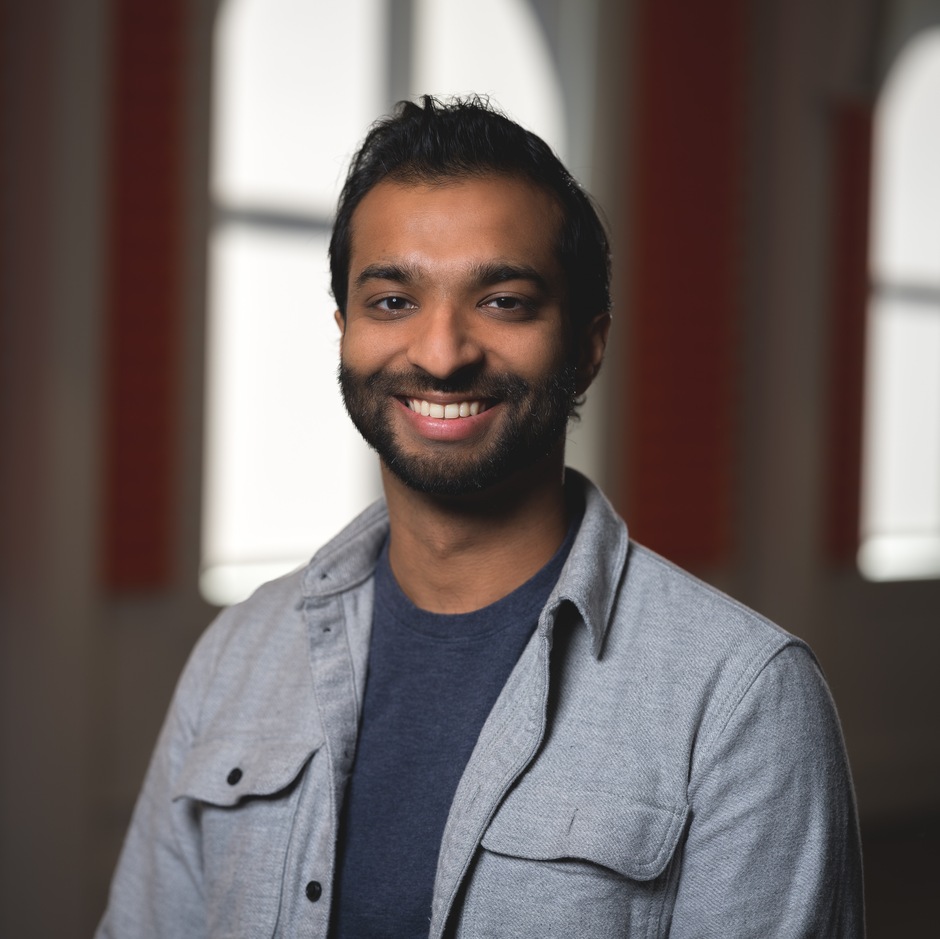
The Machine Learning Scientist Who Learned to Build Drugs - Then Went Back to Build Founders
From a Harvard thesis on dilated CNNs to Y Combinator General Partner - Ankit Gupta's path is the one nobody drew on the map.
There's a specific kind of credibility that comes only from having done the thing. Not from having read about it, advised on it, or written a think piece about it. The kind that comes from sitting in the founder's chair at 2am, watching a pivot decision loom over six years of work and thirty-one million dollars of investor trust.
Ankit Gupta sat in that chair. And when Y Combinator - the organization that first bet on him in 2018 - came looking for someone to sit across from the next generation of founders, they called him. In 2025, he became a General Partner at YC, responsible for helping AI and biotech founders navigate the same impossible calls he once had to make.
The math is tidy. The story underneath it is not.
YC took a bet on me almost 8 years ago and changed my life. The partners we worked with in building Reverie helped us navigate some of our hardest moments. I feel so fortunate to have a job helping the next generation of founders set out on their own incredible adventures.
- Ankit Gupta, on joining Y Combinator as General PartnerThe thread that runs through Ankit's career is a refusal to keep domains separate when they want to be fused. At Harvard, studying computer science, he found himself drawn to biology. His thesis, written under Professor Alexander Rush in Harvard's NLP group, applied dilated convolutional neural networks - a technique invented for natural language - to genomic regulatory marker prediction. This was 2017. The idea of treating DNA sequences like sentences was, at the time, a niche academic bet. It turned out to be a preview of an entire field.
That same year, his ICML paper "Dilated Convolutions for Modeling Long-Distance Genomic Dependencies" won both the Speaker Award and Best Poster at the ICML Workshop on Computational Biology. Ankit graduated magna cum laude, inducted into Phi Beta Kappa, and walked straight into co-founding a company.
"STEM fields often share analytical frameworks that make it possible to transition between domains. Success across disciplines requires exposure, practice, and a willingness to embrace what is unknown."
Magna Cum Laude
+ Speaker Award
Co-Founder & CTO
Ginkgo Bioworks
Partner
Reverie Labs, co-founded with Jonah Kallenbach in the YC Winter 2018 batch, started with an assumption that would take years to stress-test: that pharmaceutical companies would pay for better ML models to design small molecules. They were right about the models. They were wrong about the customers' willingness to pay for models alone.
The pivot was decisive. Reverie stopped selling software and became a fully integrated pharmaceutical company - running its own drug discovery pipeline, accumulating results rather than arguments, and showing pharma partners what the technology could actually do. It worked. Roche and Genentech came on board with milestone-based partnerships. The company advanced its own medicines toward clinical stage. By February 2024, Ginkgo Bioworks had acquired the platform, and Ankit joined as Head of AI/ML Advancement, training foundation models for protein and nucleic acid design.
There is something worth noting about the way Ankit occupied Harvard before he was a founder. He taught. He took on CS 50, CS 181 (Machine Learning), and CS 182 (Deep Learning) as a teaching fellow from 2014 to 2017. Students voted with their evaluations. He won the Derek Bok Award for Distinction in Teaching three separate times - once for each course. The award, given annually to exceptional instructors by the Harvard Bok Center, is not a participation trophy. It requires students to notice the difference.
What the teaching record reveals is not just pedagogy. It reveals someone who had already understood, before founding anything, that clarity of explanation and clarity of thinking are the same thing. Every YC founder who sits across from Ankit now gets that version of him - the one who figured out how to make machine learning legible to undergraduates before he figured out how to deploy it against cancer.
With advanced AI tools, small teams can achieve more than ever before.
- Ankit GuptaHe arrived at Y Combinator as a visiting partner in January 2025 before being named General Partner. In that interim period, he worked with dozens of founders across recent batches - not as a name on a slide deck, but as someone who knew what it felt like when the business model did not work and the investors were watching. The visiting partnership was, in a sense, a job audition where the interviewers were the founders themselves.
He is based in Cambridge, Massachusetts - a deliberate choice that helps re-establish YC's East Coast presence at a moment when the AI ecosystem is no longer exclusively a Bay Area story. He commutes to San Francisco for flagship programs, but his inbox arrives from a different timezone, and the founders he talks to know it.
The YC that Ankit joins in 2025 is a different machine than the one that funded Reverie Labs in 2018. The batches are larger, the valuations are different, the AI opportunity is different. But the fundamental contract - a small team, an impossible problem, a short window to make something people want - has not changed. And neither has the need for a partner who has actually signed that contract, felt it go bad, and found a way forward anyway.