A pet-food brand called I and love and you does not leave much room for emotional ambiguity. It sounds like something said at the kitchen door, possibly to a creature that has just eaten a shoe. Steve Ball helped build that brand. Then he learned that loving a business could involve making fewer products, declining a retailer and eventually handing over control. Affection got the company a name. Judgment would have to do the rest.
There is a useful tension in Ball’s career. His work concerns the warmest part of the consumer economy: people buying things for animals they consider family. His experience has increasingly concerned the colder decisions behind that purchase. Where should the product be sold? How quickly should the team expand? When does another funding round become a distraction? When should a founder leave?
By 2021, Ball was leading Zesty Paws when its owner agreed to a $610 million sale to H&H Group. In 2025, he became CEO of Woof, working with founder Daniel Haarburger. The connecting thread is less the species on the packaging than the stage of the business: a promising brand has found customers, and now someone must help the company catch up.
The customer with four legs
Ball’s route into that work included a mechanical engineering degree from Stanford and an MBA from Michigan’s Ross School of Business. His experience also included General Mills and Nestlé. These are useful places to learn that a product can be carefully conceived and still require a convincing place in somebody’s weekly shopping routine. The engineering graduate eventually found himself working on a particularly human problem: what people want a purchase to say about them.
In August 2012, I and love and you announced its first in-store retail launch, into 26 Whole Foods Market stores in the Rocky Mountain region. Ball belonged to a founding group that included Marty Grosjean, Brendan Synnott and Chris Bentley. Grosjean was the launch-era CEO; Synnott brought experience from Bear Naked and EVOL, while Bentley had co-founded Aspen Pet. Ball brought his background in packaged-food brands.
The setting mattered. Whole Foods already gathered shoppers who gave considerable thought to what went into their baskets. A pet-care brand could join that existing trip. The launch put the company’s proposition in front of people already buying for themselves, without first requiring a separate expedition for the animal waiting at home. Twenty-six stores made a concrete beginning: small enough to count, substantial enough to test an idea beyond a founder’s enthusiasm.
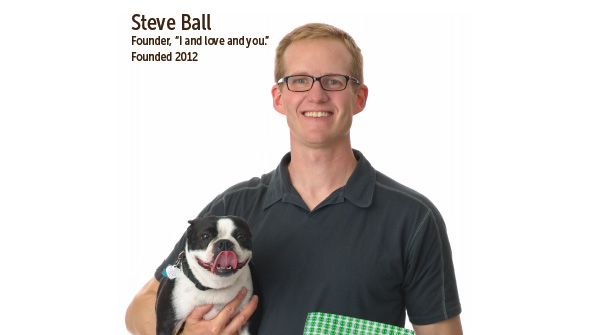
The insight ran deeper than shelf placement. In an early discussion of the brand, Ball described customers wanting the satisfaction of preparing their dogs’ food. The company was adjusting its packaging emphasis toward the idea of homemade preparation. That is a revealing distinction. The physical product still had to do its job, but the owner’s participation had value too. Opening dinner could feel like an act of care rather than a small domestic chore.
His co-founder Synnott described owners wanting more ways to express their attachment to their animals. The company’s name supplied an unusually direct answer. There was no need to excavate the brand’s emotional territory with a focus-group shovel. It was printed on the bag.
A love letter needs a distribution plan
By May 2014, Ball was identified as CEO and co-founder when the business announced a growth investment from Winona Capital Management and Revelry Brands. The money was intended to support nationwide expansion. The range already crossed several categories, including dry, canned and dehydrated food, plus treats. This was a company attempting to accompany owners through several parts of a pet’s day.
It was also part of a particular business community. The company was a founding member of the Pet Industry Sustainability Coalition. Ball credited the natural-products world with sharing advice, making introductions and helping him build a team. The appealing image of the solitary founder fits awkwardly here. I and love and you started with several founders, and its expansion involved investors, retailers and people prepared to lend their experience.
In February 2017, the company launched its first print advertising campaign, Love Me For Life. It was scheduled to appear in nine national magazines that March. Ball, then described as co-founder and chief marketing officer, spoke about the relationship between people and their pets. The message belonged in everyday life, so the company took it to the magazines people read there.
The same period provides a useful measure of the company beyond its advertising. It reported donating more than 75,000 meals during the preceding year, followed by 50,000 meals in January 2017 to two rescue organizations. These were company activities, carried out by a team. They also fit the premise the founders had chosen: the relationship with an animal was the starting point for the business.
L Catterton announced an investment in April 2017 to support further national expansion. Kevin Hall was named as CEO in that announcement. Ball’s history with the company therefore includes more than one job and more than one phase. Founding a brand, running it and shaping its marketing are related kinds of work; they come with different responsibilities.
The second business gets a shorter shopping list
Later, Ball would look back at I and love and you with candor. Too many products, too many distribution ambitions and too much attention to capital raising had competed for focus. Funding had begun to resemble an achievement in itself. The distinction became central to his thinking: an investment gives a company resources, but the customers still have to want what the company makes.
“Chasing a dollar amount is not always the route to go.”
Steve Ball, 2022
He described the decision to sell a majority stake and leave as a way of giving the business the support it needed for its next stage. For someone whose childhood included watching his father run a business, that is a less obvious definition of independence. A founder can create something worth continuing without remaining the person who controls it.
At Zesty Paws, which he joined in 2019, he applied a narrower approach to expansion. The brand already had an online business. He was selective about retail partners and turned down some opportunities. A shop offering to carry your product is flattering; it also brings work. Ball had acquired reasons to distinguish between the compliment and the commitment.
Zesty Paws had been founded by A.J. Patel. Maxim Partners acquired the brand in 2018, with Patel retaining an ownership interest and involvement. When Maxim announced the 2021 agreement to sell to H&H, it described a business that had grown from $3 million to more than $100 million in revenue during its ownership. Ball’s contribution belonged within that larger story of a founder, an investor and an expanding operating team.
Retail did become part of the business, including Target and PetSmart. The move followed an online beginning, reversing the familiar picture of a packaged-goods company first winning store shelves and then finding its internet customers. For Ball, the attraction included joining a digitally established brand that already worked. The assignment was to build on it.
The unphotogenic part of growth
The sale price makes a crisp headline. The operating work makes a more instructive scene. Ball later described a company whose growth had outrun its organization. Processes were undocumented. Hiring had to catch up. Even an employee handbook was missing. Information that once traveled easily between a few colleagues became harder to pass along as more people arrived.
He worked on putting a more consistent operating structure in place. That sort of work rarely appears on a product label, although customers eventually feel its absence. An expanding business needs people to know who decides, how meetings work and where the answer to a recurring question lives. Memory is a charming filing system until the person with the memory takes a holiday.
He also acknowledged favorable timing around the sale. “Timing was everything,” he said in a later discussion of the transaction. That admission gives his account some welcome proportion. Decisions inside a company matter; the conditions around it matter too. The $610 million outcome belongs beside the work, the existing brand and the opportunity of that moment.
- 2012Launch a brand
I and love and you - 2019Build the organization
Zesty Paws - 2021Lead a region
H&H North America - 2025Work with a founder
Woof
Another founder, another next stage
Following the acquisition, Ball became H&H’s CEO for North America in October 2021. His next publicly announced CEO appointment brought him back to a younger company. Woof announced his arrival in April 2025, with a remit to develop its team and infrastructure and expand its retail and ecommerce presence alongside Haarburger.
Woof had already made its start. Founded in 2019, it was known for the Pupsicle, a refillable dog toy. The appointment announcement described distribution in more than 7,500 stores, including REI, PetSmart and Tractor Supply. These were the company’s existing foundations when the appointment was announced. Ball was joining a moving business, with a founder still closely involved and products already out in the world.
In September 2026, The Farmer’s Dog completed its acquisition of Woof. The announced arrangement kept Woof operating independently under its existing brand and team, with access to the buyer’s resources. It is another version of a question Ball has encountered before: how to give an established idea room to grow beyond its original resources.
Strong coffee, longer perspective
For a glimpse of Ball away from transactions, go back to 2014. Asked about his free time, he mentioned his three young children, skiing, hiking, soccer and movies. His listening included the Lumineers, Mumford & Sons and Zac Brown Band. He admitted to a sweet tooth. His complaint was more pointed: “Weak coffee,” he said. “It ruins my day!” An executive may tolerate a complicated distribution problem; the morning cup apparently had less room for negotiation.
He also mentioned an ambition to teach yoga. That was a personal aspiration expressed at the time, a pleasingly different use of the word balance from anything found in a finance meeting. Across his business career, the practical version has involved deciding how much a company can sensibly take on. There are products to launch, people to hire and buyers to satisfy. Sometimes the useful contribution is another idea. Ball’s experience has given him an appreciation for the moment when the useful contribution is to stop adding them.