Brian Egan had reached the table he wanted. In Silicon Valley, he was a lawyer working with startups and venture capitalists. He had studied at Boston College and the University of Virginia School of Law, then joined Gunderson Dettmer. The trouble was the seating arrangement. He wanted to help build the businesses whose legal work occupied his days. His description of that discovery was economical: he was at the right table, in the wrong chair.
That is a useful place to begin the story of Evolve. Before the vacation rental company, before the financing rounds and the thousands of homeowners, there was a professional who had obtained the job he wanted and then changed his mind. A successful career can be an awkward thing to interrupt. It provides such persuasive reasons to continue.
Egan's next move took him into a young hospitality business. Eventually, it took him into a basement with Adam Sherry, where they began working on a different way to manage vacation homes. The work would demand both parts of his earlier life: the appetite for building companies and the pleasure of looking after people.
The education before the law degree
Restaurants came first. Egan has described doing the washing up, serving customers and working in kitchens. Until he was 25, restaurants were the only way he had earned money. He liked creating experiences for other people, a satisfaction that remained after his interests expanded to technology and startups.
Hospitality has a peculiar relationship with ambition. The customer generally hopes the ambitious machinery will stay out of sight. They want dinner to arrive, the room to be ready and the evening to go well. The work becomes visible most readily when something fails. Egan's early jobs placed him inside that machinery, long before he began talking about vacation rental brands.
In 2003, he joined Exclusive Resorts, a luxury destination club, among its first ten employees. His responsibilities grew across business development, marketing, sales and international expansion. He spent roughly seven years there. It was an opportunity to participate in a company's construction, with hospitality at the center of the work.
Sherry was another early Exclusive Resorts employee. Their shared experience became the foundation for Evolve, which they launched in 2011. The move carried lessons from luxury travel into a category populated by individual homes and individual owners. They had spent years in a business organized around holidays. Now they would try to reorganize the work behind them.
Twenty-one homes, and a doubt
Evolve ended its 2011 beta launch with 21 homes. The founders were looking for an opening between two familiar arrangements: owners doing everything themselves, and local managers providing a fuller service. Their proposal divided the work differently, combining centralized support with flexibility over what happened at the property.
Finding the right owners proved slow. They were scattered, and Evolve was asking them to understand a service they had not previously been offered. In his later account, Egan made an unusually candid distinction. The hard work of finding customers was expected. The mistake was allowing slow progress to weaken their conviction in the original idea.
This is a less comfortable founding story than the version in which everybody else is wrong and the founder knows it all along. Egan remembers doubt inside the business, too. A small portfolio could indicate a poor proposition, or an unfamiliar proposition that required more patient selling. The number itself could not settle the argument.
The basement matters because it gives that argument its proper scale. Evolve's early problem was persuading particular people to entrust particular homes to a new company. Later totals can make those decisions look inevitable. Twenty-one homes suggest how unhurried the beginning could feel.
A beta launch. A small portfolio. An idea still being tested.
A reliable stay can still have character
The distinction Egan keeps returning to is between a dependable experience and identical surroundings. Vacation homes have different rooms, layouts and personalities. Their differences are part of why people book them. A brand that erased those differences would risk removing something customers had come to enjoy.
The operational question is what should remain dependable. In explaining Evolve's model, he has emphasized property standards, professional photography, guest support and agreement among the owner, the company and the people doing work on site. An owner might bring an existing service provider or use a partner from Evolve's network. The home still needs people who can look after it.
A listing can be distributed widely and priced carefully, but somebody has to deal with the physical house. This division of responsibility is central to understanding Egan's company. Its flexibility depends on coordination between parties whose jobs overlap at the guest's front door.
The next experience is a stubborn unit of measurement. A fine history offers little comfort to the guest whose own booking goes wrong. For an operator, every new arrival reopens the examination. Egan has described his brand in precisely these terms, making its reputation depend on what it delivers next.
“We are as good as the next experience that we deliver.”
Brian Egan
The money arrived. So did the arithmetic.
By February 2022, Evolve was managing more than 19,000 homes. It announced a $100 million capital raise led by Durable Capital Partners, bringing disclosed funding to $235 million. The company said its net booking value had grown 78 percent in 2021. Nearly 800 employees were working in the business.
One detail in that announcement helps explain Egan's opportunity: 70 percent of new Evolve owners in 2021 were renting for the first time. A company serving newcomers has to do more than win business from competitors. It must help people understand the business they are entering. Support becomes part of the proposition from the beginning.
Then the market became less accommodating. On May 17, 2023, Egan announced that 164 employees, or 14 percent of the company, would lose their jobs. He explained that rental supply had grown faster than demand. Rates, bookings and revenue per property were below the company's expectations, leaving Evolve with less revenue than it had planned for.
He accepted responsibility for the effect on departing employees and their families. The letter also shows the limits of a growth story told through bookings and funding alone. A forecast becomes a staffing plan; when the forecast fails, people carry the consequences. Those departures belong in the account of what Egan built.
A house has more than one person holding the keys.
and guest support
and on-site service
A simplified view of the hybrid model, with responsibilities coordinated around property standards.
The second difficult letter
In September 2023, Egan announced another reduction, this time of approximately 20 percent of the team. He called the next phase Evolve 3.0. To explain it, he divided the company's history into stages, starting with a resource-constrained startup that had little choice but to stay focused.
The label could sound like a product update. The decision behind it was much harder: a change in how the company operated, accompanied by another round of departures. Egan's explanation connected the next version of the business to choices he was making as its leader.
There is a tension here with the way he has spoken about culture. Egan tells new employees they should help shape the company rather than simply fit in. That invitation gives work a personal dimension. It also makes the consequences of contraction personal. An account of his leadership has to hold the invitation and the departures together.
By his October 2025 conversation with Simon Lehmann, Egan described Evolve as profitable and able to sustain itself. That was his assessment of the business after the reset. It marked a different milestone from adding homes or raising capital: the company could support its own continued operation.
The same customer, a different kind of holiday
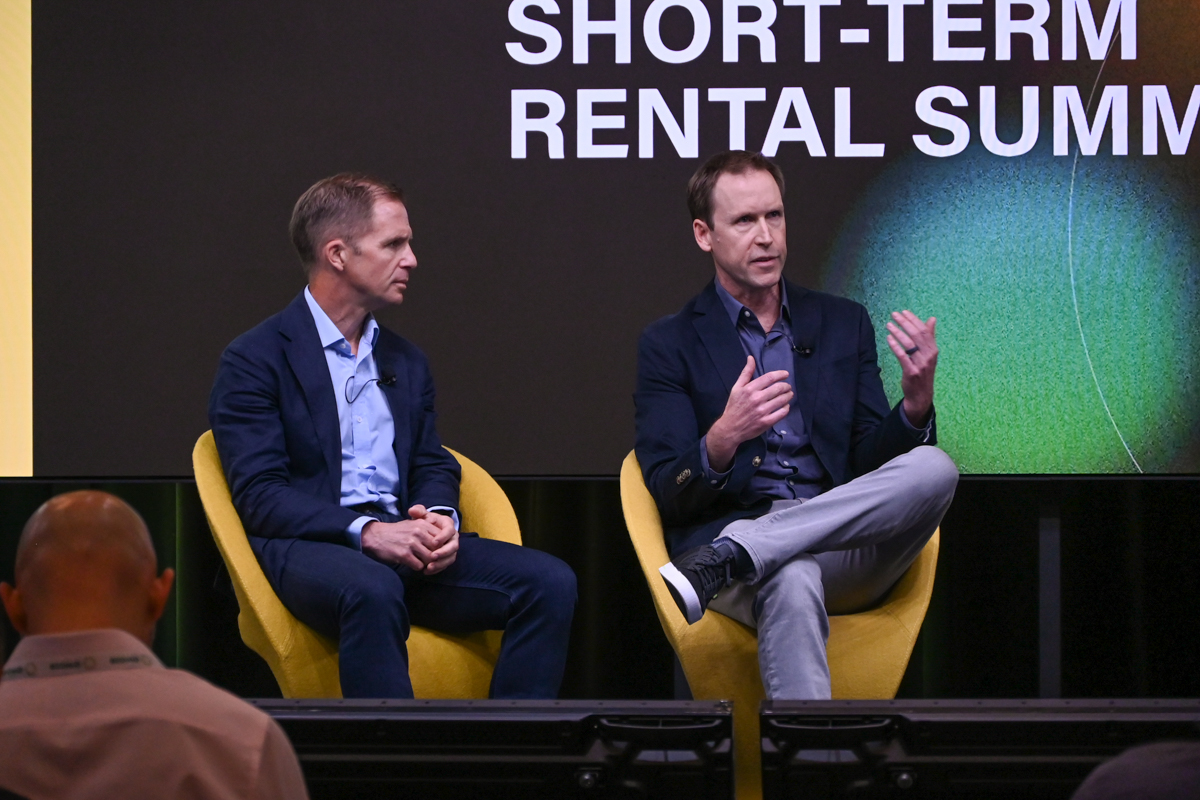
On stage at Skift's 2023 Short-Term Rental Summit, Egan appeared alongside Awaze chief executive Henrik Kjellberg. Their discussion explored customers whose travel choices could range from modest trips to expensive getaways. A traveler need not belong permanently to one price bracket or one style of holiday.
That range makes the hospitality problem interesting. The category has room for many kinds of home, but each booking still brings a concrete expectation. What people choose to spend can change; their interest in getting the holiday they expected remains.
Egan has also argued publicly for regulation of short-term rentals, favoring permits over a primary-residence requirement. In 2019, he described permits as a way to control matters such as neighborhood density. It was an argument for a particular regulatory mechanism, acknowledging that a rental business operates inside a community as well as inside a market.
More owners, fewer obstacles
In November 2025, Evolve acquired the Guestworks portfolio from Vacasa, a Casago company. The announced transition covered approximately 1,000 homeowners. It brought a group already using a technology-supported management service onto Evolve's platform, extending the model Egan and Sherry had been developing since 2011.
His June 2026 conversation with AirDNA's Jamie Lane turned to artificial intelligence, owner performance and the industry's next phase. Guest communications, revenue management and product development were among the areas discussed. The familiar operating questions remained underneath the newer technology: how well a home performs, how much work ownership requires and where professional support helps.
The scale is far removed from the basement. Evolve now reports more than 30,000 owners, over 16 million guests hosted and more than $5 billion in rental income earned. These are company totals, earned through the work of owners, partners and employees. They put the early portfolio in perspective without making the route between then and now a straight line.
Egan's own account of a good family holiday supplies a smaller measure. Traveling with his wife and twin boys, he likes a planned activity each day and room for spontaneous discoveries. Reliable accommodation provides the foundation. The memorable detour can then take care of itself. After all the work of organizing a holiday, it is pleasant to leave something to chance.
Company-reported totals · October 2026