At eleven, Andrew Fischer took an unusual interest in holiday reading. The book was Lee Iacocca’s autobiography. Other children might have preferred a story with a dragon; Fischer found a car executive trying to build and run a business sufficiently absorbing. He later recalled that family vacation as the moment his ambition to run a company began to take shape.
It is a useful place to begin because the adult Fischer has spent much of his career around subjects that can clear a dinner table: advertising networks, audience data, software subscriptions, media buying. Yet the question underneath his work is easy to understand. Why should an independent business need the resources of a large corporation to buy useful advertising?
Choozle, which he co-founded with Jeffrey Finch in Denver in 2012, was one answer. Mogl, the business he later co-founded with Martin Skotnicki, is another. The companies belong to different chapters of his career. The recurring interest is access: giving smaller agencies and brands a workable route into tools that can otherwise demand considerable money, expertise, or both.
The eleven-year-old’s reading choice makes the eventual career sound inevitable. Fischer’s route was considerably less tidy. Before he could simplify anybody else’s business, he had to change his own plans.
A short stay in finance, a long stay on the internet
In 1999, Fischer moved to San Francisco to work in finance. The internet caught his attention quickly. He joined L90, an early digital advertising sales network, beginning a career that would move from selling online advertising toward the technology used to buy it.
His education included an economics degree at Vanderbilt and an MBA at UCLA’s Anderson School of Management. Before Choozle, he co-founded and built RGM Alliance, an online advertising network. These were years spent inside an industry whose products, prices, and vocabulary kept changing. They gave him experience of the customers as well as the machinery.
That distinction matters. A person who sells advertising encounters the gap between what a platform can do and what a customer can comfortably use. Features have to survive a conversation with someone who has a budget, a deadline, and other things to worry about.
Fischer eventually brought that experience to a partnership with Finch. Their division of labor was practical: Fischer concentrated on revenue, finances, operations, and strategy, while Finch focused on product. They met over product decisions. For a software business, those conversations reach into almost everything else.
One industry. Different ways in.
- 1999San Francisco; entry into digital advertising
- 2012Choozle, with Jeffrey Finch
- 2014Choozle pivots toward programmatic buying
- 2022Ventura co-founded; Choozle CEO role ends
- 2025Ventura Growth becomes Mogl
The customer who changed the company
Choozle began with a focus on media creation. In 2014, it pivoted toward a broader advertising platform after finding that advertisers wanted to transact programmatic media through one interface, with data and analytics included. The change moved the business closer to the daily job of buying and managing campaigns.
Programmatic advertising means using software to automate the purchase of advertising placements. A marketer still has to choose an audience, allocate money, assess results, and decide what to change. Automation does not eliminate those decisions. A well-designed interface can make them easier to carry out.
Fischer saw an opening among agencies and brands in the middle of the market. They needed useful buying capabilities without the burden of a complicated enterprise arrangement. Choozle’s self-service approach let clients operate the software, with training and support alongside it.
The pivot is revealing because it required giving up an earlier definition of the product. Founders can become attached to the thing they first pitched. Customers tend to become attached to getting their work done. Choozle’s change put those customer needs closer to the center of the business.
Buying time, keeping the arithmetic honest
In November 2017, Choozle announced a $6 million Series B. Fischer described an opportunity to grow while parts of advertising technology were consolidating and some earlier competitors had disappeared. He called the company’s position a second-mover advantage: the chance to learn from businesses that had entered before it.
The money followed an operating milestone. Choozle had reached profitability in the fourth quarter of 2016, and it was reinvesting in the business. During 2017 it added employees and opened a London office. Expansion had a geography as well as a balance sheet.
His advice to entrepreneurs has been consistent with that sequence: plan a business that can function without assuming the next fundraise will arrive. Additional capital is more useful when the underlying economics already work. It is a modest-sounding rule in a field fond of very large announcements.
Recognition followed the growth. Choozle ranked No. 113 on the 2017 Inc. 5000 and No. 149 in 2018. In 2018, it also placed first on the Inner City 100 list. These are dated achievements in the company’s history, markers of the business Fischer and his colleagues were building during those years.
in the fourth quarter
November 2017
2018 ranking
People, products, profit - in that order
Fischer describes his management philosophy through three Ps: people, products, and profit. The order carries the argument. Invest in the people who do the work, give them the conditions to make good products, and the commercial results can follow. It is a business theory with consequences for the calendar and the budget.
At Choozle, those consequences could be pleasantly ungrand. There were pajama workdays, ski outings, volunteer activities, and an educational allowance that could support personal as well as professional learning. A company discussing real-time advertising auctions could also permit itself a day in slippers.
There was a civic commitment, too. Choozle set aside one percent of its founding equity for Colorado nonprofits through the Entrepreneurs Foundation of Colorado. That was an equity pledge tied to a future exit, rather than a claim that those proceeds had already been donated.
An April 2018 workplace assessment recorded unanimous positive responses to the question of whether Choozle was a great place to work. Its accompanying photographs showed an organization that made room for winter gatherings and an eighties-themed charity ping-pong tournament. Culture had acquired a few visible props.
Fischer also made a direct admission about management mistakes: “Our product and revenue flow from our people.” His stated error was putting products or profits ahead of employees. The line explains why he treated their development as part of running the company.
Invest in the team. Give good work a chance. Build a business around the result.
The founder leaves the CEO chair
A founder’s biography can lag behind the business. Fischer’s Choozle story includes a clear change in responsibility: he resigned as CEO in May 2022 and remained on the board at that transition. Adam Woods was promoted to CEO that September, having previously held technology and client leadership roles.
The distinction changes how his career should be read. Choozle is the company he helped create and previously led. His present work includes another organization, another co-founder, and another attempt to serve independent advertisers. The continuity lies in the customer problem.
By 2022, Fischer was also a co-founder of Ventura Growth. Its relationship with The Trade Desk gave the new venture a particular route to market: helping agencies and brands access an existing advertising platform, with the expertise to use it. Building the surrounding service became a business in its own right.
Build for the long haul,
Andrew Fischer · 2017
and stay focused.
A company sketched over beer
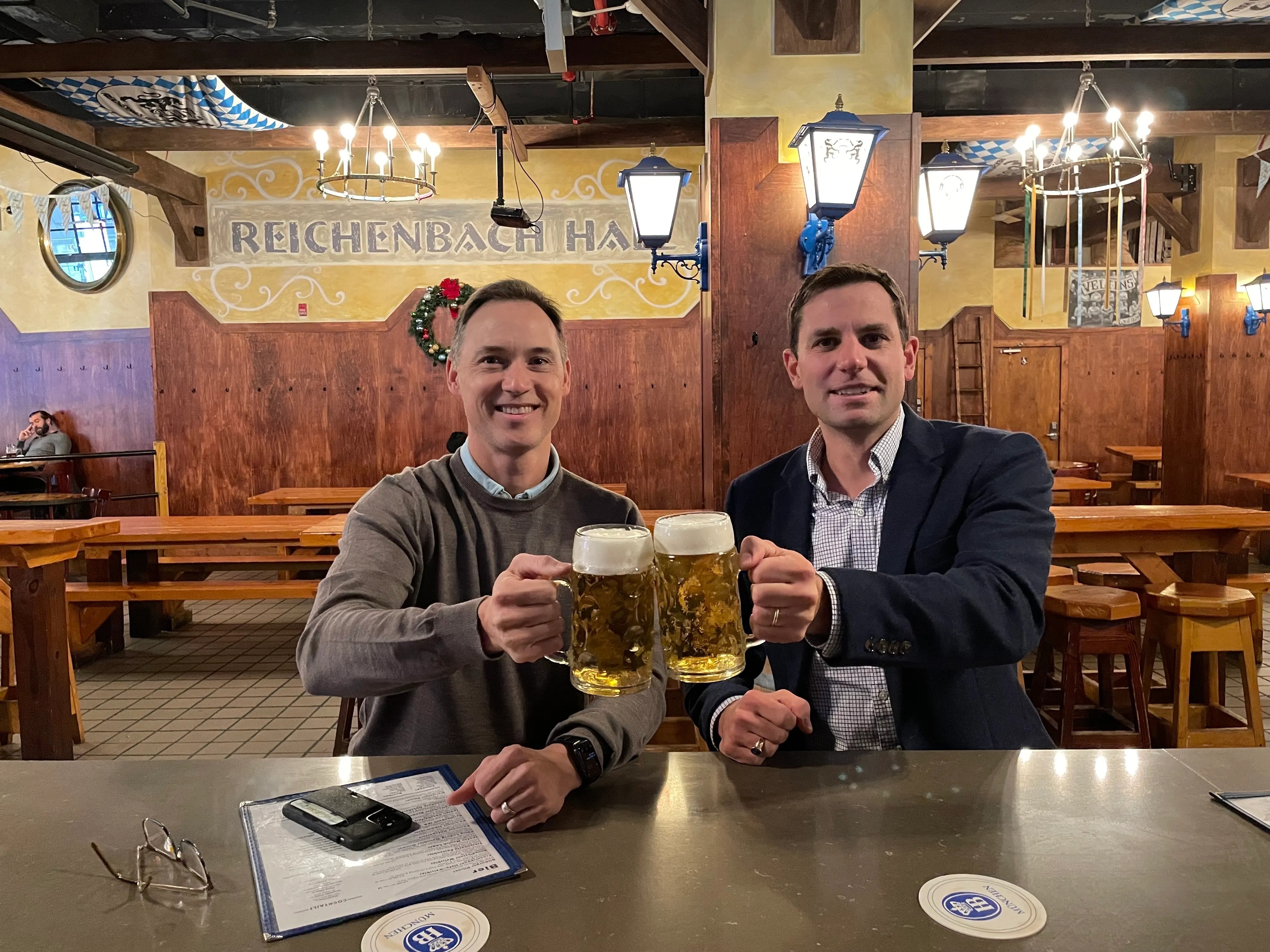
Fischer’s account of Ventura’s origins begins with a meeting at The Trade Desk’s New York headquarters about its Certified Service Partner program. Afterward, the founders went to a nearby German beer hall and worked out the outline of their new business. The photograph has the right scale for an origin story: two people, two large steins, and a table.
Ventura Growth became Mogl in September 2025. Fischer connected the name to Colorado skiing, where moguls demand repeated adjustments as conditions change. The spelling also nods toward the business meaning of a mogul. Naming a company allows an occasional double meaning; operating one demands rather more repetition.
The rebrand arrived with a broader offer. Mogl announced data enablement, retail media, and UK services alongside its programmatic business. It reported supporting more than 500 advertisers on The Trade Desk’s platform at that time. Fischer was identified as chairman and co-founder; Mogl now lists him as Principal and Chairman.
Its ambitions remain concentrated on independent agencies and growing brands. They face an increasingly fragmented collection of advertising channels, data systems, and measurement tools. The work involves helping them connect those pieces well enough to make decisions, then supporting the people responsible for using them.
The long haul has another chapter
Fischer once chose “Relentless” to describe how he worked. His preferred advice was equally compact: “Build for the long haul, and stay focused.” Both fit a career spent returning to advertising’s practical difficulties, with different companies and different ways of organizing the answer.
There is room for humor in that persistence. Asked about preparing for artificial intelligence in 2017, he joked about being polite to future robot overlords, then described the ordinary work of reading, meeting companies, and attending events. Curiosity still required a schedule.
Mogl’s published Peak Week 2026 agenda listed Fischer and Skotnicki together for an opening keynote called The Map Ahead. The event’s subjects included AI, measurement, and programmatic advertising. Those topics show how much the tools have changed since the advertising-network days of his early career.
The business question remains recognizable. An independent agency has clients to serve. A brand has money to allocate. Someone must make an unfamiliar system usable, and someone must help when it becomes difficult. Fischer has spent years building businesses around those someones. The boy with the Iacocca book eventually found a subject of his own - and enough unfinished work to keep turning the pages.