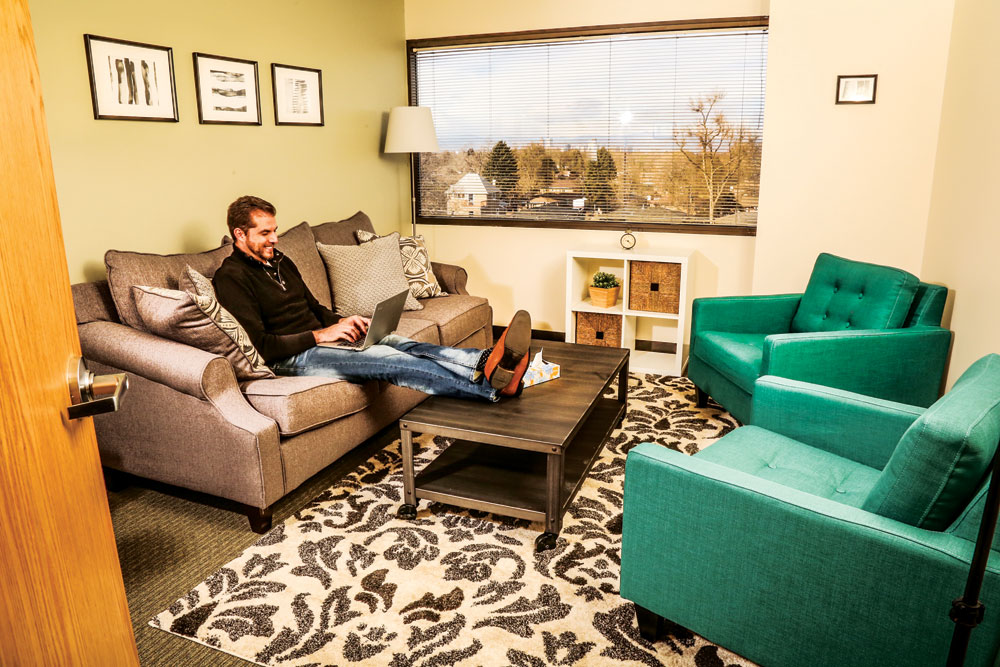
Sean Boyd has his shoes on the coffee table. In a photograph taken at a Denver office in 2018, he sits at one end of a gray sofa, laptop open, legs stretched out. Two green armchairs face him across a patterned rug. There are pictures on the wall, a lamp in the corner, and daylight coming through the blinds. Entrepreneurship has been photographed in more dramatic settings. This one has the advantage of showing the merchandise.
The room was part of a business Boyd had helped create with Mark Frank. Their venture, SonderMind, brought together a technology operation and a network of shared offices. Eventually the two would become separate companies. Boyd would lead the real estate side, now called Humanly, where the proposition could be understood without a demonstration video: have somewhere to work, for the amount of time you need it.
That sounds modest. It also describes a problem familiar to anyone who has tried to turn an individual skill into an independent business. Expertise gets you started. Then come the keys, the furniture, the internet connection, the recurring bill, and the discovery that an empty room keeps charging rent. Boyd's career follows the space between being good at a job and building the surroundings that let other people do theirs.
The business before the partnership
Boyd's route into company building began with work of his own. He studied at Regis University from 2006 to 2009, earning a master's degree. He established an independent practice and developed a business around shared offices and a professional community. The sequence matters. When Frank contacted him in 2013, Boyd already had experience running the kind of small operation their future venture would serve.
An early partnership often gets described as a meeting of ideas. This one also joined different kinds of experience. Frank had worked in investment banking and had founded businesses. Boyd arrived with firsthand knowledge of operating independently and bringing other professionals together. Neither had to imagine the entire business from a blank sheet.
By early 2014, they had formally partnered and formed SonderMind LLC. Boyd served in the company's early leadership, including the co-CEO role. His executive chapter there ran through 2016. The familiar biography would hurry onward to the next title. The more useful detail is what he had brought into the first company: an existing enterprise, an understanding of its customers, and experience with the practical demands of shared premises.
There is a particular kind of credibility in having already dealt with the thing you propose to simplify. A room can look excellent in a presentation. Someone still has to make it usable on Tuesday.
One venture, two different jobs
The original operation contained two businesses. One developed technology and services. The other organized physical space. They shared an origin and some customers, but they involved different daily work. Software could be changed centrally. An office had a location, a floor plan, and a door that somebody needed to open.
In 2017, the partners recognized the distinction. At the end of that year, they legally separated SonderMind and SonderCenters. Boyd became CEO and co-founder of Humanly, the business associated with the shared-office operation. The split gave the physical side its own direction.
It is an interesting turn in a founder's story because separation usually invites a dramatic interpretation. Here, the documented explanation is quite practical: two distinct businesses had developed inside one venture. The decision is useful to consider as an operating choice. The two sides had different products to maintain and different ways of delivering them. A company can grow complicated simply by finding more than one useful thing to do.
Boyd retained the SonderMind co-founder connection while building Humanly. Both belong in his biography. Together they show an entrepreneur moving from a combined operation toward a business whose offering could be measured in rooms and hours. The question became how to make an office available without making every customer take on an office-sized commitment.
SonderMind LLC · 2014
Boyd’s path into Humanly
An office, in portions
Humanly's answer is a range of arrangements rather than a single lease. Its memberships include an address-and-mail option, space booked by the hour, part-time use, and a full-time private office. A customer can need a professional business presence without needing a room every day. Another can want a regular day each week. Another can want to leave things exactly where they put them.
Those differences are ordinary enough to be overlooked. They also determine whether a workspace fits the business buying it. A full-time office brings continuity and control. Hourly access fits a less settled schedule. Neither arrangement makes much sense as a universal answer. Humanly puts them beside each other, letting the amount of space follow the amount of work.
The economics are straightforward. A conventional lease creates a continuing obligation even when the room is unused. Flexible access can align a portion of that expense with use. The trade-off is worth keeping in view: sharing brings convenience, while a dedicated office offers a place that remains yours. A sofa, regrettably, cannot occupy two rooms at once.
For Boyd, this is a concrete extension of the business he had before the partnership with Frank. Independence remains the customer's starting point. Humanly sells some of the infrastructure around it. The attraction lies in making a smaller commitment possible, then offering a different arrangement when the customer's work changes.
- 01An addressBusiness presence & mail
- 02An hourBook as needed
- 03A regular dayPart-time use
- 04Your own roomFull-time private space
The franchisee who started with herself
Sujatha Reddy supplies a useful view from the other side of the arrangement. After moving to Colorado in 2014, she met Boyd and Frank while considering what to do next. They were developing their franchise model. She had little experience with franchising, and she later credited the two founders with guiding and supporting her through the process.
Reddy opened the Lakewood franchise in April 2016. At the beginning, she was its sole practitioner. Within two years, she said, the location was approaching capacity and supporting more than 35 professionals. That is a local operator's account of her own business, rather than a figure for the whole network.
She also described the work behind it: attending networking events, organizing meetup groups, and marketing through social media. A furnished room did not automatically fill itself. The person running the location still had to introduce it to people and give them reasons to return.
Her experience gives the founder story a second scale. Boyd and Frank could develop the model and help someone open a location. A franchise owner then had to build a business in a particular community. Humanly's current franchise offering retains that layered structure, inviting local entrepreneurs and property owners to operate spaces. The chain of responsibility runs from the central business to the operator to each independent customer. Every link has a different job.
The unglamorous amenities department
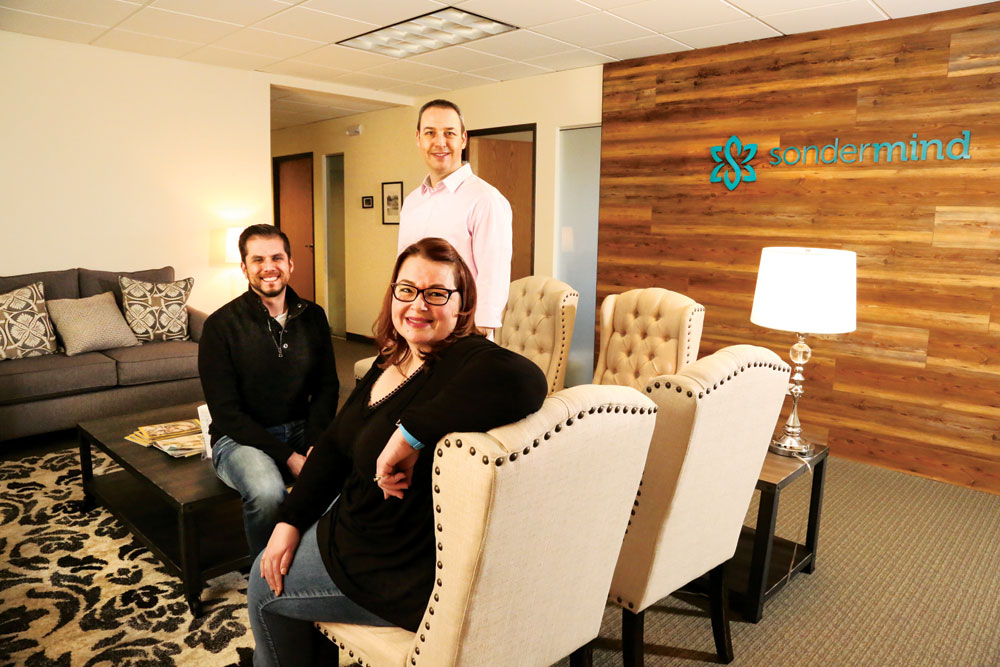
Look through Humanly's offering and the details become pleasingly specific. Mail and package handling. Printing and scanning. Wi-Fi. Secure access. Tea. Furnished waiting areas. Attention to acoustics. These are the things that can disappear into the background when they work and take over a working day when they fail.
There is an entrepreneurial insight hiding in that list, although it wears sensible shoes. An independent professional can be responsible for every purchase, every supplier, and every small interruption. A shared operation can take on some of those tasks once for several customers. The appeal is partly space and partly a shorter list of things to arrange.
The human part receives its own attention. Humanly organizes networking, introductions, events, and speaking opportunities. Its community proposition offers customers a way to meet peers while retaining their own businesses. Sharing an address creates proximity; making an introduction gives that proximity something to do.
This is also a reasonable way to read the continuity in Boyd's work. His early shared-office business included a community offering. Humanly still emphasizes connections between independent professionals. The surroundings have expanded beyond one person's operation, but the basic arrangement is recognizable: separate enterprises, some common resources, and people who can learn one another's names.
“leap into the unknown”
Sean Boyd, on starting his independent practice · 2019
A larger map, the same small unit
Humanly's published membership information now points to communities in Colorado, Connecticut, and Georgia. Its Colorado directory includes places such as Denver, Boulder, Fort Collins, Lakewood, and Parker. Boyd remains publicly identified as the company's CEO and co-founder, based in Denver. The business has a wider map than the early shared offices, while its basic unit remains a room someone can actually use.
Boyd has described his own start as a “leap into the unknown.” In a 2019 reflection, he recalled moving from an independent practice to working alongside more than 20 full-time colleagues. The surprise in that recollection is understandable. Starting a business requires a decision; discovering what that business can become takes longer.
His path has included partnership, early executive leadership, a separation of operations, and the work of building a second company. The through line is the infrastructure of independence. An owner needs somewhere to begin, a way to avoid buying more than necessary, and room to change the arrangement later.
Return to the photograph. Boyd has a laptop, a sofa, and a conspicuously comfortable posture. The office is doing what a successful piece of infrastructure ought to do: letting the person using it get on with something else. The founder's feet are up. Behind them is a business built around making room for other people's work.
Follow the next chapter
Explore Boyd’s work and the business behind the rooms.
Sean Boyd on LinkedIn ↗Humanly website ↗Sean Boyd’s YouTube channel ↗SonderMind company profile ↗The 2018 Denver office feature ↗Humanly’s workspace arrangements ↗