Steven Parker was fourteen when a parental refusal became the beginning of his working life. He wanted a dog. His younger brother, Jason, wanted a dog. Their parents remained impressively unmoved. So, in 1999, the boys started looking after other people’s dogs. It was an unusually industrious response to being told no: if a pet could not enter the household, perhaps the household could enter the pet business.
They called the venture K-9 Guardians Professional Pet Sitting. Steven was fourteen; Jason was twelve. The immediate ambition was to demonstrate responsibility, rather than establish a national franchise. That distinction makes the eventual business more interesting. Parker began with the ordinary work of showing up for a neighbor’s animal. The hotel suites, franchise agreements and awards arrived much later.
The customers came before the hotel
As the brothers became more serious, their neighborhood service acquired brochures and a mailing list. They were learning to find customers as well as walk dogs. Parker has described the early work as something they enjoyed that also earned money. A career emerged through the work itself, rather than through a grand declaration made before anyone had picked up a leash.
A professional pet-sitting convention in Nashville in 2002 widened the possibilities. Here was an industry, with people making their living from something the brothers had begun as schoolboys. The idea of a permanent place for dogs became more concrete. They went on to visit facilities around the country and examine how a boarding business actually functioned.
That research involved less glamorous questions than the phrase “luxury pet hotel” suggests. What should the rooms look like? How should staff be trained? How would people move through the building? Before the Parkers could sell an experience, they had to decide what would happen inside it. Their first resort opened in Fanwood, New Jersey, in 2005.
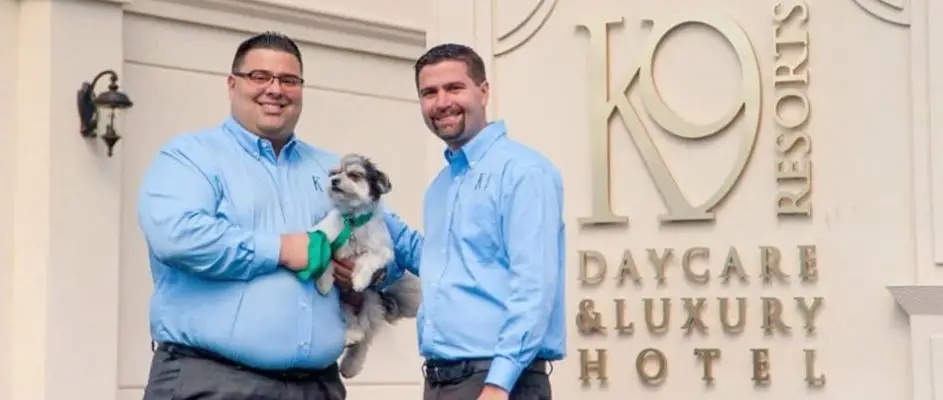
A family objection becomes a brief
Their parents’ reluctance contained a business problem. Family trips raised the question of where a dog would stay. Parker and his brother wanted to build a place where they themselves would feel comfortable leaving one. The future customers were already present in that objection: people who wanted a dog in their lives and wanted a satisfactory answer when they needed to leave town.
The first resort’s planned capacity was about a hundred dogs across boarding and daycare. Parker explained the size in personal terms: they wanted to know the customers, including the four-legged ones, by name. A business can measure capacity in rooms and still think about it in introductions. The initial proposition depended on that combination of a designed facility and familiar service.
“What we do best is service.”
Steven Parker, describing the early Fanwood resort
The family did eventually acquire a dog. An early account records an Italian Mastiff named Rocky accompanying the brothers to work. The original request had finally been granted, with a commercial building attached. There are less elaborate ways of getting a family pet, though few provide quite so much room for it.
Fanwood remained a working reference point as the brand developed. In June 2015, the flagship was rebuilt at more than twice its original size. Expansion meant returning to the first address and making it larger, as well as finding new addresses elsewhere. A company that sells a repeatable experience needs somewhere to keep testing what that experience should be.
How to teach someone else the job
January 2011 brought the formal launch of franchising. Within two months, a longtime customer had bought the first franchise. It was a useful beginning for a business built around trust: someone familiar with the service wanted to operate a version of it. The customer had seen the hotel before being asked to imagine its potential.
Parker’s account of his working day that year was concrete. He checked the corporate resort’s operations in the morning. Later, he and Jason discussed how to grow the Fanwood location and the franchise company, then worked on carrying out the plan. The schedule joined the operating business to the expansion business. A reservation still mattered while another location was being contemplated.
That is also why a franchise requires more than a handsome reception desk. Another owner must learn the reservations system, the books and the daily routines. Parker described continued training after the initial instruction. The work that appears effortless to a returning customer has to become teachable to a new operator. Familiarity at the front desk requires considerable preparation behind it.
The difficult part can be the address
In a joint interview from the company’s early franchise years, the brothers described real estate and zoning as particularly difficult. Their preferred sites put a resort within convenient reach of customers, near everyday routes and neighborhoods. Choosing that kind of address introduces a different set of negotiations from simply finding enough space for boarding.
They also described a lesson in capacity. The original resort had waiting lists for overnight stays, while its initial daycare offering served dogs weighing more than thirty pounds. Experience at subsequent locations revealed demand for smaller-dog daycare and additional overnight accommodation. The blueprint changed because customers demonstrated what they needed. Even a carefully researched first building could teach its owners something after opening day.
The business has consequently involved repeated decisions about what to build, where to build it and which details to carry forward. Parker’s responsibilities have included corporate resort development, operations and standards across the franchise system. These are connected jobs. A design decision made before construction becomes an operating condition that employees and guests encounter every day.
The founder sits the exam
In 2024, Parker earned the Certified Professional Animal Care Operator designation from the Professional Animal Care Certification Council. Four colleagues also completed certification examinations in the announcement accompanying his achievement. For a founder whose work includes setting standards, taking an external examination gives the training story a personal dimension. The requirement to learn can travel upward through a company, too.
Later that year, PACCC honored him with its Founders Award. The organization’s own announcement recognized his contributions to the profession. Amy Hillis, its board chair, singled out his advocacy for certification at the scale of a national business. That recognition concerns the less photogenic side of the operation: the knowledge and preparation of the people doing the work.
His public conversations keep returning to those details. In a 2024 discussion with pet-business host Dominic Hodgson, the agenda ranged from hospitality influences such as Disney and Ritz-Carlton to staff training and continued attendance at industry events. Parker’s interest in the trade did not end when he became a franchisor. The conference-going teenager had become a conference-going chief executive.
A bigger company, a nearby hometown
The partnership with Jason remains central. They began together as children and still appear together discussing the business. The company’s more detailed leadership biography gives Steven responsibility for corporate and joint-venture resort operations, while Jason leads the franchising entity. Those distinct responsibilities show how a sibling partnership can acquire a formal structure as the enterprise grows.
In June 2025, EY named both brothers among its New Jersey Entrepreneur Of The Year winners. The award placed their pet-hospitality business alongside companies working in insurance, software and other fields. It was a regional entrepreneurship award, recognizing a business that had traveled a considerable distance from its first neighborhood customers.
The following May, their home community announced another honor: selection for the Scotch Plains-Fanwood High School Alumni Hall of Fame, with a ceremony scheduled for June 1, 2026. Parker spoke about the significance of recognition from the community that shaped them. The hometown connection has remained visible even as the customer list has spread well beyond New Jersey.
Brooklyn, with a side of filet mignon
By October 2026, Parker was discussing a newly opened K9 Resorts in Brooklyn’s DUMBO neighborhood. The location brought the brothers’ long-running hospitality idea into a particularly conspicuous setting. Its Founders Suite was listed at $1,000 a day. Parker described a limousine pickup, a steakhouse visit and ice cream among the offerings. The guest, presumably, would be excused from making small talk with the driver.
“A five-star hotel is a five-star hotel,” he said. The line captures his willingness to borrow the language and theater of human hospitality for dogs. The suite makes a striking announcement of that intention. The wider resort also offers daycare and other boarding choices, so the elaborate package sits within a business still organized around the familiar need for somewhere to leave a dog.
There is a straight line between that Brooklyn conversation and the objection Parker heard as a child. His parents wanted an acceptable answer to a practical question about dog ownership. He and Jason have spent their working lives building answers, then teaching other people to run them. The details have grown more elaborate. The original question would still be recognizable around the family table.