Dan Hawkins’s mother came up with the name. It is a useful detail to keep in mind when considering The Human Bean, a coffee business whose ambitions have grown considerably beyond its first Oregon stand. Before there were franchise partners across the country, there was a mother with a pun. Naming consultants may wish to look away.
Hawkins, the company’s co-founder, president and CEO, has spent the years since talking about the human part of that name. His public comments return to customers, owners and the people handing drinks through windows. The setting is a drive-thru, where the entire encounter can be brief. That makes his concern with personal service particularly interesting: he is trying to make a small amount of time carry some weight.
The signature chocolate-covered espresso bean is a handy introduction to the idea. Hawkins has described serving one with the first cup as a thank-you. The gesture is small enough to sit on a drink. Keeping the feeling behind it recognizable across a franchise requires rather more room.
A name from his mother, a business among friends
The founding group consisted of Hawkins and his wife, Rhonda, alongside Tom Casey and his wife, Tami. Tom was Dan’s high school friend. Their first location opened in Ashland, Oregon, in 1998. Family and friendship were present at the beginning, before either became language used to describe the company’s culture.
Look at the original stand and the practical scale of the undertaking comes into focus. A red canopy tops a small building. There is a window, a lane and an invitation to drive through. The photograph leaves little room for entrepreneurial mythology. Somebody had to make this particular place work for the next person pulling in.
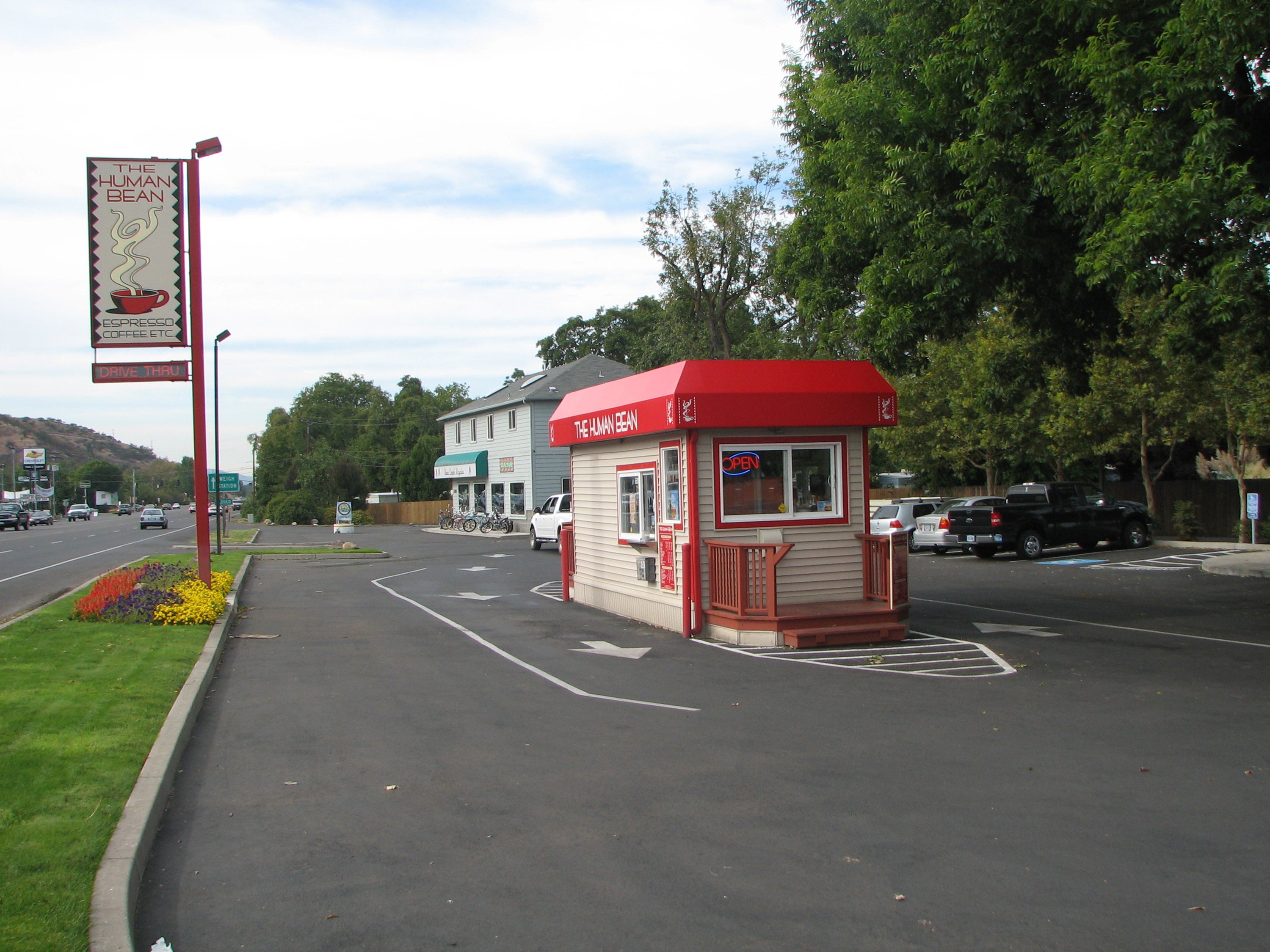
The company describes its early ambition in regional terms: developing a coffee drive-thru in Southern Oregon. Franchising started in 2002, four years after the first opening. There is something instructive in that sequence. A prospective franchise owner would eventually need a business that could be repeated. First, the founders needed an operating business worth repeating.
Hawkins’s University of Oregon education appears in his professional biography. His working identity, though, is closely bound to the company he helped establish. The friendship with Casey remains visible in its leadership: Casey is still listed as co-founder and vice president. The relationship stretches from school days to the responsibilities of running a franchise organization.
That continuity gives the founding story its particular texture. The people in it have names and relationships beyond their titles. Rhonda and Tami belong in the account alongside Dan and Tom. Four founders, two couples, one small stand: the arithmetic is straightforward, even if building the business was not.
The map gets bigger. The window stays small.
By November 2016, The Human Bean had 63 locations in nine states. One of its franchise operators, Alex Furioso, was building a group of shops in Idaho’s Treasure Valley. Hawkins described him as a good operator. Furioso’s account of the work was admirably concrete: buildings, construction crews, employees, managers and another opening coming up.
It provides a useful view of what expansion meant for Hawkins’s business. The map filled in through people taking responsibility for particular places. In Idaho, that included changes to buildings and a recognizable wood-and-steel appearance. A national brand arrived through decisions made by a local owner, with local contractors and people who would work the shifts.
Ashland, Oregon
begins
No. 4,508
By September 2020, a report on the company’s arrival in the Indianapolis market counted 106 stores in 12 states. Hawkins was discussing further expansion into central states and the East Coast. The typical shop was described as 600 square feet, configurable with single or double drive-thru windows. The footprint remained modest while the geography changed.
In 2023, the company appeared at No. 4,508 on the Inc. 5000. That same year, Hawkins joined Cynthia Scherr on Jefferson Public Radio’s business segment, The Ground Floor, to discuss the operation and its growth. The conversation’s introduction pointed out that the franchise had reached New Jersey. The Oregon idea had acquired a rather longer commute.
The figures need their dates. Announced developments belong to a different stage from shops serving customers. A June 2026 announcement described more than 213 locations open or under development in 23 states. It is a measure of the network and its plans together. The more revealing detail in that announcement was the arrival of Tracey and Riley Williams as owners of a Carrollton, Texas, location. Growth continued to have people’s names attached.
The help he wishes he had
Asked in January 2025 what he enjoyed about working with franchise partners, Hawkins talked about business ownership, collaboration and helping others avoid expensive learning curves. He offered a concise account of the service he wanted to provide: “We wish we had us when we started.”
“We wish we had us when we started.”
Dan Hawkins, January 2025
There is a little comedy in the sentence, and a useful admission. It acknowledges that the beginning involved things the founders had to learn. Their experience becomes part of what a later owner can draw upon. The promise has practical consequences: a new operator needs decisions about locations, training, marketing and the ordinary mechanics of keeping a shop running.
The founders continue to own and operate stores, according to the company’s franchise support team. That matters to the kind of authority Hawkins is offering. Advice about operating a drive-thru has a different footing when the people providing it remain involved in the same work. The window still has to open. A process still has to hold up when orders arrive.
The support organization extends that experience beyond the founders themselves. Field operations, training, development and marketing have named responsibilities within the team. Hawkins’s partner-oriented language is backed by an organization intended to answer questions after the initial agreement has been signed.
Accounts of the company’s operations describe franchisees receiving help with site development and continuing support. For product introductions, materials can include implementation guides, webinars, videos and talking points. These are unglamorous objects. A well-timed implementation guide rarely receives applause. It may, however, be precisely what somebody needs before a launch.
Read this way, Hawkins’s work involves making accumulated knowledge available to other owners. The early stand produced experience. Franchising created a reason to organize and share it. The relationship continues after opening day, when the useful question becomes whether the support team can help with tomorrow.
Where the saved seconds go
A drive-thru presents Hawkins with a recurring tension. Customers choose convenience; a slow lane tests their patience. Yet he also wants the stop to include personal attention. Faster transactions can shorten the opportunity for conversation. His stated response is to improve ordering so customers and employees have more time for the exchange itself.
In 2024, he described updates to menu boards and processes in exactly those terms. The distinction is an operational one: reduce friction in placing the order, preserve room for a human connection. A customer should not need a seminar in process design to notice the result. A clear menu and an unhurried greeting would do.
There is experimentation behind the drinks as well. The Human Bean introduced its proprietary Bright Energy beverages nationally in January 2024. Hawkins pointed to blind consumer testing and pilot-store performance when discussing the launch. The range moved beyond the espresso offering with which the company began, while remaining something baristas could prepare and customize at the window.
The launch offers a more specific picture of innovation than the word usually supplies. A formulation has to be tested. A store has to serve it. Employees need to understand it. The operating team has described testing products in working stores and checking how an item appears in the point-of-sale system. A drink’s journey to a menu includes some very ordinary screens.
For Hawkins, new products and faster ordering sit alongside an older promise about service. His challenge is keeping those pieces compatible as the business changes. A wider menu gives customers more choices. It also gives the people preparing orders more to learn. Support and training become part of the customer experience before a customer ever sees them.
A thank-you that leaves the parking lot
The community Hawkins describes also extends upstream. The company’s Farm Friendly Direct program pays coffee growers a premium directed to farm and community projects. The relationship between a drive-thru customer and a coffee-growing community is geographically distant, but it is part of the business he has chosen to discuss publicly.
In May 2026, The Human Bean reported that its Earth Day purchases had supported funding for 57,992 trees through Trees for the Future. The company put the cumulative figure at 270,790. Hawkins credited franchise partners and guests for showing up. The numbers describe a collective fundraiser, with an ordinary purchase serving as the point of participation.
That is one way to understand his continuing aspiration for the business: give more owners a workable operation, keep the customer encounter welcoming, and use those repeated encounters to support something beyond the order. Each aim creates work for people at different points in the organization. None is completed by writing it on a cup.
The name his mother supplied remains a compact reminder of the task. Hawkins can talk about a national footprint, product testing and franchise support. Eventually, all that machinery arrives at a small opening in a building. A customer is waiting on the other side. Somebody passes over a drink, with a little thank-you on top.